Showing posts with label swords and wizardry. Show all posts

Thursday, March 10, 2022

GIving the Spear its Due

It's been a while, huh?

I haven't updated this blog in a while for ... well, a lot of reasons, I guess. I haven't really been running an OSR game, Google+ went away, I've had mixed feelings about the OSR as a whole.

But, I recently started a Swords & Wizardry game up on Discord, so I wanted to write on this blog again. Go figure.

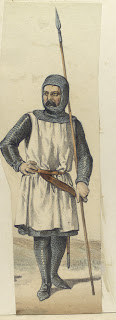
Today I want to go into some of the ideas behind a particular house rule I have in my game. It relates to one core notion: the spear is not heavily used in D&D and its clones. But historically, the spear was probably the most common melee weapon carried.

Some of this is purely functional. It's a lot easier to make a small piece of metal and put it at the end of a stick, than to craft a long piece of metal like a sword. And most people have an instinctive idea of what to do with a spear - you stick the other guy with the pointy bit. So it's both economical and, if not idiot-proof, at least it's easy to hand to a peasant conscript.

But there is scientific proof that spears have an advantage over swords. Particularly, they're very useful when you're trying to stop someone from coming into range to hit you. I think this factor is something that is significant enough to want to add into combat.

The specific rule is: if you have a weapon that has a longer reach than your opponent, you get the first hit when they're closing in on you. This applies generally to spears and two-handed weapons versus one-handed weapons, and to longer weapons against daggers. The basic principle is the same: in order to close on someone who has a reach advantage against you, you need to expose yourself to a potential attack.

To implement this, the opponent doesn't get an extra attack; they simply get the first strike when closing to melee. And it doesn't apply to someone who is surprised, or attacked from behind, or already engaged in melee combat. It mostly factors in when they lose initiative or make a defensive stand.

I like this because it makes spears an interesting weapon. It not only gives you an advantage when closing to combat, it also prevents other enemies from having the same advantage against you. And it allows you to have a character take up a defensive role - for instance, a fighter could stand guard in front of the party's wizard and prevent monsters from closing on them.

It's also an interesting tradeoff because generally reach weapons in D&D and its clones don't have the top-end damage. A spear does a d6 compared to a sword's d8, but you may decide it's worth it to fend off enemies and keep them from getting a reach on you. Similarly with a d8 polearm against a d10 two-handed sword. Both options do seem to increase the spear and the polearm in terms of viability.

There's also a good reason to limit it to the first strike in combat: once in close quarters, a person with a shorter weapon can get attacks in with relative ease. It's only when you first close in that the spear or polearm would have that first chop.

At the same time it doesn't really make combat overly complicated. It's a simple thing to decide: when closing in, does a character have the first attack? Only if the reach is the same. Once engaged, combat follows normally.

An interesting point to note is that spears and polearms are much less convenient than swords. You pretty much have to be carrying them, or securely lashing something fairly long to your back. This can be a trade-off in a dungeon situation, where characters need to choose between having a hand free and having advantage if attacked.

This rule is hardly new; the computation of strike rank in Runequest back in 1978 used a more complex variant that also takes weapon length into consideration, and there's a system in the Ready Ref Sheets that uses weapon priority. But I think this is quite a bit simpler than either of those, and it works in a simple initiative system like the ones found in most OSR type games pretty seamlessly. It would even work in a Holmes-style Dexterity based initiative system.

And since the name of this blog came from the fact that my OD&D crew always seemed to roll a 1 for initiative, it only seemed fitting to use this to break the ice on coming back.

Saturday, December 10, 2016

First Thoughts: White Boxes


On a recent Lulu jaunt I picked up a small softcover called White Box because of its Stefan Poag cover. It's a revised version of Swords & Wizardry Whitebox. Both are pictured above with what I think are their best covers: the original S&W:WB by Pete Mullen and the new WB by Poag. Both books are pretty similar in size, and both are quite affordable. White Box is all of $5.99 in print. This is quite a contrast to the actual OD&D woodgrain box that just sold for $22,100 on eBay.

If you've read the Swords & Wizardry Whitebox book before, White Box's contents are immediately familiar. Taking advantage of the original's use of the Open Game License, WB contains a lot of the S&W:WB text, though it puts it into a fresh and attractive layout. The internal art uses William McAusland's fantasy stock art, which you will find familiar, particularly from Labyrinth Lord. It's a funny feeling to see images like McAusland's mace-wielding cleric repeated, although slightly nostalgic for those of us who cut our teeth on 1990s TSR products, when pictures were in heavy reuse. Still, as a whole the look and feel of the book is a step up from S&W:WB, which felt like it was printed off of a word processor.

A Thief class sneaks into this game, with a simple "Thievery" die; this made its way from James Spahn's White Box Omnibus. It's an ultra-light solution to the thief class, fitting with the White Box approach, using a d6 roll for all thief skills. It starts off with a 2-in-6 chance, working its way up to 5-in-6 by 10th level. If this system seems simplistic, the probabilities wind up being favorable to the low-level thief. In White Box, 3rd level thieves have a 2 in 6 chance of performing a thief task, or 33%. No B/X thief at 3rd level has a skill over 30%. Likewise at 6th level, a 3 in 6 chance (50%) beats B/X's 45% chance to pick pockets or open locks. It's only at 9th level or so that thieves slip behind.

Mason expanded S&W:WB's hopelessly thin "Playing the Game" rules with a list of extra rules adapted from other sources. Overland movement from Delving Deeper makes its way in, as do the basic dungeon exploration rules (here credited to Douglas Maxwell, though I'm not sure where his rules are available). This goes a long way toward making White Box a more complete game than the Swords & Wizardry Whitebox version. Similar rules have made their way into other S&W iterations but S&W:WB has stayed in more or less the same form since 2010.

A few other rules make their way into combat, such as jousting (credited to John Stater from Bloody Basic) and a morale chart – the latter is not given specific credit but it's a fine and simple table. The rest follows, pretty straightforwardly, from S&W:WB. Curiously, the example of combat from S&W:WB has gone missing. I'm not sure how useful it was, as I wouldn't have read it if not for doing this overview. It's certainly not the densely written combat examples of Holmes D&D or the AD&D Dungeon Masters Guide.

White Box takes the rest of the book fairly literally. The one change to spells is that an overlap in the tables for the Sleep spell is removed. There are more monsters, and a few monster entries are tweaked, but what you get is pretty much what you'd expect. Treasure follows the monster-based system in Swords & Wizardry, which is probably the only real disappointment for me; I'd have preferred if Mason could have brought over the stocking rules from Delving Deeper, but that would have been a bigger shift.

This is a complete RPG for $6 in print, and captures much of the earliest edition of D&D in 166 pages at 6"x9" size. It's a good update of Swords & Wizardry Whitebox, which has sat fallow for years, and if I may have liked a further-going revision, this one is welcome. I'd recommend it over the original, particularly in the Stefan Poag cover. The edits and updates make me feel better about it as a complete game that could be run by a referee with no experience with OSR or older D&D games.

Wednesday, October 5, 2016

The Changing Face of the OSR

Yesterday the Swords & Wizardry Complete 3rd Printing Kickstarter launched. For reasons there has been talk about its cover:


The cover is a major departure from the last printing, which featured an Erol Otus original:


The Otus cover speaks strongly to me, but the change has me reflecting on the change in the OSR. We've gone from the original Labyrinth Lord:


To the art book that is Maze of the Blue Medusa:
Okay, that's enough showing pictures. I think it illustrates the basic point, which is that there is a shift afoot in the OSR away from old TSR and toward a very different and current aesthetic.

As much as I like the Otus cover for S&W Complete, it's a cover that ties the game back to TSR. As much as it's a fresh piece, it has intentional echoes of the cover for the Moldvay Basic box - and that leaves it in what is now effectively the OSR's past. Fewer and fewer OSR modules feel the need to consciously emulate TSR's look and feel, and Lamentations of the Flame Princess has been the leader here.

By severing the TSR connection, Swords & Wizardry has a chance to be its own game. I think that's particularly important for S&W to move forward, since effectively Frog God has just treated it as one of several options along with Pathfinder and 5e D&D. It doesn't have a strong identity, and if it could gain one outside of bog-standard fantasy, I think that would be a wonderful thing.

Look at the Kickstarter, by the way - the layout of the book is also getting a radical overhaul. I'm most excited for monster illustrations by Gennifer Bone, the artist who worked with Rafael Chandler on Lusus Naturae. Gennifer is one of the most exciting artists in the OSR right now, and I'd recommend you back her on Patreon.

It's kind of a funny coincidence to me that my recent game, set in the megadungeon I am slowly working on, used Swords & Wizardry Complete. More than any other OSR system, S&W really benefits from a strong vision on the referee's part, and I think giving the book a new look and adventures outside of the Gygaxo-Arnesonian tradition is a move toward that. LotFP, after all, is not far off from B/X D&D in the text of the rules but the actual play experience is far different. I'd like to see where Swords & Wizardry can go.

Friday, November 20, 2015

Clones and Rules, Inside and Out

One of the interesting aspects of the OSR is the multiplicity of clones, and particularly the way that clones emulate the games that they are based on, and even more, what they choose not to emulate. Which is why I think the cases of two popular clones that I've run, Swords & Wizardry and Lamentations of the Flame Princess, are so interesting.

Swords & Wizardry is a clone of original D&D. Or at least that's how it's sold. It has close approximations of the ability scores, classes, races, equipment, spells and monsters from OD&D, and a general semblance of similar rules. (This is hard because OD&D has lacunae.) So far so good.

But if you look at the way treasure is built in S&W, it's radically different from OD&D. In OD&D, treasure in the dungeon isn't built from the Treasure Type tables in Monsters & Treasure. It's built from the tables in The Underworld & Wilderness Adventures, which portion out treasure based on dungeon level to half of the monster rooms and one sixth of the empty rooms. Just reading Swords & Wizardry you'd never get that. S&W only ties treasures to monster Challenge Rating. It does tell you to leave some rooms empty, but not to put a significant portion of the treasure there.

This is an important difference. An OD&D dungeon designed according to its guidelines is going to have "unguarded" treasure. According to the book it should be hidden and/or trapped. But a S&W dungeon isn't going to have that, if the referee follows the guidelines in the S&W rule books. Over time the game is going to play differently, since the OD&D group is going to be looking for hidden treasure while the S&W group would be justified in looking for combat.

Indeed, if you follow OD&D's logic a bit further, treasure is based not on monster level but dungeon level, which is significant. Level 1 of an OD&D dungeon, following the monster tables, is likely to have gnolls, a 2 HD creature from the dungeon level 2 chart. But the gnolls should still be guarding a level 1 treasure. They only get level 2 treasures when they're found on dungeon level 2. This means that fighting gnolls on level 1 in OD&D is a losing proposition. But in S&W, gnolls should always be guarding CR-appropriate treasure, and therefore the reward is determined by monster level, not dungeon level. This pulls the game toward the modern "dungeon combat" genre.

All of this is fine if that's how you want to play. It clearly works for a lot of folks and they're having fun with the game. But Swords & Wizardry doesn't really talk about this anywhere, and I think that's a shame because adventure design is such a big part of how a game ultimately plays. Which brings me to another clone.

Lamentations of the Flame Princess bills itself as weird fantasy. But on a reading of the Rules & Magic book, novices typically ask the excellent question: how is this different from standard D&D? On the surface, it mostly looks like a minor variant on B/X Dungeons & Dragons, going a bit further afield than Labyrinth Lord but still very much in the same ballpark.

Except in LotFP, the adventure design aesthetic is distinctly different. Here, certain features of the typical D&D world – anthropomorphic gods, human-like monsters, cozy Tolkienesque worldbuilding – is explicitly rejected in favor of horror set in the early modern period of Earth's history.

There, as they say, is a distinction with a difference. Everything in LotFP is implicit in how B/X D&D is played. Characters are going into dark, dangerous places filled with monsters, hoping to come out alive and with arms full of gold. But it cranks up the nastiness of the threats to 11, and strips out elements antithetical to this approach. What's fascinating is that, in play, it winds up being more exploratory than Labyrinth Lord. For God's sake, you certainly don't want to be fighting!

And yet, this is 95% in the adventure design. You could run B2 Keep on the Borderlands with LotFP, and I wager that it'd go swimmingly once you converted ACs and switched GP to SP, as long as nobody casts Summon. In fact, it wouldn't be too different from running it with Swords & Wizardry. Both would have minor differences, but the underlying module would show through.

For me these differences in preparing the game show a lot of the underlying philosophy of a rule set. S&W has a lot of the exterior resemblance of OD&D, but if played as written it will have a natural tendency to drift in a direction more toward a "modern" game with a heavier emphasis on combat. Whereas LotFP, which totally upsets the apple cart of standard D&D, comes around and goes back toward exploration. It's a neat trick if you can pull it off.

Wednesday, February 19, 2014

Cryptid Wednesday: Devil Monkeys

This vicious primate originated in Appalachia but is prime for your fantasy realm.


Devil Monkeys

Hit Dice: 2+2
Armor Class: 7 [12]
Attacks: 2 Claws (1d4) or Bite (1d6)
Saving Throw: 16
Special: None
Move: 18
Alignment: Chaotic
Challenge Level/XP: 2/30

Devil Monkeys are a form of primates ranging from 3' to 4' in height, covered in shaggy fur and with long, bushy tails. They are extremely fleet of foot and can leap up to their full 18' movement range in any direction. In combat, they rely upon their vicious sharp claws, though they will sometimes bite. If it makes two successful claw attacks in a round, instead of dealing damage, the Devil Monkey may try to rend armor off of a victim. This takes 2 rounds and the victim may make a saving throw each round to break free of the monkey's grip.

These monkeys live in small troops, generally of 10-30 individuals. A large troop may have a leader, who has AC 6 [13] and 4 HD (CL 4/120). Their typical habitat is in the forests of temperate mountains, and Devil Monkeys have a particular hatred of dogs. Their primitive language may be comprehended using a Speak With Animals spell.

In the mountains where they live, Devil Monkeys are spoken of in hushed tones. They have been known to rip the roofs of covered wagons off to attack the humans inside.

Wednesday, February 12, 2014

Cryptid Wednesday: The Gevaudan Beast

Cryptid Wednesday is back with a horror from France.

Gevaudan Beast

Hit Dice: 6+2
Armor Class: 4 [15]
Attacks: 1 bite (1d8), 2 claws (1d6)
Saving Throw: 11
Special: Knock prone with tail
Move: 18
Alignment: Chaotic
Challenge Level/XP: 6/400

The ferocious beast of Gevaudan is a large creature, resembling a wolf in features but the size of a cow. Its fur is blood red with streaks of black, and its hide is mottled and mangy when seen. This is a vicious predator, showing a particular taste for humans as well as large livestock. Its odor is so noxious as to be unbearable. NPCs must make a saving throw or morale check (referee's option) to continue fighting it in melee.

In combat the Gevaudan beast will often strike directly for the throat of an opponent with its razor-sharp teeth. It can also use its heavy tail to render an opponent prone. A successful hit removes the next turn's action.

It is not clear if the Gevaudan beast is unique, but it is hoped to be. The horror will generally prowl near isolated farming villages.

Wednesday, October 30, 2013

Cryptid Wednesday: Spring-Heeled Jack

I wound up so busy last Wednesday that I missed out on giving you this entry in my series for Swords & Wizardry, which I had actually found the week before. I think he's good for the day before Halloween, though.


Spring-Heeled Jack

Hit Dice: 4
Armor Class: 7 [12]
Attacks: 2 claws (1d4 each)
Saving Throw: 13
Special: Fire breath
Move: 12 (18 leaping)
Alignment: Chaotic
Challenge Level/XP: 5/240

It is not clear whether the well-known Spring-Heeled Jack is a singular being or one of a variety of devils. In either case, it is a menace that dwells in towns and cities rather than the far-flung areas of the world. At first glance, bearing a cloak and hat, he is easily mistaken for a gentleman; but upon closer inspection his glowing red eyes and vicious claws distinguish him; reports of horns may or may not be accurate. Spring-Heeled Jack is capable of outleaping humans, hence his name; on foot he is no faster but he may close short distances in a series of quick leaps.

When he attacks, Jack is known for his blue-white fire breath. A gout of this breath will do 1d6 damage; if Jack breathes into the face of an opponent, they must make a saving throw (vs. poison) or be blinded for 1d6 turns. After he uses this fire he must wait 1d4 rounds before using it again.

Spring-Heeled Jack lives near settlements and has a habit of attacking lone travelers.

Wednesday, October 16, 2013

Cryptid Wednesday: Shadow People

This week's cryptid is an urban legend inspired by that feeling someone is following you.


Shadow People

Hit Dice: 3
Armor Class: 8 [11]
Attacks: Choking grasp (1d6/turn)
Saving Throw: 14
Special: Paralysis, choking grasp, immaterial
Move: 12
Alignment: Chaotic
Challenge Level/XP: 5/240

Shadow people are incorporeal beings that resemble typical shadows thrown by light, but are not themselves composed of shadow. They are physically distinguished by their glowing eyes. Most (75%) of encounters with shadow people are fleeting; they are seen for only a few moments before flitting away. They are not social and have no language, although some shadow people may make an eerie high-pitched noise.

When a shadow person does take an interest in a human, it is generally when it is twilight or later and usually when the human is alone. Solitary travelers and characters standing watch at night are particularly susceptible. If a character meets the eyes of a shadow person, they must make a saving throw or be paralyzed for 2d6 rounds. If the prey of a shadow person is thus immobilized, subsequent saving throws are made at -2 to the roll. After this, the shadow person will attempt to strangle the human; each round, the character must make a saving throw or take 1d6 damage. (No attack roll is made.) Magic-users and clerics may not cast spells while being strangled. A character who has taken damage this way will have the skin near their neck turned white until a Remove Curse spell is cast.

A shadow person's immaterial nature means it cannot be harmed by non-magical means. Magic weapons and spells do it full damage. Likewise, it may pass beyond any mundane boundaries (walls, doors etc) but is stopped by magical barriers, including Protection from Evil spells. It can be turned as a Wight, but is never destroyed by turning.

If killed, a shadow person leaves behind no remains.

Wednesday, October 9, 2013

Cryptid Wednesday: The Dingonek

With my diminished blog output the last month or so, I have been remiss with cryptid monsters for Swords & Wizardry. Here's a classic from Africa.


Dingonek

Hit Dice: 8
Armor Class: 2 [17]
Attacks: Bite (2d8), 2 Claws (1d8)
Saving Throw: 8
Special: Sting (1d4 + lethal poison)
Move: 12 (18 swim)
Alignment: Neutral
Challenge Level/XP: 9/1,100

Found in the most remote jungles and deepest swamps, the Dingonek is a creature that resembles a long reptile with a leonine head, massive walrus-like tusks, and a stinger at the end of its body (an average 15 feet in length). It is covered in armadillo-like scales that make it strongly armored.

A dingonek will not tolerate other predators in its territory, and has been known to quickly slay crocodiles and even hippopotami as well as humans who intrude. It fights ferociously, biting with its massive tusks. Prey that survive this must face its scorpion-like sting and save or perish from its poison.

Wednesday, September 4, 2013

Cryptid Wednesday: The Pope Lick Monster

It's a short week, so you may not have noticed it's Wednesday already. This monster is appropriate for any bridges or high crossings you may have in your campaign setting.


Pope Lick Monster

Hit Dice: 4+1
Armor Class: 7 [12]
Attacks: By weapon (1d8+2)
Saving Throw: 13
Special: Suggestion
Move: 12
Alignment: Chaotic
Challenge Level/XP: 6/400

There are several types of goatmen in the world, but the Pope Lick Monster is among the more dangerous. This solitary creature has the hind legs of a goat, with thick curly hair that is sometimes mistaken for a sheep, and the deformed upper torso of a man. It has an alabaster face with a broad nose and wide-set eyes, and its hair matches the fur on its legs.

The Pope Lick monster is named for a creek that its bridge passes over; there may be others living at other crossings. The bridge itself is an old, rickety and narrow bridge about 100' over the water. The monster's extranormal power is its voice, which is able to act as a Suggestion spell luring victims out further. Sometimes it goads them to leap, or to walk over a dangerous portion of the bridge (3 in 6 chance of falling through) or even to attack their compatriots. Victims who resist will be attacked with its rusty, blood-stained axe (+2 to hit and damage due to 17 Strength).

It is believed that this monster is the result of some horrible evil ritual, or else a fell hybrid of human and goat, and it has lived for at least a century. Whether others exist or not is the subject of fertile speculation.

Wednesday, August 28, 2013

Cryptid Wednesday: The Black Howler

Sure, it was probably a hoax - but the one your players face won't be. Here's the Ozark Black Howler for Swords & Wizardry, as part of our regular Cryptid Wednesday.


Black Howler

Hit Dice: 6+2
Armor Class: 5 [14]
Attacks: 2 claws (1d4), 1 bite (1d8)
Saving Throw: 11
Special: Fear, Surprise
Move: 12
Alignment: Neutral
Challenge Level/XP: 7/600

A black howler is a large creature, somewhat bigger than a great cat, that stalks mountainous areas far from civilization. Its shaggy hair is jet-black and it has two prominent horns that are not typically used to attack because of their backward arch. Black howlers are solitary creatures and are exclusively nocturnal, allowing them to take advantage of the darkness. They will surprise on 1-3 in 1d6 instead of the typical 1-2.

The cry of a black howler is a truly awful thing, and when it is made, all characters within 20' must make a saving throw or flee in horror as per the Fear spell (60% chance of dropping carried items) for one turn. It will generally use this before a fight to drive off as many opponents as possible.

Black howlers are not social aside from mating, and will almost always be encountered alone.

Wednesday, August 21, 2013

Cryptid Wednesday: Cynocephali

It's Wednesday again. This is an ancient cryptid, with roots going back as long as any monster, in legend living in Central Asia and reflected in Greek, Indian and Chinese stories.


Cynocephali (Dog-Men)

Hit Dice: 1+1
Armor Class: 7 [12]
Attacks: Bite (1d6) or by weapon
Saving Throw: 17
Special: Furious attack
Move: 12
Alignment: Chaotic
Challenge Level/XP: 1/15

Cynocephali are primitive, dog-headed relatives of humans. They are not considered humanoids or lycanthropes, and have canine heads but completely human bodies, including their hands and feet. These dog-headed men live in tribes like packs, and speak their own language which includes a series of barks and growls, and is difficult for humans to speak. They are inherently chaotic and live in a winner-take-all society.

The leader of a cynocephali tribe has 3 HD and has 1d4 2 HD bodyguards. Generally, cynocephali will fight with weapons but prefer combat that is close up enough to bare their teeth. When attacking with their powerful bites, these dog-men attack at +2 due to their savage fury.

Wednesday, August 14, 2013

Cryptid Wednesday: Peluda

A French cryptid for the second Wednesday in August.


Peluda

Hit Dice: 6
Armor Class: 3 [16]
Attacks: Bite (2d6)
Saving Throw: 11
Special: Firing quills, poison, breath
Move: 12 / 18 (flying)
Alignment: Chaotic
Challenge Level/XP: 10/1,400

The peluda is a creature about the size of a full-grown bull, with the head of a dragon. Its underbelly contains a mass of what initially appears to be hairs, but are actually quills that are hanging limp. It can straighten and fire these quills (up to 10 feet) at a victim, who must save or be slain by the powerful venom they contain. The peluda can also spray a stream of superheated water at up to 4 characters for 3d6 damage (save for half).

Peludas are vicious creatures that roam the countryside and raids stables. It is actively hostile to human life and will particularly target young and innocent humans. They do not speak any human languages, and will always react with hostility to humans. When killed, the salvageable venom from a peluda's quills will fetch 1000 GP from assassins, or less reputable wizards and alchemists.

Wednesday, August 7, 2013

Cryptid Wednesday: The Wolpertinger

It's Wednesday, so here's a fresh cryptozoological monster written up for Swords & Wizardry.


Wolpertinger

Hit Dice: 2 (squirrel) or 3 (rabbit)
Armor Class: 7 [12]
Attacks: bite (1d6) or antlers (1d6)
Saving Throw: 16 or 14
Special: n/a
Move: 12 / 18 (flying)
Alignment: Neutral
Challenge Level/XP: 3/60 or 4/120

A wolpertinger (pronounced "VOHL-per-ting-er," with a hard g) is a chimeric hybrid creature. Smaller wolpertingers have the body of a squirrel, while larger ones have that of a rabbit. All such creatures have long jagged fangs, antlers, and bird-like wings. They live in dense, temperate forests and hunt alone or in small groups.

In combat a wolpertinger prefers to use its teeth to attack; it will only use the antlers if cornered. They prefer to use their mobility to sneak away and attack prey unprepared.

Wolpertingers will mate with ordinary squirrels or rabbits, and the offspring will not show such characteristics until it is mature, at which time it turns viciously on other "normal" animals of its type. They seek out the company of other wolpertingers, though squirrel and rabbit types never mingle. Their antlers seem to determine status.

In areas where wolpertingers live, a stuffed and mounted sample is a tremendous prize and will be displayed with pride as a sign of good fortune by inn and tavern owners. Providing such an intact corpse (cannot be killed by any large weapon or spell such as fireball) to a tavern owner who does not already have a wolpertinger mount will win such esteem and gratitude that the hunter will not have to pay for his own drinks for the next year; the tavernkeeper and the regulars will sponsor all the beer he can quaff.

Wednesday, July 31, 2013

Cryptid Wednesday: Loveland Frogs

Celebrate Wednesday with a frog-man variant for Swords & Wizardry!

Loveland Frogs

Hit Dice: 1
Armor Class: 8 [11]
Attacks: Bite (1d4) or by weapon
Saving Throw: 16
Special: Device uses
Move: 12
Alignment: Chaotic
Challenge Level/XP: 1/15

Loveland Frogs live in remote swampy environs. These are small (3') bipedal creatures that resemble frogs except for the facility of their hands. They are occasionally mistaken at a distance for extremely ugly halflings, with wrinkled bald heads. They are social creatures and travel in small groups, usually between 2 and 5. Their preferred attack is to ambush solitary travelers or small groups by the side of roads or paths, always at night.

Owing either to magic or some rudimentary technology, these frog-men have relatively sophisticated devices in the form of metal rods. When activated, such a rod gives off telltale sparks, and if used to attack an opponent cause 2d6 electrical damage (save for half). However, a given rod only works if the referee rolls 1-4 on 1d6. A result of 5 or 6 indicates that it will not work for at least 24 hours. Each activation lasts for 2d6 rounds, and a rod should have 1d10 activations remaining before it needs to be recharged (magically or technologically, at the referee's discretion). Only one in three frog-men will have such a device.

Wednesday, July 24, 2013

Cryptid Wednesday: The Dover Demon

It's Wednesday, so there's a new cryptozoological monster for Swords & Wizardry. Like last week, it's an American cryptid, this time from the East Coast in Dover, MA.


Dover Demon

Hit Dice: 2
Armor Class: 8 [11]
Attacks: Hands (1d2/1d2)
Saving Throw: 16
Special: Mental attack
Move: 18
Alignment: Chaotic
Challenge Level/XP: 3/60

The Dover Demon is a small humanoid, with a peach skin tone. It is totally hairless and lacks a nose, mouth, or ears; the only interruption in its smooth skin is the eyes. These are green and glow visibly in the night. Its hands and feet are equally long and spindly, and it grabs and climbs readily, the extremities adapting to rocks with ease.

Most of the time, such a demon is interested in following and frightening humans, slipping away unseen. At night or in poor lighting, the demon's body can become almost translucent, leaving only its eyes visible. It does not speak any language and is not interested in eating, though it will be attracted to magic items. If it can corner a solitary human, it will use its sleep attack and subject the victim to a painful examination, leaving before they wake. Only one demon will be encountered at any time.

If attacked, it will counterattack with a powerful mental assault. This requires a saving throw (vs. spells if modifiers are applicable) and it can stun an opponent for 1d6 rounds, or put them to sleep (as per the spell) for 2d6 turns. Against magic-users only, the demon may attempt to cause the M-U to go incurably insane (same parameters apply).

Wednesday, July 17, 2013

Cryptid Wednesday: The Mountain Devil

Every Wednesday I write up a new cryptid for Swords & Wizardry. This one is from California, where it's known as the Lone Pine Mountain Devil; I'm leaving the location off but keeping the monster.


Mountain Devil

Hit Dice: 5
Armor Class: 5 [14]
Attacks: 2 claws (1d6/1d6) or bite (1d8+poison)
Saving Throw: 12
Special: Poison
Move: 12 (18 flying)
Alignment: Neutral
Challenge Level/XP: 7/600

A Mountain Devil is a fierce bird-like predator that dwells in forested mountains. It stands the height of an average human and has wings and sharp talons, but its frame is furred and its mouth is full of venomous teeth. Their screech will cause pack animals to scurry away in fear.

When a Mountain Devil first attacks, it will swoop down and use its talons to make a first warning attack. If its opponents scatter, it will continue to harry them out of its territory. However, if they stand and fight the Mountain Devil will use its bite, which contains a powerful poison (save vs. poison or die).

Despite their name, Mountain Devils are not evil, but will attack predators and humans in their habitats who are in any way despoiling nature. There is a 75% chance that a Mountain Devil will speak the secret druidic language, and in any case they will never attack a party containing a druid.

Sunday, July 14, 2013

Mapping Around Stonehell

A lot of interesting stuff can happen in a megadungeon when players don't have complete maps.  Last night didn't see much new exploration on the first level but it did get to a few new rooms, and wandering encounters did the rest of the work.

The first interesting thing happened when the party found a new area early in the adventure. There is a statue early in Stonehell where a bowl containing 400 SP is nearby, unguarded. If the silver is disturbed, everyone around saves or takes 2d6 damage. The party - which has normally been cautious - rushed in and lost a second-level magic-user to this trap. Which proved a point about caution.

Unquestionably the best moment of the night came after a fight with a group of orcs. First, the orcs had been at a portcullis, which they raised to get to the PCs - who took advantage and took out an orc before meeting combat. Then they won every initiative and got good rolls, slaying four out of the remaining five. The last orc broke morale and surrendered.

All this happened a room away from the Wheel of Fortune, one of the really neat rooms in the first level. The characters debated for a while what they were going to do with the orc, and a new player suggested barricading him in the room with the Wheel. The other players re-inspected the room, found the wheel, and there was a bit more debate - until the new player had the excellent idea of having the orc give the wheel a spin. He did, and the wheel obligingly landed on the "dies immediately" result. You can't script how this stuff is going to turn out.

On the way around the PCs found a pit trap literally 50' from the dungeon entrance that they had never run afoul of before - sometimes I just don't roll a 1 on 1d6. It's a curiosity of old school traps that I really like: even what you think is perfectly safe is occasionally an old, deadly trap. Of course, in this case it only wound up doing 1 damage to the party's new monk, but still.

A bit later, the PCs discovered a love of fire. They actually sussed out a couple of green slime traps and burnt the slime before they would get struck by it; that's quality dungeoneering. One quibble in S&W: green slime isn't listed as having hit dice, so technically it doesn't give experience; I had to overrule that particular bit and give it an arbitrary value. Beating green slime is definitely worthy of experience points.

The last encounter involved wolves and more fire - the wolves had come up at another portcullis, this one keeping the PCs safe for the moment. They successfully used oil as an incendiary, which brings up the second quibble with S&W: I always wind up using Moldvay style rules for this because S&W doesn't cover it.

There are a lot of little things like this in most rulesets; that's what house rules are for. But at this point I've inserted a good chunk of Holmes and Moldvay into my S&W game, between scroll rules, morale rules, and rules for oil as incendiary weapons. It leaves me wondering whether those aren't a better baseline for me than S&W. If I were starting again I'd be tempted to use Labyrinth Lord as suggested.

Stonehell itself has been a quality dungeon. While I think the first level is kind of dense and not "get down already" like Blackmoor is, it's continued to provide an interesting play experience over eight sessions. Or to put it another way: while I wish Stonehell were structurally more interesting, it certainly makes up for any deficiencies with what it puts on its levels. If I were to start over, I'd probably cut it up and move some things around so it's more of a 3-dimensional dungeon and less of a stack of five huge levels (for book 1 anyway).

Wednesday, July 10, 2013

Cryptid Wednesday: The Mongolian Death Worm

It's been seven days since I wrote up a cryptid for Swords & Wizardry. So without further ado, one of the better pure monsters in the field.


Olgoi-Khorkhoi (Mongolian Death Worm)

Hit Dice: 4-6
Armor Class: 7 [12]
Attacks: Spew poison
Saving Throw: 13, 12 or 11
Special: Poison, lightning, corrosion
Move: 6
Alignment: Neutral
Challenge Level/XP: 4 HD: 9/1,100; 5 HD: 10/1,400; 6 HD: 11/1,700

An Olgoi-Khorkhoi is a bright red worm varying from 2' to 4' in length. It has no head, only a gaping maw that drips venom. Most of the life of these creatures is spent burrowed in sandy or rocky soil, only coming out to hunt a few times a year. Its preferred target are camels and pack animals in general, which they use to lay their eggs, but they will attack humans.

A 2' worm will have 4 HD, 3' having 5 HD and 4' with 6 HD. The death worm has an electric shock that it can use once per day; this is a lightning bolt for a number of d6 equal to its hit dice. If encountered at a distance the olgoi-khorkhoi will always use its shock as a first weapon. Subsequently, it can spit venom up to 5'. On a successful hit, a target must save versus poison or die. If this is unsuccessful, there is a 1 in 6 chance that a character in metal armor is hit by the spray. This will corrode the armor beyond use.

The body of the olgoi-khorkoi is entirely venomous and corrosive. If a metal weapon is used against the death worm, there is a 3 in 6 chance of it being affected and corroded beyond use after the combat (subtract any bonus on a magic weapon from this chance). Any character touching the skin of the death worm must make a saving throw versus poison at +2 or die. Both dangers continue to exist after the creature itself dies.

A dead olgoi-khorkhoi's body is a valuable resource, that may be purchased by wizards, alchemists or assassins. As a rule of thumb, each foot of body weighs 25 lbs. and fetches 500-1000 GP, up to a maximum of 4000 for a 6 HD monster.

Wednesday, July 3, 2013

Cryptid Wednesday: The Batsquatch

In honor of the middle of the week, I write up a cryptozoological horror for Swords & Wizardry. This one is too odd to pass up.


Batsquatch

Hit Dice: 6
Armor Class: 6 [13]
Attacks: 2 claws (2d4/2d4)
Saving Throw: 11
Special: Squeeze
Move: 15 (Flying 30)
Alignment: Neutral
Challenge Level/XP: 7/600

The batsquatch is a creature similar to the elusive sasquatch, and preferring similar hunting territories in temperate and sub-arctic forests and mountains. It stands nine feet tall, covered in bluish fur, and has bird-like claws on its feet. The massive leathery wings on its back are fully functional. Its legs are powerful and muscular, and the knees bend backward, giving it an unearthly gait when it walks. The yellow eyes have half-moon pupils and darkvision.

In the wild, the batsquatch is often hunting, and will attack intruders into its territory. If it is encountered from a distance it will pick up large rocks and throw them for 2d6 damage each. Once engaged in melee combat, the batsquatch lashes out with its long, fierce claws. If a single opponent is hit by both claws in the same round, the batsquatch can squeeze them for 2d6 extra damage.

A batsquatch is a solitary creature. There may be more than one, but no groups are ever spotted together. The batsquatch does not speak Common, but it does speak a variant of the sasquatch language and can be understood by anyone who speaks Sasquatch.