Showing posts with label combat. Show all posts

Friday, April 1, 2022

The Brave Art of Running Away

In last night's game, on two separate occasions the player characters decided that discretion is often the better part of valor, and decided not to fight potential enemies. One was a group of Selenites occupying a mine - the PCs charmed one of them and got enough information to know they'd be outnumbered. The second was a giant badger, which they were simply able to outrun (it only has a move of 6 compared to the PCs' 12). This did land them in a different fight, but they avoided the badger.

Generally I think that this is encouraged by the design of old school D&D (or in this case, S&W). PCs don't have a lot of hit points at low levels, and often don't have a lot of resources to regain lost ones other than time. It's one of the things that defines the OSR mode of play as more in the dangerous-exploration vein and less high-heroic. The PCs who emulate Sir Robin instead of Sir Lancelot in Monty Python and the Holy Grail are, frankly, more likely to survive. (Sir Robin doesn't do as well at the riddle part, another lesson for players.)

Mechanically, running away is one of the least complicated things in D&D. Movement rates are objective, and this has been true in pretty much every edition of the game you can go to. Whether it's described as 12" or 30 feet, PCs tend to move away at roughly the same speed, and monsters are either faster or slower. Encumbrance becomes important in this regard, of course, because if you are overloaded with treasure, you can't run as fast. This can set up a Sophie's Choice for the players: do you save your GP or your HP?

This is where the ethos of "free Kriegsspiel" or "rulings not rules" becomes important. For the most part, the difficulties of running away will be situational. Is it dark? Is there an obstacle or danger that the PCs can run into unawares? You may want to allow a saving throw or a d6 roll - old D&D's surprise mechanic might be a good guide to see whether the PCs land in something unexpected, or see a hazard before hitting it. Rulings may also let the PCs improvise a strategy to gain some distance, or make a mistake that allows the pursuer to catch up.

Likewise, when they flee is a good time to roll for a random encounter. With some luck, this could be a good or a bad thing. Maybe it's another hostile force (as with the bandits my players ran into); the combination of two of these may be interesting depending on your local factions. They could even get lucky and run into some relatively friendly person or creature that could help them in a pinch.

Of course, in a dungeon or wilderness, running away means taking the risk of getting lost. Almost any older D&D ruleset has rules for this in the wilderness, though you might have to improvise somewhat within the dungeon based on where the PCs are in the map. I wouldn't make this an automatic consequence, but there should be some chance of losing one's bearings, especially in unfamiliar terrain.

One factor that isn't in the rules that the referee should consider is: how long can the PCs run for? After a certain period of time, PCs should become exhausted; some kind of check, maybe a save or a Constitution roll, could be in order. As a cautionary note: one thing worth knowing about humans is that running over very long distances is a specialty of ours as a species. If the pursuer is non-human, and can't gain a decisive advantage, it will probably tire out before they do.

In itself, running away is hardly a heroic action. Players might say that they didn't sign up to play Sir Robin. But in an exploration game, picking the right time to run away is likely to be one of the things that keeps the PCs alive long enough to become the heroes.

Just be sure the minstrels don't write a ballad about that part.

Thursday, March 10, 2022

GIving the Spear its Due

It's been a while, huh?

I haven't updated this blog in a while for ... well, a lot of reasons, I guess. I haven't really been running an OSR game, Google+ went away, I've had mixed feelings about the OSR as a whole.

But, I recently started a Swords & Wizardry game up on Discord, so I wanted to write on this blog again. Go figure.

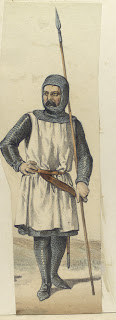
Today I want to go into some of the ideas behind a particular house rule I have in my game. It relates to one core notion: the spear is not heavily used in D&D and its clones. But historically, the spear was probably the most common melee weapon carried.

Some of this is purely functional. It's a lot easier to make a small piece of metal and put it at the end of a stick, than to craft a long piece of metal like a sword. And most people have an instinctive idea of what to do with a spear - you stick the other guy with the pointy bit. So it's both economical and, if not idiot-proof, at least it's easy to hand to a peasant conscript.

But there is scientific proof that spears have an advantage over swords. Particularly, they're very useful when you're trying to stop someone from coming into range to hit you. I think this factor is something that is significant enough to want to add into combat.

The specific rule is: if you have a weapon that has a longer reach than your opponent, you get the first hit when they're closing in on you. This applies generally to spears and two-handed weapons versus one-handed weapons, and to longer weapons against daggers. The basic principle is the same: in order to close on someone who has a reach advantage against you, you need to expose yourself to a potential attack.

To implement this, the opponent doesn't get an extra attack; they simply get the first strike when closing to melee. And it doesn't apply to someone who is surprised, or attacked from behind, or already engaged in melee combat. It mostly factors in when they lose initiative or make a defensive stand.

I like this because it makes spears an interesting weapon. It not only gives you an advantage when closing to combat, it also prevents other enemies from having the same advantage against you. And it allows you to have a character take up a defensive role - for instance, a fighter could stand guard in front of the party's wizard and prevent monsters from closing on them.

It's also an interesting tradeoff because generally reach weapons in D&D and its clones don't have the top-end damage. A spear does a d6 compared to a sword's d8, but you may decide it's worth it to fend off enemies and keep them from getting a reach on you. Similarly with a d8 polearm against a d10 two-handed sword. Both options do seem to increase the spear and the polearm in terms of viability.

There's also a good reason to limit it to the first strike in combat: once in close quarters, a person with a shorter weapon can get attacks in with relative ease. It's only when you first close in that the spear or polearm would have that first chop.

At the same time it doesn't really make combat overly complicated. It's a simple thing to decide: when closing in, does a character have the first attack? Only if the reach is the same. Once engaged, combat follows normally.

An interesting point to note is that spears and polearms are much less convenient than swords. You pretty much have to be carrying them, or securely lashing something fairly long to your back. This can be a trade-off in a dungeon situation, where characters need to choose between having a hand free and having advantage if attacked.

This rule is hardly new; the computation of strike rank in Runequest back in 1978 used a more complex variant that also takes weapon length into consideration, and there's a system in the Ready Ref Sheets that uses weapon priority. But I think this is quite a bit simpler than either of those, and it works in a simple initiative system like the ones found in most OSR type games pretty seamlessly. It would even work in a Holmes-style Dexterity based initiative system.

And since the name of this blog came from the fact that my OD&D crew always seemed to roll a 1 for initiative, it only seemed fitting to use this to break the ice on coming back.

Wednesday, August 6, 2014

Better Living Through Clones: Fighters & Combat


OD&D and classic D&D tend to have rather prosaic combat systems. Everything is neatly abstracted; there are a few well-known wrinkles, but really it's straightforward d20 rolls where Strength and Dexterity may be a factor, and fighters improve in blocks of 3 levels and don't get much else aside from hit points. Most clones do something about one or both.

Just about every clone breaks up the 3-level bands for fighters and improves the fighter's to-hit chances at either 2nd or 3rd level, if not both. The groups are never exactly even, but tend to improve the to-hit every level or two. This makes 2nd and 3rd level a bit easier than their OD&D / classic D&D counterparts, but generally in a useful way. Swords & Wizardry and Labyrinth Lord both have varied charts that are generally applicable here.

Swords & Wizardry has a very simple rule: fighters get 1 attack per level against creatures with 1 HD or less. It makes fighters much better when fighting orcs or goblins, but I have never really liked how it doesn't scale at all. In a d6-based damage system, I prefer Empire of the Petal Throne to S&W here.

Lamentations of the Flame Princess improves fighters at the cost of every other class, making it so only fighters improve their to-hit probabilities. I don't like that approach, specifically because I think fighters shouldn't improve at others' expense. There are some good combat options, though: pressing an attack (+2 to-hit for -4 AC) and its opposite, defensive fighting (-4 to hit, +2 to AC). These are good alternatives to the Holmes parry, which requires the full attack for a small bonus to AC.

Adventurer Conqueror King does a couple of interesting things as well. Fighters and dwarves get bonuses to damage by level, with fighters having (Level/3, round down)+1 points of bonus damage. It's so simple I actually missed it in previous read-throughs of the rulebook. ACKS also allows a Cleave attack. This is similar to the 3e D&D Cleave feat, so the fighter moves on to the next foe within 5' after killing the previous one. The number of such attacks is limited by level (or level / 2 for clerics). I like the idea in general, but I'm not enamored of the 5' space which tends to be a 3e contrivance.

Each of these rules adds interest to combat or makes the fighter more effective without making the system noticeably more complicated. I tend to like the ACKS Cleave for variable damage, with or without its damage, better than S&W's OD&D-based 1 HD rule because of the scaling. LotFP's press and defend, meanwhile, are straightforward and I like the tendency to give up 4 points to gain 2.

One other thing that's worth mentioning is Dungeon Crawl Classics, with its Mighty Deed of Arms. I like this idea generally but it's so bound to the action die system (a Deed succeeds if the action die is 3 or higher) that I'm not sure I'd use it. But it does make me think: what about using it as general inspiration for critical hits? (As opposed to the critical charts in DCC, which remind me of Player's Option: Combat & Tactics for 2e.) A natural 20 gets some bonus action in addition to the normal damage roll. I've been using a flat +2 but something like a disarm or called shot might feel more appropriate.

Wednesday, June 25, 2014

Empire of the Petal Throne style damage

I've been taking a look at M. A. R. Barker's Empire of the Petal Throne specifically for what rules content it contributes to the original Dungeons & Dragons game. EPT was such an early variant, and deeply tied up in the Wisconsin and Minneapolis scenes and early TSR, and as such the ways its rules expand upon OD&D are interesting even for campaigns not set on Tékumel.

Probably the best known of EPT's rule changes is the idea that players re-roll hit dice each time they gain a level. This makes sense of the OD&D progressions, which have bonuses that appear and disappear over a PC's career. Re-roll, and your HP total can't go down. Simple and a fairly popular choice in OD&D.

Less discussed is EPT's damage, which until recently I hadn't looked deeply into. There are two simple changes. First, two-handed weapons do 1d6+1, and two-handed swords specifically do 1d6+2. This is a good alternative to the popular "roll 2d6 and take the higher result," though both are perfectly usable. The second damage rule is that a natural 20 (using those words) does double damage, with the possibility of an automatic kill if the character rolls a second d20 and gets a 19 or 20. This is a 1-in-200 chance; not exactly devastating. It's the first recorded instance of the simple critical hit rule of double damage.

The one I think gets the least love, though, is the damage by level versus enemy hit dice. Basically, at 4th level PCs get 2 damage dice versus 1 HD creatures. This increases at subsequent levels. This is the whole chart:


This seems quite odd; after all, how can a 1 HD creature take 5 dice of damage unless the first four are 1s? But in EPT, excess damage goes onto the next opponent, in a sort of prototype of the "cleave" maneuver. So a 10th-level fighter might take out five or six 1 HD opponents with that 5d6 damage.

In the OD&D FAQ, there is a basically similar rule implied: fighters get one attack per level against creatures of 1 HD or less. But that doesn't scale well to opponents that you'd fight at higher levels; unless you are literally taking on hordes of orcs or bandits, mowing them down in the mighty-thewed barbarian style, it's not half as useful as the EPT system. It's a more interesting interpretation, and it has the benefit of greater simplicity: there is only one to-hit and one damage roll.

The EPT damage system has another factor in its favor: one attack might be different from the next. If 5d6 come up right around their average of 18, it could kill three 1 HD creatures with 6 HP each, or nine with 2 HP each. This is more interesting than having to sit through 10 to-hit rolls, 10 damage rolls and the resolution of whether or not the lord has slain all the orcs yet.

If you don't have it, you should pick up the PDF of Empire of the Petal Throne over at RPGNow, and if you're really an enthusiast the Green Cover original manuscript that contains the version Barker put in limited circulation back in 1974.

Monday, March 17, 2014

Crossbows, Bows and the Dungeon

As a referee, I am known among my players for emphasizing the capricious nature of missile weapons. I believe in the chaos of melee, and when a character fires into melee and misses, I often have them make a second roll to hit against a nearby target. Often an ally. That's not to say I don't like missile weapons. When I was younger I wasn't half bad at archery, though mostly with modern compound bows. My father did a lot of hunting and while I picked roleplaying over hunting deer, I did a good deal of practice.

(My father did have a friend who used a hand-crafted recurve bow on a boar hunt. Even my dad had the sense to use a compound bow.)

D&D of course has three kinds of bow: self bows (short and long), laminates (composite bows) and crossbows. In Holmes the differences are mostly technical ones to do with range, and even Moldvay with variable weapon damage sticks them all at d6. So why would you use one over the other?

Bows are fast. Crossbows are slow. That's a fundamental difference - bows should fire quickly while crossbows need reloading. In reconstructed Holmes combat I'd think about giving bows 2 fires per round while keeping crossbows to 1/round and heavy crossbows at once every other round. So why would you have a crossbow at all?

The reason turns out to be simple. A crossbow is designed to be drawn and held at tension. You cannot be a sniper with a longbow. You can't hold someone at the point of an arrow for more than a handful of seconds; if the string has a reasonable draw weight, you'll start to waver sooner rather than later. If you want to wait for an enemy to pop his head around a corner and fire, you want a crossbow. If you intend to hold a victim at the point of a weapon, a crossbow is the better solution. If you want to do your dungeon exploration and be able to fire on an opponent at a moment's notice, that's a job for a crossbow.

A crossbow seems like a dungeon weapon to me in a way a self bow doesn't. Traditionally self bows and composite bows were fired up, to get a better trajectory, and were used for raining down hundreds of missiles rather indiscriminately on an enemy force. Crossbows were more of a siege weapon, the kind that really feel like dungeon combat.

In a dungeon, I figure that most arrow traps are crossbow-type rigs. This makes it easy to have a pressure or tripwire switch that releases the tension and lets the arrow fly. Besides, the kobolds who go around checking on the traps probably aren't strong enough to pull it on their own and need a winch.

When fighting in a dungeon environment, it's probably best to keep rules that encourage characters to drop their missile weapons and switch to hand-to-hand fighting once in range, so when I run a Holmesian game I might not go with adding a second bow fire and stick with once per round. After all, that aiming has to happen at some point. And meanwhile my players may want to check for crossbows....

Saturday, March 1, 2014

Reconstructing Holmesian Combat

The Holmes "Blue Book" rules are well known as the original "Basic" rules for D&D, a bridge between OD&D and what we now know as the "classic" line – B/X, BECMI and Rules Cyclopedia D&D. They also have assorted references to AD&D, although few rules actually reference the advanced version in anything more than a one-liner.

Over the last few months, the Zenopus Archives have been excavating a typed manuscript that Holmes had turned over to TSR, before (relatively arbitrary) changes were made to the original. You can read the whole series here; it has gotten up to the monster section and is revealing that the original picks were a bit more diverse and OD&D-inspired.

But here I want to focus on Holmes's combat system, because it kind of went astray in the TSR version. The blue book is infamous for a rule that makes daggers super-weapons and two-handed swords virtually useless. It also makes fighters (always d6 damage) less useful than most monsters, who do variable damage. But this turns out not to be how Holmes actually intended it. Instead we find that Holmes didn't actually include damage in his monster listings and assumed that everything had 1d6 for damage and for hit dice. This draws things even and actually puts a first level fighter at a slight advantage over the orc, particularly if said fighter has a high Constitution score. Statistically it works out about the same as OD&D's 1d6+1 hit points for the fighter at first level.

Order of combat was based on Dexterity just as in the published blue book. Zenopus points out the OD&D basis of this rule, although Holmes used it more strictly than the OD&D FAQ implies. But where it gets really interesting is in Holmes's description of the melee round. He described it precisely - "Each round consists of an exchange of two blows with ordinary weapons." When this was excised from the blue book as printed by TSR, it made a muddle of the dagger rules, which simply followed normal weapons such as the sword in striking twice. Two-handed weapons and missile weapons only went once in a Holmes round.

This is a much more workable system than the published blue book, which slowed two-handed weapons down to 1 strike per 2 rounds, while leaving daggers at full speed. It also has a number of interesting implications. First, it makes melee combat quite powerful in comparison to using spells and special abilities, since the latter goes off only once in a round; melee characters are working twice as fast as their spellcasting counterparts. Second, it makes parrying an attractive option: a PC can opt to make two strikes in a round, or one strike and a parry, or even to do a double parry.

An interesting wrinkle is that TSR added the concept that shields do not count toward AC when retreating; it's a rather cumbersome rule that seems more in line with some AD&D combat than basic or OD&D. Also, through some analysis of the examples of combat, Zenopus comes to the conclusion that magic-users can't cast spells the round after they are struck in combat. This follows a rough order of spells, missile fire, then two bouts of melee.

This is one of the more interesting combat systems devised for D&D. It needs some tweaking, particularly in the case of morale, and it needs a rule to make two-handed weapons worthwhile, but it's got significant advantages over the system presented in the published blue book. The double melee attacks per round and parry rules make for some rich tactical choices, and create the potential to expand to extra attacks at higher levels without throwing everything out of whack. You can give fighters 3 attacks for every 2 of lower level opponents, without it seeming absurd or doing AD&D's odd alternating. It would also work well with claw/claw/bite type attack routines that the Monster Manual is fond of without making the monsters using it unbeatable attack machines. At the same time, it preserves the simplicity of OD&D's d6 based damage and hit dice, without making fighters underpowered. Moldvay fighters are much better than their blue book counterparts, but in the original Holmes combat system they actually come out looking pretty good.

Once Zenopus's series is done, I think this may create the basis for a really robust set of Blue Book D&D house rules, which I could see becoming a go-to for my future games.

Tuesday, August 31, 2010

On Critical Hits

As I was reading the commentary on a recent Grognardia post about ignored rules, I came across this observation by Matthew Johnson:

And then there are the rules that EVERYBODY used that are actually nowhere in the books. For instance, I was amazed to find when flipping through the DMG recently that a natural 20 officially has no special meaning (in the example of play section -- you know, the one with the calcified bone scroll tube in the pool -- one of the characters rolls a natural 20 and it's nothing but a regular hit.)

This is one of the things that I'd embraced more or less every time I have run D&D: a roll of 20 has some special effect, double damage dice or max damage or whatever. I've always been pretty even handed about it, applying it to PC as well as monster rolls, but really - 5% of hits being critical is actually fairly frequent, and the simple system in OD&D wasn't really developed for it. Some kind of critical hit rule was extremely common in actual play, probably because the system is otherwise pretty bland as-is.

Unfortunately critical hits are the opposite of what D&D combat is supposed to be modelling. Hit points are, from OD&D right through to 4th edition, representative of something other than the raw physical capacity to take damage. A single to-hit roll represents, not a single swing of the sword, but a number of feints, parries, thrusts, slashes and so on, and 4 points of damage out of 10 may not represent any physical injury at all but rather exhaustion or draining of the endurance, luck, etc of the character. (In terms of the underlying system this also calls into question both magical healing and variable weapon damage.) Saying that a great hit results in extra damage may be dramatic but it creates dissonance with the underlying combat engine.

The impulse for this is to create the really devastating death blows we read about in Conan stories or medieval romances, when a hero smashes an opponent in the face or rends them clean in half. (Le Morte d'Arthur and La Chanson de Roland are both full of people getting cut in half, sometimes to the point where it kills their horses too.) But I would argue that D&D already models this: when a character dies, it is narratively open how they actually meet their end. Just because you rolled exactly the 14 you needed to hit that orc doesn't mean you didn't hit the bastard right in his eye so the arrow went clean through his skull.

Still, the combat system leaves the impression of missing a certain something, and it makes sense to put it on that crucial roll of 20. But what is really missing from the D&D combat system? OD&D combat is lightning-fast and extremely deadly for most involved. What I am thinking goes like this: if a character hits and it's a 20, the target must roll to save versus paralysis (favoring Fighters) or lose their next turn. It's pretty simple, only adding 1 die roll, and to a saving throw chart. I think it does a good job of preserving that "nice hit" effect, in fact moreso as most combat you'll find in a good sword & sorcery yarn tends to have periods where one or the other combatant finds themselves incapacitated, but manages to come back.

Has anybody ever used a system like this? Can I (should I) simplify it any further, or spruce it up, or use it as-is?