Showing posts with label houserules. Show all posts

Thursday, March 10, 2022

GIving the Spear its Due

It's been a while, huh?

I haven't updated this blog in a while for ... well, a lot of reasons, I guess. I haven't really been running an OSR game, Google+ went away, I've had mixed feelings about the OSR as a whole.

But, I recently started a Swords & Wizardry game up on Discord, so I wanted to write on this blog again. Go figure.

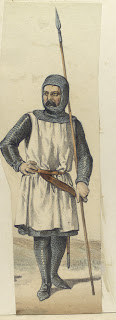
Today I want to go into some of the ideas behind a particular house rule I have in my game. It relates to one core notion: the spear is not heavily used in D&D and its clones. But historically, the spear was probably the most common melee weapon carried.

Some of this is purely functional. It's a lot easier to make a small piece of metal and put it at the end of a stick, than to craft a long piece of metal like a sword. And most people have an instinctive idea of what to do with a spear - you stick the other guy with the pointy bit. So it's both economical and, if not idiot-proof, at least it's easy to hand to a peasant conscript.

But there is scientific proof that spears have an advantage over swords. Particularly, they're very useful when you're trying to stop someone from coming into range to hit you. I think this factor is something that is significant enough to want to add into combat.

The specific rule is: if you have a weapon that has a longer reach than your opponent, you get the first hit when they're closing in on you. This applies generally to spears and two-handed weapons versus one-handed weapons, and to longer weapons against daggers. The basic principle is the same: in order to close on someone who has a reach advantage against you, you need to expose yourself to a potential attack.

To implement this, the opponent doesn't get an extra attack; they simply get the first strike when closing to melee. And it doesn't apply to someone who is surprised, or attacked from behind, or already engaged in melee combat. It mostly factors in when they lose initiative or make a defensive stand.

I like this because it makes spears an interesting weapon. It not only gives you an advantage when closing to combat, it also prevents other enemies from having the same advantage against you. And it allows you to have a character take up a defensive role - for instance, a fighter could stand guard in front of the party's wizard and prevent monsters from closing on them.

It's also an interesting tradeoff because generally reach weapons in D&D and its clones don't have the top-end damage. A spear does a d6 compared to a sword's d8, but you may decide it's worth it to fend off enemies and keep them from getting a reach on you. Similarly with a d8 polearm against a d10 two-handed sword. Both options do seem to increase the spear and the polearm in terms of viability.

There's also a good reason to limit it to the first strike in combat: once in close quarters, a person with a shorter weapon can get attacks in with relative ease. It's only when you first close in that the spear or polearm would have that first chop.

At the same time it doesn't really make combat overly complicated. It's a simple thing to decide: when closing in, does a character have the first attack? Only if the reach is the same. Once engaged, combat follows normally.

An interesting point to note is that spears and polearms are much less convenient than swords. You pretty much have to be carrying them, or securely lashing something fairly long to your back. This can be a trade-off in a dungeon situation, where characters need to choose between having a hand free and having advantage if attacked.

This rule is hardly new; the computation of strike rank in Runequest back in 1978 used a more complex variant that also takes weapon length into consideration, and there's a system in the Ready Ref Sheets that uses weapon priority. But I think this is quite a bit simpler than either of those, and it works in a simple initiative system like the ones found in most OSR type games pretty seamlessly. It would even work in a Holmes-style Dexterity based initiative system.

And since the name of this blog came from the fact that my OD&D crew always seemed to roll a 1 for initiative, it only seemed fitting to use this to break the ice on coming back.

Tuesday, December 9, 2014

Initiative, Dexterity and Ready Ref Sheets


The title of this blog is Macaronic Latin for "Always Initiative One," but I don't actually write about initiative much. Which is odd, because I actually do think about it a good bit, just not in a format that's ready to write about. Here I'm going to be focusing on OD&D, although coming at it by way of Chainmail.

In the first round of Chainmail man-to-man, the attacker strikes first, unless the defender has a longer weapon, or the defender has high ground. In subsequent rounds, initiative stays the same, unless one side has a shorter weapon or the high ground. All of this makes sense. If a man with a sword attacks a man with a spear, the spear-wielder can fend him off and get the first blow in, but if they both survive, the man with the sword has the advantage because he's overcome the spear's range and can work more quickly.

The state of affairs in Chainmail is good, and it's worth seeing what we can do in terms of replicating it in D&D. Unfortunately, it doesn't cover enough possibilities; what if someone is firing missiles, or throwing spells, or fighting against a creature that attacks with its claws? Chainmail only has 12 weapon types (if you don't have Chainmail but do have OD&D or Holmes Basic, the weapons are arranged in order by length in both of those books). So clearly it's going to need some work.

Outside of surprise, the main comment that OD&D has on initiative is under the description of abilities:
Dexterity applies to both manual speed and conjuration. It will indicate the character's missile ability and speed with actions such as firing first, getting off a spell, etc.
We're not told how Dexterity indicates this. We can compare stats when an Elf is taking a shot at an Evil High Priest, to see whether the Elf's arrow gets off before the EHP's Finger of Death spell, but it breaks down once we have monsters with no stats. So if a Hobbit is fighting a Manticora, does the plucky hero throw his stone before the creature's tail spikes fire? We don't have a Dexterity score for the monster. Also, this doesn't specify whether it factors into melee at all.

But I like the idea that Dexterity should impact on initiative. Now our goal is twofold: a spear should get first action over a sword, and Dexterity should impact on initiative.

In the 1975 article in The Strategic Review, "Questions Frequently Asked About Dungeons & Dragons Rules," Gygax did make some attempt to clarify initiative:
Initiative is always checked. Surprise naturally allows first attack in many cases. Initiative thereafter is simply a matter of rolling two dice (assuming that is the number of combatants) with the higher score gaining first attack that round. Dice scores are adjusted for dexterity and so on.
This doesn't specify exactly how Dexterity adjusts initiative, but in the ensuing example Gygax says that the Hero gets a bonus of 1 due to high Dexterity. We can reasonably extrapolate that he is geting +1 for a Dexterity of 13 or better, matching the missile adjustments given in OD&D.

Unfortunately the method in the OD&D FAQ doesn't get us an effect much like that in Chainmail. Now initiative is mostly random, with a bump for Dexterity, but weapon length has disappeared from the equation.

The Judges Guild tried to solve all these factors (and add a few more) in the Ready Ref Sheets. The Weapon Priority table (you can see it on the Zenopus Archives site here) factors in weapon length, spell level, missile weapons, dragon breath weapons, armor, monster speed and Dexterity. Which is all for the good, except that the priority system has a fatal flaw: it makes longer weapons better in absolute terms than shorter ones. A spear in these rules is better than a sword, and if you're using all d6 damage, there's no reason to ever use a sword. Which is silly, as there are plenty of reasons to use swords in real life.

This really only works if you can work out in advance that, say, a fighting-man in plate with a sword and Dexterity of 14 has a total rating of 5, while an orc (9" move) with a spear has 6. The orc always goes first. But it has some good ideas, and we can pull this all together without so much work that it's unwieldy.

This is a much-simplified table that takes into account weapon length:

Factor Round 1 Rounds 2+
Long Weapon* +1 n/a
Short Weapon** -1 n/a
Dexterity/Move 8 or less -1 -1
Dexterity/Move 13 or higher +1 +1
Encumbered (Moving at 1/2 speed) -1 -1

* Morning Star, Flail, Spear, Pole Arm, Halberd, 2-handed Sword, Lance, Pike
** Dagger, Hand Axe, Mace

The system is simple: roll initiative on 1d6, individual for PCs, as a group for monsters, and apply the above modifiers. Roll-off (no modifiers) on ties.

I chose not to flip the modifiers after round 1. Particularly in d6-based damage systems, 2-handed weapons don't have a large advantage, and giving them a penalty for most of the fight makes them nearly useless. I also threw in the encumbered modifier from the Ready Ref Sheets rule, and merged Dexterity and monster Move rates, which are pretty similar.

This does pretty much everything I want an initiative system to do: it takes into account weapon length, but only on the first round, it takes Dexterity into account, and it makes movement rates a bigger part of the game. A dextrous, light-armored fighting-man with a spear (+3) is at a pretty big advantage versus a clumsy, heavily encumbered cleric with a mace (-3), and will almost certainly get the jump on him.

Wednesday, June 25, 2014

Empire of the Petal Throne style damage

I've been taking a look at M. A. R. Barker's Empire of the Petal Throne specifically for what rules content it contributes to the original Dungeons & Dragons game. EPT was such an early variant, and deeply tied up in the Wisconsin and Minneapolis scenes and early TSR, and as such the ways its rules expand upon OD&D are interesting even for campaigns not set on Tékumel.

Probably the best known of EPT's rule changes is the idea that players re-roll hit dice each time they gain a level. This makes sense of the OD&D progressions, which have bonuses that appear and disappear over a PC's career. Re-roll, and your HP total can't go down. Simple and a fairly popular choice in OD&D.

Less discussed is EPT's damage, which until recently I hadn't looked deeply into. There are two simple changes. First, two-handed weapons do 1d6+1, and two-handed swords specifically do 1d6+2. This is a good alternative to the popular "roll 2d6 and take the higher result," though both are perfectly usable. The second damage rule is that a natural 20 (using those words) does double damage, with the possibility of an automatic kill if the character rolls a second d20 and gets a 19 or 20. This is a 1-in-200 chance; not exactly devastating. It's the first recorded instance of the simple critical hit rule of double damage.

The one I think gets the least love, though, is the damage by level versus enemy hit dice. Basically, at 4th level PCs get 2 damage dice versus 1 HD creatures. This increases at subsequent levels. This is the whole chart:


This seems quite odd; after all, how can a 1 HD creature take 5 dice of damage unless the first four are 1s? But in EPT, excess damage goes onto the next opponent, in a sort of prototype of the "cleave" maneuver. So a 10th-level fighter might take out five or six 1 HD opponents with that 5d6 damage.

In the OD&D FAQ, there is a basically similar rule implied: fighters get one attack per level against creatures of 1 HD or less. But that doesn't scale well to opponents that you'd fight at higher levels; unless you are literally taking on hordes of orcs or bandits, mowing them down in the mighty-thewed barbarian style, it's not half as useful as the EPT system. It's a more interesting interpretation, and it has the benefit of greater simplicity: there is only one to-hit and one damage roll.

The EPT damage system has another factor in its favor: one attack might be different from the next. If 5d6 come up right around their average of 18, it could kill three 1 HD creatures with 6 HP each, or nine with 2 HP each. This is more interesting than having to sit through 10 to-hit rolls, 10 damage rolls and the resolution of whether or not the lord has slain all the orcs yet.

If you don't have it, you should pick up the PDF of Empire of the Petal Throne over at RPGNow, and if you're really an enthusiast the Green Cover original manuscript that contains the version Barker put in limited circulation back in 1974.

Thursday, June 5, 2014

Talking Blue Book D&D: Ability Scores

I haven't talked for a while about Blue Book D&D, my name for a fusion of Holmes Basic D&D with Cook/Marsh Expert. But lately it's been on my mind, and I've thought more about cleaning it up and solidifying it for my own future games.

Specifically I've been thinking a lot lately about tweaks to ability scores. Holmes is minimal with bonuses, copying OD&D's Dexterity and Constitution bonuses, but increasing the Constitution bonuses to hit points at 17 and 18. Moldvay, meanwhile, sets out with the standardized thresholds: 13-15 for +1, 16-17 for +2, and 18 for +3, with corresponding penalties on the low side.

But Moldvay's attribute curve is misleading. One +1 is not the same as another, if the first bonus is on 1d6 and the second bonus is on 1d20. +1 to 1d6 is 16.67%, while +1 to 1d20 is only 5%. This has a distorting effect, particularly with Strength where damage bonuses go as high as +25% (for daggers and such that deal 1d4 damage).

OD&D has a schema hidden within it. Constitution gives -1 hit point per die (d6) at 6, and +1 at 15. These are the same distance, 3 units, from the median range of 9-12. Dexterity gives -1 to hit with missile weapons (d20) at 8, and +1 at 13. Again, these are equidistant from the median range. This is an interesting rule of thumb, and I think it's a good one for Blue Book.

So, Wisdom can give a bonus to save versus spells, just as in Moldvay, but it only gives +1 at 13 and -1 at 8. This gives Wisdom some role mechanically that it lacks in Holmes.

Strength is a thornier matter. If we have it give bonuses to hit and damage, the logical places are for a bonus to-hit at 13, a bonus to damage at 15, and penalties at 8 and 6, respectively. The difference is that 13 Constitution doesn't already grant a bonus, and 8 Constitution gives no penalty, so it seems fairer to move the second bonus 1 unit further away: +1 damage at 16 Strength, and -1 at 5.

This happens to dovetail nicely with Supplement I: Greyhawk, up to 16 anyway. But Greyhawk goes nuts and gives +2/+2 at 17 and +2/+3 at 18 - with a chance that the 18 Strength fighter's bonuses can go even higher. I don't like that so much. I'd rather follow a slower pattern, and give +2 to hit at 17, and +2 to damage at 18. That's idiosyncratic, but I think it works better for me.

My rationale behind this is the observation that Holmes fighters are way underpowered compared to Moldvay fighters, due mainly to strength, but I don't care for either the Moldvay or Greyhawk strength charts. Mine is simpler, and fits right in the sweet spot for me.

One of my least favorite additions is Greyhawk's modification of Armor Class by Dexterity score. It actually was supposed to represent an active parry, and only apply versus one opponent per round. But this addition wound up changing the definition of Dexterity; it stopped being a measure of hand-eye coordination and nimbleness of fingers, and became a measure of general agility. That doesn't really make sense, though; the two aspects are not firmly linked, and it's not a coincidence that Caltech's Warlock rules added Agility as a separate ability score. D&D never followed suit. But I'm not for using Dex to modify AC.

(This is one of the reasons I like Blue Book conceptually; it's easier to add than to subtract, and since Blue Book assumes Holmes, I can get rid of Dexterity bonus to armor class just by not adding it in the first place.)

Which leaves Charisma. Holmes says that Charisma is supposed to modify the reaction roll. OK, great! But how? He doesn't say. Moldvay actually breaks from his standard here and gives an OD&D-like +1 for 13-17 and +2 for 18, with corresponding -2 for 3 and -1 for 4-8. This is the one place where Moldvay ability scores actually go along well with the dice roll type, since +2 on 2d6 is a very significant boost.

Now, that's a lot of thought to give a few ability score bonuses. But I really think it's worth figuring it all out. As I've run a good bit of older D&D, I feel like Blue Book D&D is really very close to what my sweet spot is for the game rules, and it's really a question of tuning all the elements so the game works just like I want it to.

Monday, June 2, 2014

Special Abilities Tables

California in 1975-79 is an interesting place in the early history of the roleplaying game. It brought us Alarums & Excursions, Warlock, Arduin and Runequest – and as a result, the biggest and best documented locus of non-Gygaxo-Arnesonian gaming from our hobby's dawn. It was a place where pre-RPG entertainments had laid fertile soil for gaming, as documented in Playing at the World; Coventry and SCA and different life experience all added up to a scene which was totally different from that in the upper Midwest.

One of the things that we can look at historically from this period is the idea of a special ability table: a chart where dice are rolled to give each PC some distinctive characteristic. It's not exactly revolutionary, but it was one of the earliest common house rules.

The Arduin Grimoire features such a table in its early pages, or rather, one for "warrior" types, one for "magical" types, a third for "religious" sorts and a fourth for "secret" types. Each has a percentile dice roll, and options that follow from it. Many are bonus/penalty combinations, such as a warrior's "+1 with norningstars, whips, bolos and slings, -2 with all swords." Others are pure negative, like a magical type's "-1 on all character abilities, -3 versus all spells or magic." (Hargrave always underlined the word "all".) Some are all positive, like "Taught by a true weaponsmaster, get +2 with all western weapons." And some are just odd, like the magical sort's "Flesh tastes so bad to monsters they spit you out 95% of the time."

Arduin's chart is just plain odd, but it's a good illustration of something that was popular at the time. Most of Hargrave's abilities are just pluses or minuses, with some minor bit of rhyme or reason behind them, but others are backgrounds. These are sometimes imbalanced (a religious type can get "Mountain man. plus 2 to strength, agility and dexterity. Climb as a thief.") but nevertheless add a bit of appeal to the characters.

The AD&D Dungeon Master's Guide has a "Secondary Skills Table" that is used to determine background skills for player characters; the difference is that it doesn't really add much to the characters other than to say that they have an unspecified skill. It does seem to be in a similar vein to the California tables, though nowhere near as wild and wooly as they were. 18% of results give no skill at all.

What I like about the idea, if not the execution, of the old tables was the idea of leaving characters up to chance. Much like 3d6 rolled in order, a bonus ability that isn't known in advance is a good method of generating characters who will make you think a little outside the box to define who they are.

The potential I see for them is that, if you generate a really high quality list of minor modifiers (say, for instance, bonuses and penalties within the D&D system – saving throws, all those checks rolled on 1d6, etc – you can create an interesting incentive to be a human: just declare that only humans get a roll on this chart. Demihumans have the special abilities allotted by the system in the first place.

Just a little something that's been percolating. I think it has potential, and I think it could be disastrous, or gonzo fun – all depending on the execution.

Thursday, October 10, 2013

More Troll Questions Answered

Because I like it (and don't like things like the 30-day challenge), I'm answering Top Ten Troll Questions Part Two.

(1). Should level drain take away one level of experience points from the character? Yes or No? If no, what should level drain do?

Yes. It should be reversible with some spell though.

(2). Should the oil used in lanterns do significant damage (more than 1 hp in damage) if thrown on an opponent and set on fire? Yes or No? If yes, how much damage should it do?

I prefer Holmes's rule of 1d8 on the first turn, and 2d8 on the second. It does a lot for a group's tactics to have the fire option.

(3). Should poison give a save or die roll, with a fail rolled indicated instant death? Yes or No? If no, how should game mechanics relating to poison work?

Poison is save or die unless specified otherwise. Specifying otherwise is good.

(4). Do characters die when they reach 0 hit points? Yes or No? If no, then at what point is a character dead?

I prefer that characters die when killed. I do sometimes use a d6 to determine how many rounds dying takes; if a character is taken below 0 hit points, the "negative" HP are factored into the die roll (i.e. at -2 HP you take d6-2 rounds to die). Magical healing is possible while dying, but no "I bind their wounds" - it's a mortal wound.

(5). Does the primary spell mechanic for a magic user consist of a "memorize and forget system" (aka Vancian)? Yes or No? If no, what alternative do you use?

Yes. Though I like the Holmes scroll rules, as I've discussed here multiple times.

(6). Should all weapons do 1d6 damage or should different weapons have varying dice (1d4, 1d8, etc...) for damage?

I go back and forth on this, because I mainly prefer OD&D and Holmes, but I also like different dice. If I'm running straight-up OD&D or Holmes, I use d6; when running Moldvay or S&W, I use variable damage dice.

(7). Should a character that has a high ability score in their prime requisite receive an experience point bonus? Yes or No?

Yes.

(8). Should a character with an strength of 18 constitution get a +3 bonus to hit points, or a +2 bonus to hit points, or a +1 bonus to hit points or no bonus to hit points? And should other ability scores grant similar bonuses to other game mechanics?

Holmes and Moldvay agree: 18 Constitution gives +3 per hit die. My ideal is that Strength gives +1 to hit for 13 or higher (-1 at 8 or lower), and Wisdom gives similar bonus/penalty on save vs. spells. Intelligence gives you languages, and if you read this blog you should know I think that's a terrific ability.

(9). Should a character have 1 unified saving throw number, or 3 saving throw types based on ability scores (reflex, fortitude, will), or 5 types based on potential game effects (magic wand, poison attacks)? or something else?

The third most popular post in this blog's history doesn't lie: Save vs. Death Ray!

So on that basis alone, 5 saves, as long as one is Death Ray.

(10). Should a cleric get (A) 1 spell at 1st level (B) no spells at 1st level (C) more than 1 spell at 1st level?

B, no spells at 1st level. Clerics in older D&D should be gaining levels quickly. It also reduces the feeling that they are "heal-bots" that you get in AD&D, and makes their healing magic more of a valuable resource.

Friday, July 12, 2013

Defying Death


A few things have had me thinking about what happens when characters are reduced to 0 HP or less. In OD&D and most versions of Classic D&amp:D, characters by the book are dead. AD&D gives a countdown to -10 HPs.

Most of the time when I'm running, characters taken down to 0 hit points are in fact dead. In large part this is because I've been dissatisfied with the behavior that letting PCs go down to -10 HP causes, where PCs will take bigger risks and rather blithely go down to negative numbers. The OD&D rule creates more paranoia. But at the same time there are interesting possibilities for giving a PC a chance to be "not quite dead yet."

The Dungeon Crawl Classics rules have a Luck check for "recovering the body" where the PC may be dead or not. If they aren't, they have 1 HP and a permanent loss of one point to a physical statistic. That's not a bad start, but I think there are more interesting and flavorful ways to go about not quite dying.

What I have in mind is the idea of defying death. Basically: once in a character's life, they have a 3-in-6 chance of not being dead when reduced to 0 or fewer hit points. This permanently subtracts one from Constitution and one from Charisma. However,they have stolen a life from the gods of death, and owe them a death. Failure to deliver will bring about the character's death by seeming accident.

Now, simply killing your own enemies doesn't seem thematically right for this. I like the idea that, somewhat like in the A Song of Ice and Fire series, the life stolen has to be repaid by killing at the request of another. Anything that can be perceived as cheating, like having a fellow party member ask you to kill that orc over there, could draw the ire of the death gods. Ideally it will be a deed the player doesn't actually want to do, and result in some trouble that will create an interesting adventure.

I'm tempted to limit this to people who have gained a level. It would seem to me that there is some degree of heroism that makes such a thing possible. The curse is more for fun; my main concern is to make the idea that not being dead is a one-time thing with a real cost.

What do folks do for defying death in their games? What do you think about this idea?

Sunday, June 9, 2013

Little things

One thing that I've noticed recently in running Swords & Wizardry is a couple of the little things that have an impact on the game. I want to talk about one that comes from S&W and one based in the Holmes rules.

Swords & Wizardry gives fighters the benefit of extra attacks versus creatures with 1 hit die or less. This has a big impact, giving the fighter a serious advantage. Quantity of attacks really matters in old school D&D more than either hit dice or armor class, given how things average out. It also makes a much more significant gap between 1HD opponents and 2HD enemies, which I think I like: the bigger foes are more dire threats. Very interesting dynamic.

This is part of the key of old-school D&D, in whichever edition: if you play with too few PCs, you won't do well. People often look at the game's lethality, particularly in OD&D and "classic" (Holmes, B/X, BECMI, RC), as something that needs to be fixed - but it's fixed by sheer numbers. Quality of troops comes into it in certain ways, mainly in the ability to maintain those numbers, but Mike Mornard's core advice is correct. People wishing to survive the megadungeon should go into it with nine characters.

The other little tweak that's having a big impact is scroll creation, since I use the Holmes rules. It really gives magic-users a feel of not being useless until 5th level, and also helps "fix" their excess of wealth otherwise. The M-U in our Stonehell campaign has been using it for Sleep, which is great for avoiding fights where you're outnumbered.

A quirk of this that I've been thinking about is "inheritance." That is, once an M-U has made a scroll, it's there even if they die. This could come in particularly handy when a higher level M-U dies in the campaign with several scrolls in tact; a fresh replacement (1st level) would still be able to use, say, Web or Fireball or what you will at least once in a game.

So let's open this for conversation. What tweaks have you found to make a relatively big impact in your games?

Tuesday, July 6, 2010

Further on Holmes

So I'm still looking seriously at Holmes D&D as a basis for a campaign, and digging up my megadungeon maps and working them into a new, bigger design. Particularly I think Holmes is more suited to the campaign dungeon than the wilderness sandbox, and I'm primarily interested in the dungeon environment anyway. (I'm not much of an artist, but I certainly can make dungeon-lookin' shapes on a piece of graph paper.)

Still, there are a few concerns with Holmes, mostly in the short combat section. Initiative based on Dexterity - I leave that to long time Holmes fans to make the case to me. Honestly rolling 3d6 and counting down Dex scores sounds cumbersome compared to my preferred initiative method, which is each side rolls 1d6, high roll wins it, ties occur simultaneously. (This blog is, after all, named after a long run where the PCs lost the initiative in every fight.) But more worrisome are the rules for weapon speed.

Basically, daggers are said to roll twice per round, most one-handed weapons go once, and two-handed weapons go once every other round. There is no "weapon type vs. AC" chart, and everything does d6 damage - so a two-handed sword means you're rolling to hit 1/4th as often as a dagger with no benefit. In fact, everybody but clerics (who have to use maces) should be combat gods according to this comparison.

I've been thinking about raising the damage dice for other weapons and lowering it for daggers, but that still doesn't work. To actually have a better average effective result as a dagger, with the dagger doing 1d4 twice (average 2.5 x 2 = 5), the long sword would need to do 1d10 (average 5.5) and the two-handed sword would need to be rolling a d20 (average 10.5 / 2) for damage.

Looking at the actual data, I think the solution lies in relative effectiveness, which can be done without the high degree of complication present in Greyhawk or AD&D. If you say that daggers do 1d4 damage and suffer a -2 penalty against characters with AC 7 or better, they are deadly effective against unarmored characters, but their impact goes down dramatically with lower ACs. If you say that 2-handed weapons have 1d12 damage and take the opposite effect, treating AC 7 or better as two categories higher, e.g. AC 7 becomes AC 9 and so on, they become more effective, on the whole, than standard weapons in the d6/d8 range. I'm envisioning 4 "classes":

Light weapons - daggers, mainly - 1d4 damage, Fighting-Men and Thieves get 2 attacks / round, -2 to hit versus AC 7 or better.
Normal weapons - maces, spears etc - 1d6 damage, 1 attack per round.
Heavy weapons - swords and similar - 1d8 damage, 1 attack per round.
2 Handed Weapons - two handed swords and polearms, 1d10 or 1d12 damage, 1 attack per 2 rounds, +2 to hit versus AC 7 or better.

Holmes does have one other "hole" in the combat system - specifically it says that Fighting-Men get more attacks but doesn't go into detail. I'm considering that at Hero level, they get 3 attacks per 2 rounds, with the 2 coming in round 2, with normal weapons, 3 attacks per round with light weapons, and 3 attacks per 4 rounds (essentially skipping a "rest" round) on 2-handed weapons. When they reach Super-Hero, this goes to 2, 3, and 1 respectively; I realize that the consistent thing would be 4 dagger attacks per round but that's just silly. Holmes rounds are 10 seconds long, not the 60 second abstraction of AD&D.

I think I like the dynamics of the house rules listed above. It doesn't complicate things too much, it differentiates weapons without giving too much advantage to one type or the other, and it's mathematically sound. Any thoughts?