Showing posts with label monsters. Show all posts
Tuesday, January 31, 2017
Typology of Random Encounters: In the Dungeon
Most of my games this past weekend were driven by the random encounter. And, despite the image above, none of them were with bears. Although one was with a crocodile. That, along with general considerations about dungeon design, has me thinking about the types of random encounters you'll find in a large dungeon or megadungeon.
Type I: Faction Members. When you have a faction in the dungeon, it should be represented on the random encounter table, unless there's a good reason that its members stay put. So if there is a goblin tribe, a gang of bandits, or a cross-species evil cult, you should be able to run into them. This allows for PCs to figure out what else might be in the dungeon without knocking down every door, and provides opportunities for faction members who leave an encounter alive to tell their allies about the PCs' activities.
Type Ia: Factions without a Base. It's possible for there to be a faction in the dungeon that is an itinerant group. This should be a temporary condition; perhaps you have a group of cavemen who've wandered into the dungeon for shelter, or maybe a half-dozen goblins got away when the PCs beat their king. They will initially be "homeless" within the dungeon, but within a session or two, they may take over a cleared room.
Type II: Predatory Monsters. There are "big" monsters that have their own room in the dungeon, but logically will be wandering about looking for things to eat. It could be a pack of hell-hounds or the minotaur; whatever it is, it's not home. If the PCs kill a significant monster outside of its lair, of course, now they have to find its treasure before anyone else does.
Type III: Animals and Unintelligent Creatures. These are your Rodents Of Unusual Size, your skeletons and zombies, your oversized bugs and so forth. They are here on little more than instinct, and most are optional encounters one way or another. The PCs can throw some rations to distract the R.O.U.S., or have the cleric turn the skeletons, or just go around them and hope the reaction roll isn't an instant attack. (These encounters should always involve reaction rolls.) They don't have the same impact as faction monsters, although they may also come from another room. I particularly enjoy relatively innocuous animals like dungeon chickens (there is a coop in my dungeon).
Type IIIa: The Clean-Up Crew. Jellies, slimes, oozes, globs, glops, puddings, molds, blobs, and various other unwholesome growing things come along and eat dead stuff. Sometimes they convert the PCs into new dead stuff to eat. These come in particularly handy if the PCs are in an out-of-the-way corner and you roll a random encounter.
Type IV: Non-Player Characters. In the encounter tables for older editions of D&D, NPCs with classes and levels were regular entries. (OD&D used the level titles for this, which is great if you remember the level titles.) They are distinct from faction members; generally once somebody has at least 2 hit dice, you should think up a name and a background rather than leaving it at "bandit #479". Fighters and thieves may have hirelings; wizards may also have familiars; clerics are more likely to have acolytes. They may have a relationship to one or more factions, and in time may constitute a faction in themselves. It's also entirely possible that they will join the PCs, and if they do so, they could also betray the PCs. Sure it's possible for bandits to do that, but in my experience PCs get stabby once someone says "stand and deliver."
Type V: Wandering Oddities. Perhaps the most neglected category, strange and wondrous effects can sit on the random encounter table along with all kinds of monsters. This can be as simple as an unknown sound, seeing a figure disappear around a corner or down a hallway, optical illusions, or even minor magical effects. This is a good way to reinforce a theme throughout a dungeon or dungeon level without necessarily dedicating a room to it or hammering it home constantly. It could be a detail like a particular fungus that is growing in this level, or mini-features like having carvings left behind by the cult that is operating nearby. This makes the dungeon a richer and stranger place.
Each of these types feeds back into solid dungeon design, and helps tie together a living environment that has strange and wondrous features. Featuring multiple examples of each type should help fill out that encounter list without the exploration feeling like a slog.
Labels:
dungeons,
factions,
megadungeons,
monsters,
NPCs,
random encounters
Monday, January 16, 2017
Mythic Underworld: Cerberus and Mysteries
The story of the twelve labors of Heracles is simple. Driven mad by the goddess Hera, he killed his own children. Since this was such an awful deed, he was given ten labors by Eurystheus to expiate himself; technicalities allowed Eurystheus to add two additional labors. The twelfth, capturing the hound Cerberus, is the one we're interested in.
Cerberus (the "C" is hard) is the guard-dog of Hades, who prevents unwanted access to the underworld. He is usually depicted with three heads, although in connection with the Hecatoncheires (100-handed giants), may have had 50 or 100 heads, some of which may have been snake heads. And he had snake tails, or several backs. In any case, you've got a nasty beast that stops the dead from escaping the realm of Hades.
As Heracles prepared to enter the underworld and retrieve Cerberus, he was initiated into the Eleusinian mysteries. This was a rite of knowledge, granting Heracles insight into the secrets of Persephone and Hades, and is certainly notable because it is the earliest reference to Greek mystery religions. So armed with new understanding, Heracles descended into the realm of Hades.
It's not exactly clear how Heracles got Cerberus out. Some accounts have him wrestling the beast and beating it, possibly involving the impenetrable skin of the Nemean Lion that Heracles used as a cloak. Others say that Persephone, who thought kindly of Heracles, gave the hero a chain, or possibly that she herself chained the beast and handed it over. The fight makes the more obvious of the two stories, but it's intriguing to think about the hero winning the fight by getting Persephone on his side.
Of course, Eurystheus did not actually want Cerebus, and Heracles returned the beast to its proper place in Hades after having brought it up to the surface. This last bit is probably the most amusing part of the tale; unlike the Lernaean Hydra or the Nemean Lion, Cerebus is not a menace to be slain. Hell is supposed to have a three-headed dog-beast who eats anyone trying to leave.
If all we got for gaming from the tale was Cerberus as guard-dog, that'd still be an interesting twist on the dungeon guardian. After all, Cerberus was not there to keep intruders out, but to pen the denizens of the underworld in. I really like the idea of a formidable monster that is not necessarily an immediate threat for PCs to overcome, but plays a role in the dungeon's ecology nonetheless. Some groups will try to kill simply anything, but that can always be solved by a powerful creature that refuses to offer direct combat. Of course, at some point the PCs will have to deal with the creature – but by that time it will become a strategic obstacle to overcome.
Then there's the little matter of the Eleusinian mysteries. This is a secret initiation ritual that gives hidden knowledge; in many cases this hiddenness was quite literal, and the content of the mysteries have been lost to the ages. Such an initiation is a way to integrate player characters more deeply into the setting. We are used to scriptural religion in the West, but introducing a mystery is an opportunity to create literally esoteric knowledge about the world, which can be revealed to players only when their PCs make a particular commitment. PCs, of course, will be inclined toward the mysteries that grant knowledge of the dungeon underworld they face.
The last idea that I particularly like is the loan of a chain from Persephone. This is a good way to have a taste of powerful artifacts in the campaign, by lending them instead of permanently giving them to the PCs. Most artifacts throw off the ability of PCs to be meaningfully challenged, but having them given on short-term loan lets them flavor the game without dominating it.
However many heads Cerebus has, the story of Heracles subduing him has a lot of interesting wrinkles for the D&D underworld. I do want to tackle more Mythic Underworld segments, because Greek myth alone has a lot to offer in this regard.
Thursday, January 12, 2017
Goblins, or Why Use Humanoids
(Note: this post contains spoilers for my Sunday morning game.)
The first time I ever played D&D, I took a piece of graph paper, sketched some rooms on it, and stuck a few goblins in them. Two players went through them, beat the goblins, got the treasure and some XP. I've enjoyed goblins ever since.
I feel like there's a particular prejudice against using default humanoids in OSR games. I think that two points from Bryce Lynch's review standards sum up the reasons why.
I've actually tried using this approach in my games for a while, and switched between humans and odd monster races (beastmen, Selenites and others) for my main monsters. But I keep going back to goblins. Why? Well, frankly I don't think a gang of bandits is necessarily a better match than a horde of goblins, and having the option to use either makes the game a bit richer. Sure, the bandits might eventually say "Stand and deliver," but I feel like they're possibly more of a cliché in my game than goblins are.
- Non-standard monsters.
- The party should not know what to expect. What are it’s attacks and weaknesses? Mystery, wonder, and fear!
- Go light on the humanoids, or even replace them with normal bandits, etc.
- If all it’s going to do is swing a sword and die then it can be a human. People can do can pretty disgusting stuff.
(As an aside, I'm not picking on Bryce; I like his reviews and I think his standards are good, I just find them a useful statement of an attitude I see in a lot of places.)
When it comes to humanoids, I think the key is to focus on a single type of monster. In my Sunday AM game, there is an influx of goblins in the Fazren Hills, so they'll be a piece of the low-level games. I don't intend for the goblins to act as a step on the cursus honorum before the PCs get to orcs and hobgoblins etc, but rather to use them as one of several factions in a larger sandbox.
For the goblins in the Fazren Hills, what the PCs will find out as the game goes on is that the goblins who are now pushing into human territories have been exiled from the Fae realm. Many of these goblins have links to that realm, and one of the things I need to work up is a chart of minor effects of this exposure – minor illusions, short-range teleportation, conjuring minor items, strange features, and so on.
I particularly want to play with this idea because I love the notion that goblins are really bogeymen, in the old fairy-tale sense. There was an element of this in the bugbear, but there's a reason that we talk about ghosts and goblins, and bugbears was a vocabulary word until Gygax decided to make each thesaurus entry into a monster.
I think a sandbox game needs strong factions, and ruling out humanoids cuts off a whole category right off the bat. The problem with most humanoids in D&D is that they're just an entry in the monster zoo, the ordered thesaurus that the PCs have to kill to get the treasure. I'd say that a good faction in an adventure or sandbox campaign has the following:
- A strong hook
- A tangible goal in the game
- Something that distinguishes them from other factions
At the end of the day, I just like goblins. But I do think they can fit into creative old school play in a way that I don't think is properly acknowledged.
Labels:
charts,
factions,
goblins,
humanoids,
monsters,
ready reference,
rules cyclopedia,
Sunday AM
Monday, December 28, 2015
On Goblins and Gnomes
I was looking at some 19th century sources on goblins and fairies (basically the same thing) because Gus L's takedown of The Lost Mine of Phandelver at Dungeon of Signs is so harsh on goblins. I was trying to find some material for a different take on the goblin, when something hit me.
Open any classic D&D book, from Holmes on to the Rules Cyclopedia, or open the Monster Manual for 1e AD&D. Look at Goblins. Now look one entry back (in the MM, just skip the entry for "GOAT, Giant"). That entry will be Gnomes. Every single number for Gnomes and Goblins will be within 1 point of the other. Gnomes have AC 5, Goblins have AC 6. Gnomes have 1 HD, Goblins 1-1 HD. In Moldvay and later versions of classic D&D, Gnomes have 8 Morale and Goblins have 7 Morale. In AD&D, Gnomes speak the Goblin language. In each version, we find that they even have similar (though not identical) leaders, even with similar morale boosting effects in Moldvay. Not to mention, they are both chthonic humanoids somewhere between 3' and 4½' tall.
The implication should be clear: these are the same monster.
I mean, what real differences are there? Gnomes have beards? Goblins are a bit uglier? Alignment? A point of AC and a single hit point? A point of morale? Gnomes are fond of crossbows? All that is minor details. Goblins and gnomes are more like each other than they are like other monsters. More important, it gives things an interesting hook. It's simple to merge the two and differentiate them by alignment and disposition. Goblins are now like gnomes but Chaotic or Lawful Evil in alignment. You can even keep the terms "goblin" and "gnome" and the respective languages.
I picture the merged creatures as favoring classical gnomes. The evil "goblin" versions may be uglier because of association with Chaos, or because they live in the Dungeon-as-Mythic-Underworld, but they should look basically similar. Since goblins have an antipathy to dwarves, perhaps they don't keep beards, but I think visual cues should be subtle to make the merger meaningful.
Twentieth century fantasy literature drew extensively on the fairy tales collected in the 19th century. These were far from precise in terminology. "Goblin" is one of several catch-all terms that referred to pretty much any of the diminutive, chthonic creatures, whether we are referring to mine spirits such as the Welsh Coblynau or domestic brownies. "Gnome" isn't any different. The idea that gnomes are somehow separate is an invention of Gygax.
Once you recognize that goblins and gnomes are the same monster in D&D, a few things happen. First, the dynamic of encounters with short humanoids will be different. Just because a creature is about 3½' tall, doesn't mean that it is always good or evil. This creates an ambiguity that games with short humanoids otherwise lack: you can no longer tell at a glance whether a creature is a friend or foe.
Second, the idea that gnomes have an affinity for illusions is a natural fit for goblins. It's a downright nasty twist to add goblin spellcasters with access to Phantasmal Force. A goblin lair is a dangerous place, and adding illusions can give them some bite. It becomes a place where you cannot trust anything, which adds a distinct layer of classical fairy lore. If the idea doesn't appeal to you on its own, watch Jim Henson's film Labyrinth.
Third, it justifies the existence of gnomes. As written, there's no reason to ever use gnomes. You can always do the same thing with dwarves or halflings, and do it better. But once you make gnomes and goblins the same monster, there's a reason to put them in a dungeon. Neutral gnomes/goblins are a great faction to add to the dungeon mix, with just enough potential for nastiness to make them interesting.
Fourth, there is a great amount of 19th century folklore that works with this view of goblins/gnomes as chthonic fairies. For instance, British Goblins by Wirt Sikes is a good guide to Welsh fairy lore, and the merged creatures that we get from goblins and gnomes can fit a lot of the stories within. The Coblynau (Welsh mine-spirits) are one of several examples of creatures that can be used as inspiration for gnomes. The pranks and demands of British goblins are good ways to make goblins more than one-dimensional bags of HP to be killed.
I think this is a simple solution to a dilemma that I've seen in OSR circles for years now. There is a need for straightforward dungeon factions in the best tradition of B2 Keep on the Borderlands. But after 40 years of the goblin being abused as an entry-level monster, there is some understandable goblin fatigue. This brings them close to their folkloric roots and I think changes the way things work without losing an iconic monster to overuse.
Monday, September 14, 2015
More Dragons in the Dungeons
So there's this game you may have heard of called Dungeons & Dragons. It seems to have more dungeons than dragons, which is a shame.
Ancient and medieval depictions of dragons aren't of multi-story lizards breathing out gigantic fireballs. They are generally small, more slender reptiles, comparable in size to large horses, that seek out treasure hoards and guard them. It's a classic underworld trope to have dragons atop a burial mound or ancient tomb, which makes them a natural fit for dungeons.
Dragon inflation has been a constant of D&D, and it has slowly pushed the dragon out of the game, except at high levels. Dragons went up in hit points significantly in the first edition PHB, and much further in second edition, firmly ensconcing them as upper-echelon enemies. They have stayed that way ever since; a party will pretty much have to be 5th level or higher before even thinking about slaying a dragon.
OD&D dragons aren't unbeatable super-beasts. White dragons only have 5-7 hit dice, and are 25% likely to speak, and 60% likely to be sleeping when encountered. A Very Young white dragon only has 5-7 hit points and a similar score on its breath weapon; in my opinion that's not out of the question for an encounter on the first dungeon level. It's a logistical challenge, since the party will want to avoid being hit by the breath weapon, but not one that the party can never overcome. Even at 3 square inches (30 feet), the cone of a white dragon's breath will not necessarily hit multiple party members if they arrange themselves properly, using terrain obstacles or shapes to their advantage. If nothing else, they won't just assume they can kick in every door and slay the monsters.
All OD&D dragons are treasure type H. This is a hoard with literally piles of coins; there is a 75% chance of 10,000-60,000 GP. On average (and not counting magic items), a hoard should be in excess of 80,000 GP, with most of that coming in jewelry and gold pieces. Slaying a dragon and taking this much treasure would be a fine haul, although the reward stops being quite so dramatic after 5th level, when a dragon's hoard is no longer an automatic level gain. But up to level 5 or so, dragons are an efficient way to gain a level.
If you want to picture a hoard, let's say that gold pieces are about the size of a Krugerrand. 60,000 gold pieces would be about 50 gallons of space, which would be larger than the volume of a typical bathtub. This would have about 25 pieces of jewelry and/or 50 precious gems mixed in. Armored PCs could only take out about 1800 coins each; you'd probably want a few wheelbarrows. Transporting gold out of the dungeon should be almost as much of a challenge as slaying the dragon. It's impressive, but not cavernous rooms full of coins. The largest possible hoard would have 184,000 coins, which is in the area of a refrigerator.
By design, dragons should be a low to mid level monster: a hard challenge at level 1 or 2, but able to be handled with much more ease at levels 4 to 6.. If the referee is running OD&D by the book (as it were), it's a poor decision to take on a blue or red dragon. They are more likely to talk, and thus to parley, and less likely to be sleeping. And their treasure will be the same as a white dragon, which could be as much as 6 hit dice lower than its red cousins.
There's another reason to put dragons in your dungeon, though: factions. Dragons will naturally relate to the other denizens, although obviously this relationship may be more of a predator/prey one. But it will always make the dungeon more interesting if there is a dragon sitting on a big treasure hoard. Whether or not the dragon talks is a big factor in this, as a brute white dragon that picks on the goblin tribe would be very different from a crafty green dragon that has a group of gnolls or bandits doing its bidding.
The moral is simple: don't be afraid to add dragons to your dungeon. They are designed in OD&D to be things that you can handle but still have some "badass factor."
Wednesday, August 26, 2015
So You Like Monsters?
The second edition AD&D Monstrous Manual is now available as a PDF. This is part of the AD&D 2e books being made part of the D&:D Classics website. Unlike the PHB and DMG, the Monstrous Manual did not get hit with an ugly stick in the 1995 redesign, so it has exactly the same art and layout that it had originally featured two years earlier.
The original 2e books featured the Monstrous Compendium, with the idea being that the monster books should be loose-leaf sheets collected in an oversized binder, so new monsters could be added alphabetically instead of keeping them in a growing series of hardcovers. This failed for a simple reason: the monster entries didn't all take up a full page, front and back, meaning that one monster would be on the back of another. If it went from GA to GI, then where the heck do GE monsters fit? It also created a proliferation of loose-leaf monster sheets in boxed sets that would inevitably get lost in the shuffle. Happily, the Monstrous Manual and the Monstrous Compendium Appendix series pretty much fixed this, putting everything "core" into a big hardback and the "expansion" monsters into perfect-bound softbacks.
One of the things that you need to remember when looking back at TSR products is that they were laid out first and had content written to fit. This became extreme in the case of the Monstrous Compendium / Monstrous Manual series. Each monster had to take up at least a full page, whether it was needed or not. To facilitate this, sections on Combat, Habitat/Society and Ecology were added to pad out the entries. This is occasionally interesting but often reads like useless filler, which is a shame, as the format has a lot of potential that is occasionally reached. For instance, the Githyanki and Githzerai are extremely well-imagined and well-realized in this book, and the Tarrasque comes off well. But on the whole it doesn't stay at that level, and the format feels bloated.
A tremendous deal of the monsters in this book were illustrated by Tony DiTerlizzi. This was his first major work for TSR, and led directly to his doing all of the art for the Planescape line. For instance, DiTerlizzi's hobgoblin is a fully realized concept of a monster:
The art, despite happening against a plain white background, manages to evoke creatures that have come from a high-fantasy world with a lot of detail and a touch of whimsy. His new art book Realms is worth the price and shows a great array of his imagination, including sketches that didn't make it all the way to the MM. Shannon Appelcline (who writes the "product history" sections for these books) fails as a historian for managing to not even mention Tony's name when he describes a book that very directly feels Tony's stamp and was critical in starting his career as an RPG illustrator.
One game issue in this book that I see primarily as a negative: 2e experienced a lot of "dragon inflation." Dragons were bigger and more powerful in this edition than in previous ones. If you like that, that's cool, but I prefer dragons that fit in dungeons: relatively small, mostly threatening because of their breath weapons, and otherwise very realistic enemies starting at a fairly low level. D&D has trended away from this view, which paradoxically makes it so that you see fewer dragons in adventures outside of the really high levels.
If you want to read a monster book cover to cover, this isn't a bad choice. (The appendix books are a better choice, because the focus in the MM is primarily on "standard AD&D" monsters, while the other collections by definition are of new creatures.) The real issue with the book is that it feels like it was written by a committee. This intensive monster format could have been a great way to present a tightly integrated fantasy world, but instead it comes off piecemeal, really not even justifying all of these critters existing in the same universe. Due to the bloated stat entries, it's not very good for at-the-table use, and I switched to the 1e books while I was running a hybrid 1e/2e game in high school.
This was my first book of monsters, and I do think it's part of why I like monsters so much. As you've probably figured out, I credit Tony DiTerlizzi with a lot of that. If you've never read the book before, I'd definitely pick up the PDF and give it a whirl.
The original 2e books featured the Monstrous Compendium, with the idea being that the monster books should be loose-leaf sheets collected in an oversized binder, so new monsters could be added alphabetically instead of keeping them in a growing series of hardcovers. This failed for a simple reason: the monster entries didn't all take up a full page, front and back, meaning that one monster would be on the back of another. If it went from GA to GI, then where the heck do GE monsters fit? It also created a proliferation of loose-leaf monster sheets in boxed sets that would inevitably get lost in the shuffle. Happily, the Monstrous Manual and the Monstrous Compendium Appendix series pretty much fixed this, putting everything "core" into a big hardback and the "expansion" monsters into perfect-bound softbacks.
One of the things that you need to remember when looking back at TSR products is that they were laid out first and had content written to fit. This became extreme in the case of the Monstrous Compendium / Monstrous Manual series. Each monster had to take up at least a full page, whether it was needed or not. To facilitate this, sections on Combat, Habitat/Society and Ecology were added to pad out the entries. This is occasionally interesting but often reads like useless filler, which is a shame, as the format has a lot of potential that is occasionally reached. For instance, the Githyanki and Githzerai are extremely well-imagined and well-realized in this book, and the Tarrasque comes off well. But on the whole it doesn't stay at that level, and the format feels bloated.
A tremendous deal of the monsters in this book were illustrated by Tony DiTerlizzi. This was his first major work for TSR, and led directly to his doing all of the art for the Planescape line. For instance, DiTerlizzi's hobgoblin is a fully realized concept of a monster:
The art, despite happening against a plain white background, manages to evoke creatures that have come from a high-fantasy world with a lot of detail and a touch of whimsy. His new art book Realms is worth the price and shows a great array of his imagination, including sketches that didn't make it all the way to the MM. Shannon Appelcline (who writes the "product history" sections for these books) fails as a historian for managing to not even mention Tony's name when he describes a book that very directly feels Tony's stamp and was critical in starting his career as an RPG illustrator.
One game issue in this book that I see primarily as a negative: 2e experienced a lot of "dragon inflation." Dragons were bigger and more powerful in this edition than in previous ones. If you like that, that's cool, but I prefer dragons that fit in dungeons: relatively small, mostly threatening because of their breath weapons, and otherwise very realistic enemies starting at a fairly low level. D&D has trended away from this view, which paradoxically makes it so that you see fewer dragons in adventures outside of the really high levels.
If you want to read a monster book cover to cover, this isn't a bad choice. (The appendix books are a better choice, because the focus in the MM is primarily on "standard AD&D" monsters, while the other collections by definition are of new creatures.) The real issue with the book is that it feels like it was written by a committee. This intensive monster format could have been a great way to present a tightly integrated fantasy world, but instead it comes off piecemeal, really not even justifying all of these critters existing in the same universe. Due to the bloated stat entries, it's not very good for at-the-table use, and I switched to the 1e books while I was running a hybrid 1e/2e game in high school.
This was my first book of monsters, and I do think it's part of why I like monsters so much. As you've probably figured out, I credit Tony DiTerlizzi with a lot of that. If you've never read the book before, I'd definitely pick up the PDF and give it a whirl.
Friday, August 7, 2015
How did these people get into the dungeon?
OD&D volume 3's Monster Level tables include numerous human-types in the dungeon, mostly a mix of fighting-men, magic-users and Chaotic clerics. Of the humans in volume 2, only Bandits and Berserkers appear. The rest are listed by their level titles from volume 1, and run the gamut from Warriors (level 2 Fighting-Men) to Wizards (level 11 Magic-Users) and Evil High Priests (level 8 Chaotic clerics).
It's telling that the charts don't contain any Lawful clerics. If you run into priests, they are either Evil Priests, or Evil High Priests with a retinue of apprentices. In typical OD&D fashion, other possibilities include at least a couple man-types: Mermen (who are not necessarily fish-tailed) and cyborgs (who are not mentioned elsewhere).
Dungeons probably aren't suitable places to find dervishes, nomads, buccaneers, or pirates, but it is a bit odd that cavemen don't show up on the monster level table. Given everything else that's in the dungeons, why not a Neanderthal? After all, we call them cavemen because they tended to leave artifacts underground, which seems consistent with the underworld. Brigands are also missing, but they're really just Chaotic bandits.
Supplement I: Greyhawk changes things around. We find various levels of thieves at all levels, and encounter dwarves and elves only on the first monster level. We also get our only Lawful wanderers, as there are paladins roaming about these dungeons.
B/X D&D changes things around, by creating a whole category of random humans to wander around the underworld. Class-leveled characters still appear, but so do Traders, described as armed merchants carrying trade goods. This has potential that simply has never been fully exploited, in my opinion.
OD&D, though, has an interesting wrinkle: the Monster Determination and Level of Monster Matrix. Basically, the monster encountered on a given level might be from the same monster level, or from 1 level lower, or from up to 3 levels higher. The upshot of this is that dungeon level 3 is the only level where you can encounter all of the class-levelled types in OD&D. Level 4 (Evil Priests, Myrmidons, and Enchanters) is the most common Monster Level encountered there.
If we extrapolate logically from all this, the OD&D megadungeon suggests to us at least 3 human factions, and probably more. First, there are both bandits and berserkers, who are likely to appear on level 1 of the dungeon (both monster levels 1 and 2 appear most frequently on level 1). It's possible that one or both groups have a "base" on the first level of the dungeon, or that they are coming from a base camp outside the dungeon entrance. But either way, a classic OD&D megadungeon has bandits and berserkers nearby.
Beyond that there is at least one faction of leveled humans. Lords, Wizards and Evil High Priests – presumably the leaders of any such faction(s) – appear from level 3 and downward, so it is unlikely that the base of any faction would be on the first two levels. Evil Priests are most frequent on levels 3, 4, and 5, so one of these levels is likely to have a Chaotic temple, or at least some kind of idol or presence, in its depths.
Other factions are possible. Any faction with magic-users or fighting-men to it should have at least one outpost on level 3; otherwise, the Warriors, Conjurers and Theurgists in the monster level 2 table would have no "home base." But the faction's leader is increasingly likely to be on a deeper level, suggesting a faction that holds several areas in the dungeon.
This is an interesting challenge for dungeon design. Say that a faction has its "home base" on level 7 and its "outpost" on level 3. There should be a way for members of that faction to get from one to the other without fighting their way through. This may include truces with other factions, or a secret passageway, or a specific "safe" pathway that could also be found and exploited by the PCs.
Beyond these factions, it is of course possible that at least some of the humans are freelance. They may be a "rival NPC party," an idea that has been written about before. They might be traders; some accounts in Alarums & Excursions show that OD&D play did in fact include such oddities as wandering salesmen and religious proselytizers (think '70s Hare Krishna types) as dungeon encounters. Such a dungeon should have "neutral" spaces that are not simply about fighting all the time, and areas where at least some of its human inhabitants actually live.
Or, you know, they're just guys wandering around the dungeon. It doesn't have to make sense. But you can do a lot of interesting dungeon design if you extrapolate.
It's telling that the charts don't contain any Lawful clerics. If you run into priests, they are either Evil Priests, or Evil High Priests with a retinue of apprentices. In typical OD&D fashion, other possibilities include at least a couple man-types: Mermen (who are not necessarily fish-tailed) and cyborgs (who are not mentioned elsewhere).
Dungeons probably aren't suitable places to find dervishes, nomads, buccaneers, or pirates, but it is a bit odd that cavemen don't show up on the monster level table. Given everything else that's in the dungeons, why not a Neanderthal? After all, we call them cavemen because they tended to leave artifacts underground, which seems consistent with the underworld. Brigands are also missing, but they're really just Chaotic bandits.
Supplement I: Greyhawk changes things around. We find various levels of thieves at all levels, and encounter dwarves and elves only on the first monster level. We also get our only Lawful wanderers, as there are paladins roaming about these dungeons.
B/X D&D changes things around, by creating a whole category of random humans to wander around the underworld. Class-leveled characters still appear, but so do Traders, described as armed merchants carrying trade goods. This has potential that simply has never been fully exploited, in my opinion.
OD&D, though, has an interesting wrinkle: the Monster Determination and Level of Monster Matrix. Basically, the monster encountered on a given level might be from the same monster level, or from 1 level lower, or from up to 3 levels higher. The upshot of this is that dungeon level 3 is the only level where you can encounter all of the class-levelled types in OD&D. Level 4 (Evil Priests, Myrmidons, and Enchanters) is the most common Monster Level encountered there.
If we extrapolate logically from all this, the OD&D megadungeon suggests to us at least 3 human factions, and probably more. First, there are both bandits and berserkers, who are likely to appear on level 1 of the dungeon (both monster levels 1 and 2 appear most frequently on level 1). It's possible that one or both groups have a "base" on the first level of the dungeon, or that they are coming from a base camp outside the dungeon entrance. But either way, a classic OD&D megadungeon has bandits and berserkers nearby.
Beyond that there is at least one faction of leveled humans. Lords, Wizards and Evil High Priests – presumably the leaders of any such faction(s) – appear from level 3 and downward, so it is unlikely that the base of any faction would be on the first two levels. Evil Priests are most frequent on levels 3, 4, and 5, so one of these levels is likely to have a Chaotic temple, or at least some kind of idol or presence, in its depths.
Other factions are possible. Any faction with magic-users or fighting-men to it should have at least one outpost on level 3; otherwise, the Warriors, Conjurers and Theurgists in the monster level 2 table would have no "home base." But the faction's leader is increasingly likely to be on a deeper level, suggesting a faction that holds several areas in the dungeon.
This is an interesting challenge for dungeon design. Say that a faction has its "home base" on level 7 and its "outpost" on level 3. There should be a way for members of that faction to get from one to the other without fighting their way through. This may include truces with other factions, or a secret passageway, or a specific "safe" pathway that could also be found and exploited by the PCs.
Beyond these factions, it is of course possible that at least some of the humans are freelance. They may be a "rival NPC party," an idea that has been written about before. They might be traders; some accounts in Alarums & Excursions show that OD&D play did in fact include such oddities as wandering salesmen and religious proselytizers (think '70s Hare Krishna types) as dungeon encounters. Such a dungeon should have "neutral" spaces that are not simply about fighting all the time, and areas where at least some of its human inhabitants actually live.
Or, you know, they're just guys wandering around the dungeon. It doesn't have to make sense. But you can do a lot of interesting dungeon design if you extrapolate.
Labels:
dungeons,
factions,
humans,
megadungeons,
monsters
Wednesday, May 6, 2015
That's One Large Spider!
Zach H. over at the Zenopus Archives blog has done another of his excellent Holmes Manuscript series comparing the published Blue Book to the original document Holmes provided TSR. He's into the Sample Dungeon at this point and describes the giant spider as originally conceived:
The spider pictured above is a Brazilian wandering spider, reputedly the most venomous spider in the world. The largest is the giant huntsman spider, whose leg span reaches up to twelve inches. A Goliath birdeater tarantula only goes up to 6 ounces, and that's the heaviest spider by weight. So that gives us parameters for spiders.
Humans are the archetypal 1 hit die creature. At minimum, an adult human is about 4'10" tall and weighs 100 lbs. According to the square-cube ratio, if we took our maximum spider and made it 3' in width, that would be over 100 lbs already, and at 6' it would weigh almost 500. Compared to a person, I think that's enough to merit extra hit dice!
But Holmes's giant spider could be the more modest 3' wide spider. That's still a mean critter, but it is a sensible 1 hit die. We could scale up by a hit die per foot of leg span, with a 6' spider being 4 HD, and the monstrosity in the Blue Book at 8' and over 800 lbs. This gives us a good scale for giant insects in general, and allows for a flourishing variety. Maybe the spiders on your 3rd dungeon level have 3 hit dice. That would make them 5' wide and weighing as much as an NFL offensive lineman (over 330 lbs.). Similarly, we can change the effects of their bite, or even make them non-poisonous (if such a thing can be imagined).
Here's a chart based on some quick-and-dirty math:
From here, you can get an idea of the size and hit dice of any giant insect or arthropod you care to put in your game.
Spitder Image by Techuser, CC-BY-SA
He is Armor Class 3, plate mail, has 1 hit die and a poisonous bite.The final text is significantly emended:
He is armor class 3 (plate mail), has 6 hit dice (31 hit points), and his bite causes 1-8 points of damage and is poisonous (-1 on saving throw dice because it is so strong)For a first level group, that is straight-up nasty: 31 hit points takes 9 average hits to kill, and at AC 3 in Holmes that takes 36 attacks. It's quite likely to be a TPK unless the PCs just run from the encounter. Certainly a good lesson, but it points to the giant spider becoming standardized as a type.
The spider pictured above is a Brazilian wandering spider, reputedly the most venomous spider in the world. The largest is the giant huntsman spider, whose leg span reaches up to twelve inches. A Goliath birdeater tarantula only goes up to 6 ounces, and that's the heaviest spider by weight. So that gives us parameters for spiders.
Humans are the archetypal 1 hit die creature. At minimum, an adult human is about 4'10" tall and weighs 100 lbs. According to the square-cube ratio, if we took our maximum spider and made it 3' in width, that would be over 100 lbs already, and at 6' it would weigh almost 500. Compared to a person, I think that's enough to merit extra hit dice!
But Holmes's giant spider could be the more modest 3' wide spider. That's still a mean critter, but it is a sensible 1 hit die. We could scale up by a hit die per foot of leg span, with a 6' spider being 4 HD, and the monstrosity in the Blue Book at 8' and over 800 lbs. This gives us a good scale for giant insects in general, and allows for a flourishing variety. Maybe the spiders on your 3rd dungeon level have 3 hit dice. That would make them 5' wide and weighing as much as an NFL offensive lineman (over 330 lbs.). Similarly, we can change the effects of their bite, or even make them non-poisonous (if such a thing can be imagined).
Here's a chart based on some quick-and-dirty math:
| Size | Weight | HD |
|---|---|---|
| 1' | 6 oz. | 1 hp |
| 2' | 14 lbs. | 1-2 hp |
| 3' | 122 lbs. | 1 |
| 4' | 216 lbs. | 2 |
| 5' | 338 lbs. | 3 |
| 6' | 486 lbs. | 4-5 |
| 7' | 662 lbs. | 5-6 |
| 8' | 864 lbs. | 7-9 |
| 9' | 1094 lbs. | 8-10 |
| 10' | 1350 lbs. | 9+ |
From here, you can get an idea of the size and hit dice of any giant insect or arthropod you care to put in your game.
Spitder Image by Techuser, CC-BY-SA
Tuesday, March 17, 2015
Carnivorous Plants and the Dungeon
Reading about exotic South American mountains and their unique flora got me thinking about pitcher plants, which are also known as pitfall traps. These tend to be small, exotic plants that trap insects and convert them into nutrients. The pitchers of plants like Nepenthes lowii, pictured to the left, tend only to run as long as 35 centimeters (just over a foot). But this is Dungeons & Dragons; if there is one thing the game is good at, it's taking things and making them bigger.
You probably already know where I'm going with this. Sticking a pitcher plant, particularly one with a snap-shut "lid" like Nepenthes lowii, in a D&D pit trap is a wonderfully nasty surprise. The hapless dungeon delver falls in, and all of a sudden they're trapped in a suffocating plant, trying to get some weapon free and cut their way out while they still have air left. Meanwhile the digestive liquid burns them as it starts to turn them into plant food. Their friends can to try and cut them out, but that's pretty dangerous.
The tentacle of the sundew Drosera capensis is another nasty trap. When the long hairs are sprung, the sticky tentacle curls up and rolls its prey into more of its digestive juices. This one might, depending on size, do crushing as well as acidic damage as it entraps a character. These liquids should, by the by, also be doing a number on armor even if the PC gets away; a coat of mail or plate that is scarred and pitted by acid is no longer useful for defense. These can be in pit traps as well, or used as room traps in a weird sort of "garden room."
It should be obvious why carnivorous plants are the kind that thrive in a dungeon, of course: lacking much in the way of sunlight, dungeon plants will consume flesh. And it lets you have plants in your underworld in a semi-logical way.
Of course, we can hardly discuss carnivorous plants without talking about the Venus flytrap. Once the trigger hairs on this plant are sprung, its powerful leaves snap shut and the unfortunate insect caught inside is done for. A huge flytrap can catch a single character, but a really massive one could even get a whole party. Again we're relying on the combination of crushing damage and acid to actually do in the character. The initial blow as the flytrap shuts might also do some damage. They're iconic and, like the pitcher plant, will pose the difficulty of freeing a trapped character without harming them. Dungeon variants might have hardened bristles that do damage while the flytrap closes.
Plants, of course, are typically something we see only above ground. This makes their appearance in the dungeon setting startling, and clearly the sign of weird Chaotic mutation and/or a mad wizard's experimentation. Of course, you could always go full-on Little Shop of Horrors or Attack of the Killer Tomatoes as the end stage of dungeon carnivorous plants; but I think the initial horror of being consumed by a pitcher plant in a pit trap or caught by a giant sundew is a great way to incorporate some plant life into your dungeon crawls.
Sundew image by Noah Elhardt CC-BY-SA
Venus flytrap image by Noah Elhardt CC-BY-SA
You probably already know where I'm going with this. Sticking a pitcher plant, particularly one with a snap-shut "lid" like Nepenthes lowii, in a D&D pit trap is a wonderfully nasty surprise. The hapless dungeon delver falls in, and all of a sudden they're trapped in a suffocating plant, trying to get some weapon free and cut their way out while they still have air left. Meanwhile the digestive liquid burns them as it starts to turn them into plant food. Their friends can to try and cut them out, but that's pretty dangerous.
The tentacle of the sundew Drosera capensis is another nasty trap. When the long hairs are sprung, the sticky tentacle curls up and rolls its prey into more of its digestive juices. This one might, depending on size, do crushing as well as acidic damage as it entraps a character. These liquids should, by the by, also be doing a number on armor even if the PC gets away; a coat of mail or plate that is scarred and pitted by acid is no longer useful for defense. These can be in pit traps as well, or used as room traps in a weird sort of "garden room."
It should be obvious why carnivorous plants are the kind that thrive in a dungeon, of course: lacking much in the way of sunlight, dungeon plants will consume flesh. And it lets you have plants in your underworld in a semi-logical way.
Of course, we can hardly discuss carnivorous plants without talking about the Venus flytrap. Once the trigger hairs on this plant are sprung, its powerful leaves snap shut and the unfortunate insect caught inside is done for. A huge flytrap can catch a single character, but a really massive one could even get a whole party. Again we're relying on the combination of crushing damage and acid to actually do in the character. The initial blow as the flytrap shuts might also do some damage. They're iconic and, like the pitcher plant, will pose the difficulty of freeing a trapped character without harming them. Dungeon variants might have hardened bristles that do damage while the flytrap closes.
Plants, of course, are typically something we see only above ground. This makes their appearance in the dungeon setting startling, and clearly the sign of weird Chaotic mutation and/or a mad wizard's experimentation. Of course, you could always go full-on Little Shop of Horrors or Attack of the Killer Tomatoes as the end stage of dungeon carnivorous plants; but I think the initial horror of being consumed by a pitcher plant in a pit trap or caught by a giant sundew is a great way to incorporate some plant life into your dungeon crawls.
Sundew image by Noah Elhardt CC-BY-SA
Venus flytrap image by Noah Elhardt CC-BY-SA
Thursday, February 19, 2015
The First Dungeon Monster
In Greg Svenson's article The First Dungeon Adventure, a participant's account of the very first Blackmoor dungeon delve, the player of the legendary "Great Svenny" recounts the very first monster that the players encountered.
At this point Dave took us into the laundry area of the basement, telling us he wanted to see what we would do. He had us line up in our marching order. Then he turned off the lights saying a sudden wind had blown out our torches. Then we heard some screaming. We generally scattered as best we could. He turned on the lights looked at what we had done and then went back to the other room, telling us that a black blob (like the thing in the classic Japanese horror movie "The Blob" from the 1950’s) had killed one of the NPCs who ran into it. We soon found that our weapons dissolving when we struck it. Then we got some torches relit and found that we could fight it with fire. Eventually we killed it losing a couple more men in the process.I have no idea why Greg remembered The Blob – an American movie starring Steve McQueen – as Japanese, but that was the first monster. It's funny to imagine a bunch of college students (wearing early '70s clothes) running around a dark basement, essentially doing the first LARP, to determine relative position, but these were literally people figuring out how to play these games for the first time.
The fact that the first monster was a blob warms my heart. It wasn't a humanoid or undead, there was no pedigree from mythology or pulp fantasy. Monster Number One was the creature from a bona fide Creature Feature. When look at the time that the guys playing Blackmoor grew up, this makes perfect sense. Science fiction film then didn't mean big budget productions, but B-films with whatever creatures could be cooked up on a shoestring budget. 2001: A Space Odyssey was less than three years old, and Star Wars wouldn't come out for another six years. These were kids who grew up on these movies, of course that's what they imagined.
One twist that I find interesting is that Arneson's blob is killed by fire. This is similar to the OD&D monster Black Pudding (itself something of a culinary joke) and the opposite of the Blob in the eponymous film, which is found to be vulnerable to cold via a CO2 fire extinguisher. Gygax would separate Blob-types into two, with the Black Pudding vulnerable only to fire, and the Gray Ooze harmed by weapons or lightning. The morale effect on a party is quite visible when they find they have used the wrong attack type on a blob, and a torch gutters out harmlessly in a Gray Ooze or the Black Pudding is struck by a lightning bolt and divides in two.
The premier generator for unique blobs every time is the "Goops, Glops and Gobs" section of Geoffrey McKinney's Dungeon of the Unknown. A creature whose vulnerability has not been discovered, but has a movement rate, can easily become the villain of a terrific chase sequence. After all, in The Blob the title creature does ooze under doors and over various surfaces, making getting away from it a difficult problem.
Aside from the importance of the blob itself, I think this shows us the importance of the B-movie as an "Appendix N" for early D&D. Much as Gygax would be influenced by Harryhausen as much as Howard and Vance, this kind of sensibility – the willingness to go in for weird aliens, giant creatures and things of indeterminate origin as "feature" monsters – provides another, deeply old school, alternative to monsters out of the fantasy "canon." And if anybody gives you grief for it, remember - the blob was first.
Tuesday, January 20, 2015
Getting Hyperborean: the Voormis
They stood only half erect, and their shaggy heads were about his thighs and hips, snarling and snapping like dogs; and they clawed him with hook-shaped nails that caught and held in the links of his armor.I've been under the influence for a while now of Clark Ashton Smith's writing, and have grown particularly fond of his material on Hyperborea. I want to mine some of his work for D&D purposes, and there hardly seems any candidate more suitable than the Voormis, featured in "The Seven Geases." (Indeed, the story features a plethora of weird creatures, some of which make their way into the venerable Cthulhu Mythos.)
- Clark Ashton Smith, "The Seven Geases"
Voormis are slavering, shaggy-furred humanoids, who the arrogant Ralibar Vooz hunts for pelts. Smith describes them as "possessed of quasi-human cunning," using stones as missile weapons, but heavily implies that their "vile feeding-habits" include anthropophagy. Once Ralibar Vooz closes on them and starts pummeling them to death with his fists, they attack with tooth and claw rather than having weapons of their own. Perhaps most important to their use in D&D, the Voormis are frequently a subterranean race.
Smith has Ralibar Vooz take on a skeptical cast to the heritage of the Voormis, who are supposed to have been descended from the toad-like god Tsathoggua (who we see as a recurring theme in Smith's Hyperborean work). It is the kind of irony that CAS used heavily that this skeptic will soon be under the compulsion of several magic Geases and encounter all variety of gods and monsters in the underworld of Voormithadreth.
The most terrible Voormis in CAS's stories is Knygathin Zhaum, the antagonist of "The Testament of Athammaus," who causes the abandonment of Commoriom (and may well be the anthropophagic creature encountered in "The Tale of Satampra Zeiros"). In "Athammaus," the Voormis are described closer to degenerate humans than pure beasts, and Knygathin Zhaum is an almost invulnerable creature descended from Tsathoggua with the uncanny ability to reform after his head is repeatedly chopped off.
"Athammaus" also tells us that the Voormis did speak, using the "Eiglophian dialect" for which translators are needed in Commoriom. It also gives us a pattern of raiding, and the knowledge that it was relatively uncommon for them to be too aggressive with it. They are further anthropomorphized by Lin Carter in a short story called "The Scroll of Morloc," a tale assembled posthumously from CAS's notes and found in an old DAW paperback called Lost Worlds or in Chaosium's The Book of Eibon. (The current Wikipedia entry for Voormis focuses heavily on this story.)
The Voormis are an excellent "weird" answer to D&D's standard humanoids, both in role and flavor. I think their savagery but slightly more human edge gives them a weight where fighting them feels significantly different from the classic human / orc antagonism. I also think the ambiguity can be very useful to a referee; they can be as human-like as in "Athammaus" and "Morloc" or as bestial as the specimens in "Geases."
As far as stats, I would say they could safely vary from those usually given for orcs to gnolls; i.e., from 1 to 2 hit dice, and with an armor class between 5 and 7. Damage will differ based on specific system, but I would think either one attack of 1d6 or two of 1d3 each is appropriate. Morale would get a bonus when defending their homes.
So that is the Voormis; I think they're excellent adversaries, and can fill a classic D&D niche while helping to set a weird fantasy tone. I'm going to spend a few more posts on the creatures of "The Seven Geases," which is richest in terrors and wonders.
Saturday, January 10, 2015
Nuking the Monster Manual
In 1977, TSR released the Monster Manual. This was the first hardcover AD&D manual, and established a number of things. First, TSR became dominant in the market; the Monster Manual quickly outsold its more ecumenical competitor, Chaosium's All the World's Monsters, which had a great number of weird and "gag" monsters. The Monster Manual contains copious statistics for each creature featured, many of them totally useless, such as the dozens of entries reading "SPECIAL ATTACKS: Nil; SPECIAL DEFENSES: Nil; MAGIC RESISTANCE: Standard." Other entries contain lines of questionable utility like "SPECIAL ATTACKS: See below." It is fine to have a template that informs the referee of special attacks, but it's almost never put to use, and even when it is the detail is repeated in the monster's text block below.
The Monster Manual contains many of the classic creatures that are iconic to D&D. James Maliszewski talked at length about the curious sense of naturalism in the book. It seems unfair to beat up on this book, but I think some of the choices made by Gygax had a limiting effect on the evolution of D&D and fantasy gaming in general.
By sticking with hierarchical lists of various types of creatures (demons, devils, dragons, and humanoids), Gygax wound up creating not examples of how to implement a concept, but canonical creatures. D&D's various monster types became a huge part of its current intellectual property, and many have leaked into fantasy more generally. If I could insert my own Monster Manual into history in place of Gygax's, I would have replaced particularly demons, dragons and the humanoid types with baseline examples and tables to create variations from there. For instance, orcs would be just one implementation of humanoids, but many others could be generated. Dragons would no longer be color-coded, and demons would be many and varied.
At the same time, I think the human types are somewhat limited. I like the concept that OD&D's "Evil High Priest" has Finger of Death and other reverse-cleric powers; rather than relying on the spell list I would have preferred a monster book that has human types like Evil Priest, Witch and so on that have more unique powers. Even the leveled NPCs could have made really interesting human encounters.
In OD&D, Balrogs were "boss" monsters. Despite the named demon and devil lords, I don't think AD&D managed to reproduce the feat. They are too remote, too distant, to take that role. You'd never put Orcus on a random encounter list, but the OD&D list had balrogs on it. Re-creating this would have been another goal in changing the Monster Manual.
But the real shame was that the Monster Manual unceremoniously dumped all the science fantasy elements that had been in OD&D. The various Martian creatures are more understandable given the Burroughs estate's tendency to sue over various slights, but the lack of the androids and robots described in Monsters & Treasure is not. By leaving them out, I think the Monster Manual ultimately situated AD&D in "high fantasy" whereas OD&D had been a bit more ambiguous; this not only hurt D&D as a game, but stopped it from becoming a force against that genre of fantasy's rise in the late '70s and through the '80s.
I do wonder if there may be something to an alternate bestiary that is an alternative Monster Manual, as outlined above. I would have to think it would start with the OD&D monsters but rethink the humanoids, and add several categories of creatures that are based on adding elements to a template – dragons, demons, robots, and so on. I think this might be a good compromise between "standard" and "unique" monsters that has been a tension in the OSR.
The Monster Manual contains many of the classic creatures that are iconic to D&D. James Maliszewski talked at length about the curious sense of naturalism in the book. It seems unfair to beat up on this book, but I think some of the choices made by Gygax had a limiting effect on the evolution of D&D and fantasy gaming in general.
By sticking with hierarchical lists of various types of creatures (demons, devils, dragons, and humanoids), Gygax wound up creating not examples of how to implement a concept, but canonical creatures. D&D's various monster types became a huge part of its current intellectual property, and many have leaked into fantasy more generally. If I could insert my own Monster Manual into history in place of Gygax's, I would have replaced particularly demons, dragons and the humanoid types with baseline examples and tables to create variations from there. For instance, orcs would be just one implementation of humanoids, but many others could be generated. Dragons would no longer be color-coded, and demons would be many and varied.
At the same time, I think the human types are somewhat limited. I like the concept that OD&D's "Evil High Priest" has Finger of Death and other reverse-cleric powers; rather than relying on the spell list I would have preferred a monster book that has human types like Evil Priest, Witch and so on that have more unique powers. Even the leveled NPCs could have made really interesting human encounters.
In OD&D, Balrogs were "boss" monsters. Despite the named demon and devil lords, I don't think AD&D managed to reproduce the feat. They are too remote, too distant, to take that role. You'd never put Orcus on a random encounter list, but the OD&D list had balrogs on it. Re-creating this would have been another goal in changing the Monster Manual.
But the real shame was that the Monster Manual unceremoniously dumped all the science fantasy elements that had been in OD&D. The various Martian creatures are more understandable given the Burroughs estate's tendency to sue over various slights, but the lack of the androids and robots described in Monsters & Treasure is not. By leaving them out, I think the Monster Manual ultimately situated AD&D in "high fantasy" whereas OD&D had been a bit more ambiguous; this not only hurt D&D as a game, but stopped it from becoming a force against that genre of fantasy's rise in the late '70s and through the '80s.
I do wonder if there may be something to an alternate bestiary that is an alternative Monster Manual, as outlined above. I would have to think it would start with the OD&D monsters but rethink the humanoids, and add several categories of creatures that are based on adding elements to a template – dragons, demons, robots, and so on. I think this might be a good compromise between "standard" and "unique" monsters that has been a tension in the OSR.
Wednesday, July 30, 2014
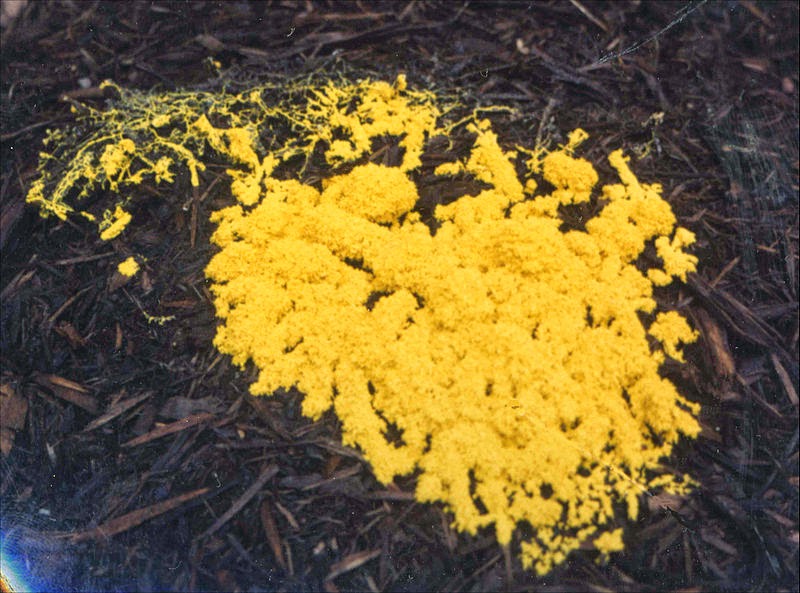
Slime Molds
This is an idea that is very visual, so I've included a bunch of pictures.
D&D has long thrived on the ideas of slimes, molds, oozes and jellies. After listing monsters taken mainly from fantasy fiction, folklore and myth, OD&D finished off with the "clean-up crew," the famous infinitely dividing black pudding, deadly green slime, spore-bearing yellow mold, and the big amoeboid horrors like ochre jelly and gray ooze.
Slime molds are a great template for creating your own variations on the clean-up crew. They're an excellent fit for dungeons because their natural habitat is anywhere that is dark and moist, preferably with excess organic matter (like dung or carrion) for them to grow on. They share a life cycle where a fluid mass consumes what it needs before turning into a fruiting body, which then lets off spores that will start the process again. You usually don't see it until it gets into this later stage. Some of them almost form a slug-like body while moving toward better locations for feeding.
The varieties of these life forms are pretty impressive. They were often confused with fungi, which some of them superficially resemble, but they are not such. Visually the slime molds are often quite colorful; several of the most common such molds are obnoxiously yellow in color, but some are actually iridescent. Their bodies sometimes resemble vomit, or other times are distinct fungoid objects. It can be totally unsuspected, and easily confused for something harmless - or harmful - depending upon the referee's wish.
Slime molds are great because they can have all of the qualities of your classic clean-up crew; poison, acid, paralysis, and other similar nasty effects can all readily result from contact. Depending on the coloration they can be a nasty surprise when PCs step on them. But they have one characteristic that makes them endlessly fascinating: they're not readily killed. Slime molds often come out in moist weather, and go away when it dries up, but there is no real "thing" to kill. Hacking them apart will, at best, get spores on you.
There is something weirdly inhuman, almost Lovecraftian, about the way that slime molds spread ooze-like from place to place and are totally immune to most of the things that PCs would use to destroy monsters. The potential for molds to lay spores that sit dormant, whether in a backpack or article of clothing or similar place, that will grow back and return relentlessly. There are shades of "The Colour Out of Space" if the spores spread and are seen by a farmer who thinks they're nothing more offensive than dog vomit ...
D&D has long thrived on the ideas of slimes, molds, oozes and jellies. After listing monsters taken mainly from fantasy fiction, folklore and myth, OD&D finished off with the "clean-up crew," the famous infinitely dividing black pudding, deadly green slime, spore-bearing yellow mold, and the big amoeboid horrors like ochre jelly and gray ooze.
Slime molds are a great template for creating your own variations on the clean-up crew. They're an excellent fit for dungeons because their natural habitat is anywhere that is dark and moist, preferably with excess organic matter (like dung or carrion) for them to grow on. They share a life cycle where a fluid mass consumes what it needs before turning into a fruiting body, which then lets off spores that will start the process again. You usually don't see it until it gets into this later stage. Some of them almost form a slug-like body while moving toward better locations for feeding.
The varieties of these life forms are pretty impressive. They were often confused with fungi, which some of them superficially resemble, but they are not such. Visually the slime molds are often quite colorful; several of the most common such molds are obnoxiously yellow in color, but some are actually iridescent. Their bodies sometimes resemble vomit, or other times are distinct fungoid objects. It can be totally unsuspected, and easily confused for something harmless - or harmful - depending upon the referee's wish.
Slime molds are great because they can have all of the qualities of your classic clean-up crew; poison, acid, paralysis, and other similar nasty effects can all readily result from contact. Depending on the coloration they can be a nasty surprise when PCs step on them. But they have one characteristic that makes them endlessly fascinating: they're not readily killed. Slime molds often come out in moist weather, and go away when it dries up, but there is no real "thing" to kill. Hacking them apart will, at best, get spores on you.
There is something weirdly inhuman, almost Lovecraftian, about the way that slime molds spread ooze-like from place to place and are totally immune to most of the things that PCs would use to destroy monsters. The potential for molds to lay spores that sit dormant, whether in a backpack or article of clothing or similar place, that will grow back and return relentlessly. There are shades of "The Colour Out of Space" if the spores spread and are seen by a farmer who thinks they're nothing more offensive than dog vomit ...
Monday, July 21, 2014
Ready Reference: Mix-and-Match Humanoids
I've gone back and forth a lot about humanoids in D&D. The cursus honorum of kobolds, goblins, orcs, hobgoblins, gnolls and bugbears is a tired set of clichés. On the other hand, D&D has a lot of resources dedicated to them and they are an archetypal part of the game. Demihuman bonus languages are based on the whole list of humanoids, and default encounter charts pretty much assume them. AD&D makes it even more severe; not having the humanoids basically eliminates the ranger's biggest bonus.
But they are still entirely too predictable. In the interest of alleviating that, here's a table that can give them a bit of variety. Any time there is a need for a low hit dice human-shaped creature in your games, use the table below to create a quick, appropriate humanoid.
The table above might produce odd results if you run too literally with it; you could easily have a 1/2 HD creature 8' tall. This would probably be a thin, wispy type of humanoid. Likewise, a 3' type with 3 HD could be stocky almost to the point of being barrel-shaped.
Of course, older D&D never had monster types without some kind of leaders. Only 3 HD humanoids should be considered truly independent. For the remainder, the following chart should be used.
If the above tables give "bodyguards" more powerful than the leader, this may call for a "Klingon promotion" for one of them.
Because I like you, here's another chart to determine how your new humanoids look.
So there you have it: quick replacements for humanoids that still fit in most OD&D, classic and advanced old-school games.
But they are still entirely too predictable. In the interest of alleviating that, here's a table that can give them a bit of variety. Any time there is a need for a low hit dice human-shaped creature in your games, use the table below to create a quick, appropriate humanoid.
| 1d6 | HD | AC | Move | Morale | Language | Height | Damage | Special |
| 1 | 1/2 | 7 | 60' | 6 | Kobold | 3' | Weapon-1 | Small; hate gnomes |
| 2 | 1-1 | 6 | 60' | 7 | Goblin | 4' 6" | Weapon | -1 to hit in daylight |
| 3 | 1 | 6 | 120' | 8 | Orc | 6' | Weapon | -1 to hit in daylight |
| 4 | 1+1 | 5 | 90' | 8 | Hobgoblin | 6' 6" | Weapon | +1 to hit if chief present |
| 5 | 2 | 5 | 90' | 8 | Gnoll | 7' | Weapon+1 | Wield 2-handed weapons |
| 6 | 3 | 5 | 90' | 9 | Bugbear | 8' | Weapon+1 | Surprise on 1-3 |
The table above might produce odd results if you run too literally with it; you could easily have a 1/2 HD creature 8' tall. This would probably be a thin, wispy type of humanoid. Likewise, a 3' type with 3 HD could be stocky almost to the point of being barrel-shaped.
Of course, older D&D never had monster types without some kind of leaders. Only 3 HD humanoids should be considered truly independent. For the remainder, the following chart should be used.
| 1d4 | Leader | Bodyguards |
| 1 | 9 HP / 2 hit dice | 1-6: 6 HP / 1+1 hit dice |
| 2 | 15 HP / 4 hit dice, +2 to damage | 1/group: 8 HP, +1 to damage |
| 3 | 22 HP / 5 hit dice, +2 to damage | 1-4: 3d6 HP / 4 hit dice |
| 4 | 16 HP / 3 hit dice | N/A |
If the above tables give "bodyguards" more powerful than the leader, this may call for a "Klingon promotion" for one of them.
Because I like you, here's another chart to determine how your new humanoids look.
| 1d6 | Skin | Pattern | Coloration | Head Shape |
| 1 | Smooth skin | Solid (1 color) | Red | Human |
| 2 | Hairy skin | Striped (2 colors) | Orange | Canine |
| 3 | Completely furred | Mottled (2 colors) | Yellow | Feline |
| 4 | Scaled | Different torso (2 colors) | Green | Porcine |
| 5 | Feathered | Multi-hued (3 colors) | Brown | Serpentine |
| 6 | Exoskeleton | Iridescent (2 colors) | Grey | Avian |
So there you have it: quick replacements for humanoids that still fit in most OD&D, classic and advanced old-school games.
Friday, June 27, 2014
Weird and Remote Tribes
Ancient historians and chroniclers were fascinated by stories about weird tribes. The two world-spanning histories that come down to us from antiquity, Herodotus's Histories and Pliny the Elder's Natural History, are replete with tales of bizarre tribes that were similar to humanity but not quite the same. These are all great material for weird and somewhat savage characters in roleplaying games. I've included some images of these types from the Nuremburg Chronicle.
I've written before about the dog-headed cynocephali but they are hardly the only ancient tribe that was generally like humanity, but with a small twist or two. The Arimaspoi pictured to the left, for instance, are human-sized but have only one eye; one has to imagine that their skill with missiles is not significant. In Herodotus, they were the enemies of gold-hoarding gryphons, and lived outside of the idyllic Hypberborea. They make a great substitute for cavemen or similar tribes in mountains or caves.
Blemmyes are a tad bit harder to understand. We know they didn't have heads — Herodotus called them akephaloi and located their eyes in their chests, while Pliny said they were in the shoulders. Our artist, following Pliny, gave them a nose and mouth in their chests, which may seem awkward but does make sense; the nose is closer to the lungs, and the mouth to the stomach, than in a human.
What is strange is whether or not the headless men are supposed to be intelligent; the name may literally mean "brainless," implying a frightful savage type.
The Chronicler also drew a great picture of the sciapods — literally meaning "shadow foot," a mythic type described by the great comic playwright Aristophanes and our Pliny. They had a single gigantic foot that they would use to shade themselves. They leap surprisingly well for all that. Not much else is known of them, but there are reports of their existence from India and Ethiopia throughout the whole of history when traveler's tales and rumor were the only hints anyone had of the world beyond a very narrow boundary.
Then there are the diminutive pygmies, who were skilled with slings, rode on goats, and were engaged in continuous warfare with cranes. Yes, the birds. The cranes were supposed to have stones in their gullets that could be used to test for gold, a tremendously useful sort of thing. And I just have to love the Chronicle's picture of a well-dressed pygmy fighting birds with a big club and a proper buckler shield, a true study in contrasts. If you don't like Tolkienesque hobbits, a semi-savage race of bird-fighters might be a good substitute.
Each of these tribes, and several other types (troglodytae who went from cave-dwelling humans to inhuman monsters, myrmidons who were supposed to have sprung from ants, amazons and others) were always off in the furthest known stretches of land - north of the barbarian tribes you knew in Europe, south of Ethiopia or east of India. They are probably based on innuendo, rumor and ignorance, and grew in the imaginations of travelers.
I like these tribes because they can fill a lot of different roles in a game, much like humans, but give it a feel that is a bit more fantastical than your vanilla people. The Nuremberg Chronicle's art hints at the critical ambiguity where you just aren't sure which side a people stands on. The cynocephali and arimaspoi are wearing robes that might imply civilization, while the naked hair-covered woman (a member of the tribe known as the gorgades) or the blemmyes speak of savagery through and through. You just don't get that with the cursus honorum of humanoids; goblins and orcs are for killing, and not much more.
Once expectations have been upset, of course, the door is also open for NPC members of these tribes to advance in various classes and levels. A one-eyed sorcerer or a fierce headless warrior can be a fascinating foe or ally — obviously depending on circumstances and alignment. Some can also have various types of shamans, witch-doctors and the like, as tribal types are inclined to.
You can see all of the Nuremburg Chronicle's odd people at Wikimedia Commons, and there is a terrific resource for Greco-Roman mythological tribes over at the Theoi Greek Mythology site. And drop me a line if you use these types in your game.
I've written before about the dog-headed cynocephali but they are hardly the only ancient tribe that was generally like humanity, but with a small twist or two. The Arimaspoi pictured to the left, for instance, are human-sized but have only one eye; one has to imagine that their skill with missiles is not significant. In Herodotus, they were the enemies of gold-hoarding gryphons, and lived outside of the idyllic Hypberborea. They make a great substitute for cavemen or similar tribes in mountains or caves.
Blemmyes are a tad bit harder to understand. We know they didn't have heads — Herodotus called them akephaloi and located their eyes in their chests, while Pliny said they were in the shoulders. Our artist, following Pliny, gave them a nose and mouth in their chests, which may seem awkward but does make sense; the nose is closer to the lungs, and the mouth to the stomach, than in a human.
What is strange is whether or not the headless men are supposed to be intelligent; the name may literally mean "brainless," implying a frightful savage type.
The Chronicler also drew a great picture of the sciapods — literally meaning "shadow foot," a mythic type described by the great comic playwright Aristophanes and our Pliny. They had a single gigantic foot that they would use to shade themselves. They leap surprisingly well for all that. Not much else is known of them, but there are reports of their existence from India and Ethiopia throughout the whole of history when traveler's tales and rumor were the only hints anyone had of the world beyond a very narrow boundary.
Then there are the diminutive pygmies, who were skilled with slings, rode on goats, and were engaged in continuous warfare with cranes. Yes, the birds. The cranes were supposed to have stones in their gullets that could be used to test for gold, a tremendously useful sort of thing. And I just have to love the Chronicle's picture of a well-dressed pygmy fighting birds with a big club and a proper buckler shield, a true study in contrasts. If you don't like Tolkienesque hobbits, a semi-savage race of bird-fighters might be a good substitute.
Each of these tribes, and several other types (troglodytae who went from cave-dwelling humans to inhuman monsters, myrmidons who were supposed to have sprung from ants, amazons and others) were always off in the furthest known stretches of land - north of the barbarian tribes you knew in Europe, south of Ethiopia or east of India. They are probably based on innuendo, rumor and ignorance, and grew in the imaginations of travelers.
I like these tribes because they can fill a lot of different roles in a game, much like humans, but give it a feel that is a bit more fantastical than your vanilla people. The Nuremberg Chronicle's art hints at the critical ambiguity where you just aren't sure which side a people stands on. The cynocephali and arimaspoi are wearing robes that might imply civilization, while the naked hair-covered woman (a member of the tribe known as the gorgades) or the blemmyes speak of savagery through and through. You just don't get that with the cursus honorum of humanoids; goblins and orcs are for killing, and not much more.
Once expectations have been upset, of course, the door is also open for NPC members of these tribes to advance in various classes and levels. A one-eyed sorcerer or a fierce headless warrior can be a fascinating foe or ally — obviously depending on circumstances and alignment. Some can also have various types of shamans, witch-doctors and the like, as tribal types are inclined to.
You can see all of the Nuremburg Chronicle's odd people at Wikimedia Commons, and there is a terrific resource for Greco-Roman mythological tribes over at the Theoi Greek Mythology site. And drop me a line if you use these types in your game.
Tuesday, June 24, 2014
Unique Monsters: A Challenge to the Imagination
This is a long response to Erik Tenkar's recent question about unique monsters.
Gary Gygax had a letter in the second issue of Alarums & Excursions. There is a version of it online at the Acaeum forums. I definitely have to recommend reading the whole thing, but I just want to put an extract on monsters that I think is very relevant.
My experience has been that unique enemies work best as contrast. This also corresponds to the "weirdness level" of the individual monsters: something that's familiar-ish but odd can then alternate with something really out-there. For instance, various types of beast-men are good substitutes for humanoids if you're bored of orcs, goblins and bandits. If you have a group of goat-men, then they provide a decent backdrop against which something full-bore odd, like a chimeric creature from Geoffrey McKinney's work, can stand out.
Lacking this element of contrast, monsters tend to become more or less similar. If everything is equally weird, nothing is really weird. Lamentations of the Flame Princess has an interesting solution to this dilemma: remove everything except for one big monster (which is really strange and unique), and make everything else humans or animals. But the "monster of the week" is a hyper-focused format, and doesn't fit if you want to do a megadungeon or hexcrawl full of interesting and diverse factions.
An alternate solution that I've been playing with works more or less like this:
I'll have more tweaking on this method as I get to see more of its results in practice, but I'm liking the results so far.
Gary Gygax had a letter in the second issue of Alarums & Excursions. There is a version of it online at the Acaeum forums. I definitely have to recommend reading the whole thing, but I just want to put an extract on monsters that I think is very relevant.
Dave and I disagree on how to handle any number of things, and both of our campaigns differ from the "rules" found in D&D. If the time ever comes when all aspects of fantasy are covered and the vast majority of its players agree on how the game should be played, D&D will have become staid and boring indeed. Sorry, but I don't believe that there is anything desirable in having various campaigns playing similarly to one another. D&D is supposed to offer a challenge to the imagination and to do so in many ways. Perhaps the most important is in regard to what the probabilities of a given situation are. If players know what all of the monster parameters are, what can be expected in a given situation, exactly what will happen to them if they perform thus and so, most of the charm of the game is gone. Frankly, the reason I enjoy playing in Dave Arneson's campaign is that I do not know his treatments of monsters and suchlike, so I must keep thinking and reasoning in order to "survive".I have long had mixed feelings about this. I love monsters. You can't long have read this blog without noticing that. And I love bestiaries — whether it's the extremely "light" format of the Swords & Wizardry Monster Book, or the thoroughness of the AD&D 2nd Edition Monstrous Compendium and its many appendices and annuals. I could go to my shelves and populate a very large dungeon without repetition of a single monster.
My experience has been that unique enemies work best as contrast. This also corresponds to the "weirdness level" of the individual monsters: something that's familiar-ish but odd can then alternate with something really out-there. For instance, various types of beast-men are good substitutes for humanoids if you're bored of orcs, goblins and bandits. If you have a group of goat-men, then they provide a decent backdrop against which something full-bore odd, like a chimeric creature from Geoffrey McKinney's work, can stand out.
Lacking this element of contrast, monsters tend to become more or less similar. If everything is equally weird, nothing is really weird. Lamentations of the Flame Princess has an interesting solution to this dilemma: remove everything except for one big monster (which is really strange and unique), and make everything else humans or animals. But the "monster of the week" is a hyper-focused format, and doesn't fit if you want to do a megadungeon or hexcrawl full of interesting and diverse factions.
An alternate solution that I've been playing with works more or less like this:
- Strip back the bog standard monsters to the very basics: humans and animals (including, at most, some varieties of giant animal).
- Create new creatures similar to the default monsters for the intended level. Change appearances and special abilities, but keep HD / AC ranges similar.
- Make a few "big impact" monsters that are totally unique.
- Give the players ways to find out about the impact monsters' characteristics and abilities.
I'll have more tweaking on this method as I get to see more of its results in practice, but I'm liking the results so far.
Labels:
Alarums and Excursions,
Gygax,
monsters,
philosophy
Friday, June 13, 2014
Thinking about Dungeon Factions
I'm quietly doing some work on a megadungeon and one of my main concerns as I design it is the factions. While I'm not yet at the point where I want to tell you exactly what the factions are, I do want to go through some ideas on broad types of factions that will exist.
The factions in B2 Keep on the Borderlands are primarily classifiable as tribes: kinship groups of humanoids organized around a single leader. The tribe is a basic, fundamental unit and can be used to describe basically any monocultural society with a strong leader, whether it's hobgoblins, berserkers, cavemen or hill giants. Typically they are not humans of the prevailing civilization. These are a solid form of organization and work well, although they shouldn't be the only type of faction.
A second type of common faction is the voluntary group. A cult, a group of bandits, or rival party, often made up of human or demihuman characters. There are two interesting factors about voluntary groups. One is that the characters in it will frequently speak Common, and therefore be able to negotiate, bargain and discuss with PCs. The other is that membership is an open question. You can do fun things like having a henchman or PC get Charmed by the evil cult and used to betray the PCs' cause. It's also possible to ally with or even join the voluntary group.
Related to voluntary groups are alliances. These are not as formal, and may actually be partly made up of a tribe or voluntary group – for instance, a tribe of goblins may have "pet" giant rats, or be enslaved by an ogre. These are not generally groups that are being recruited, and may form on more tentative lines than other factions. Player intrigue might be able to turn an alliance into two or three separate factions, while others may form in the face of PCs raiding the dungeon.
The specific form of the faction might also differ. These are a few ideas for how leadership is decided, each of which I'm sure has some variants.
Frequently leaders are assumed to be despots, absolute leaders who rule through violence or fear of violence. That can be plenty of fun, particularly if the faction uses "Klingon promotion" where a new leader rises by killing the previous one. There are several potential player hooks there – particularly if, in the style of A Princess of Mars, PCs actually find themselves as leaders within the faction.
But there are other methods. Maybe bandits will use a pirate democracy, where a leader is elected, and can be recalled (violently) if needed. Or there may be a cult of personality; I'm interested in the idea of having a charismatic leader in a dungeon who leads a sort of motley coalition by sheer charisma. Others might be a protection relationship, where a powerful creature or NPC leads weaker followers because it offers physical or magical defense. Some enemies will undoubtedly use slaves, which present a bit of moral dilemma.
As my own dungeon keeps growing, I'm going to develop several of these types of factions. A dungeon with sufficient factions, IMO, is rife for more roleplaying than even many city-based adventures. And it reinforces that my favorite type of roleplaying is the kind with the threat of violence behind it.
The factions in B2 Keep on the Borderlands are primarily classifiable as tribes: kinship groups of humanoids organized around a single leader. The tribe is a basic, fundamental unit and can be used to describe basically any monocultural society with a strong leader, whether it's hobgoblins, berserkers, cavemen or hill giants. Typically they are not humans of the prevailing civilization. These are a solid form of organization and work well, although they shouldn't be the only type of faction.
A second type of common faction is the voluntary group. A cult, a group of bandits, or rival party, often made up of human or demihuman characters. There are two interesting factors about voluntary groups. One is that the characters in it will frequently speak Common, and therefore be able to negotiate, bargain and discuss with PCs. The other is that membership is an open question. You can do fun things like having a henchman or PC get Charmed by the evil cult and used to betray the PCs' cause. It's also possible to ally with or even join the voluntary group.
Related to voluntary groups are alliances. These are not as formal, and may actually be partly made up of a tribe or voluntary group – for instance, a tribe of goblins may have "pet" giant rats, or be enslaved by an ogre. These are not generally groups that are being recruited, and may form on more tentative lines than other factions. Player intrigue might be able to turn an alliance into two or three separate factions, while others may form in the face of PCs raiding the dungeon.
The specific form of the faction might also differ. These are a few ideas for how leadership is decided, each of which I'm sure has some variants.
Frequently leaders are assumed to be despots, absolute leaders who rule through violence or fear of violence. That can be plenty of fun, particularly if the faction uses "Klingon promotion" where a new leader rises by killing the previous one. There are several potential player hooks there – particularly if, in the style of A Princess of Mars, PCs actually find themselves as leaders within the faction.
But there are other methods. Maybe bandits will use a pirate democracy, where a leader is elected, and can be recalled (violently) if needed. Or there may be a cult of personality; I'm interested in the idea of having a charismatic leader in a dungeon who leads a sort of motley coalition by sheer charisma. Others might be a protection relationship, where a powerful creature or NPC leads weaker followers because it offers physical or magical defense. Some enemies will undoubtedly use slaves, which present a bit of moral dilemma.
As my own dungeon keeps growing, I'm going to develop several of these types of factions. A dungeon with sufficient factions, IMO, is rife for more roleplaying than even many city-based adventures. And it reinforces that my favorite type of roleplaying is the kind with the threat of violence behind it.
Sunday, May 18, 2014
Lured Into Service
Monsters can be lured into service if they are of the same basic alignment as the player-character, or they can be Charmed and thus ordered to serve. Note, however, that the term "monster" includes men found in the dungeons, so in this way some high-level characters can be brought into a character's service, charisma allowing or through a Charm spell.This is something that I know Mike Mornard has talked about several times with relation to Gygax's Greyhawk campaigns: the dungeon should be fertile ground for retainers.
Recruitment from adversaries is something I think has gotten neglected in OSR materials, and in later editions of D&D. The text above comes shortly before the reaction table, which in itself I think should be used more frequently. In my experience, roleplaying in the dungeon or wilderness has an interest element to it that you just can't get in a city, where the negotiation could lead to violence at any moment.
The point about the "same basic alignment" is much more interesting in OD&D than in classic or advanced D&D. Lycanthropes can be neutral, as can orcs, ogres, dragons, wyverns, centaurs, hydrae, purple worms, sea monsters, chimerae, minotaurs and giants. Among the types of men, Bandits and Buccaneers can be chaotic or neutral (50/50 chance); Berserkers, Cavemen and Mermen are all neutral; and Dervishes are lawful. This makes neutrality really interesting as a choice, because a lot of monsters might turn out not to be Chaotic after all and can be lured into service.
Flexibility of alignment is an important idea for this. If orcs are always chaotic, then an encounter with them has fewer possibilities, because a neutral PC can't lure one into service. The same is true of bandits: the 50/50 chance of them being neutral should guide the referee in how they are played. When creating new monsters, I think such questions should be considered in some instances. After all, goblins and trolls only appear in the chaotic column of OD&D, and won't be attracted by offers from neutrals. But even if you aren't using the "vanilla" monster list, your encounters wind up richer if it's possible to recruit some of them (or if PCs even seek out neutral monsters to hire).
It's also worth realizing exactly how powerful the OD&D version of Charm Person is, because it's easy to forget if you're not reading the booklets: "If the spell is successful it will cause the charmed entity to come completely under the influence of the Magic-User until such time as the "charm" is dispelled (Dispell Magic)." Supplement I: Greyhawk introduces limits on Charm that make it substantially less permanent (the system of multiple saving throws that makes it into classic and advanced). But in OD&D it's an instant henchman, if you want it - a failed saving throw is all you need.
Such henchmen give great potential reactions for subsequent encounters. Elves encountered in a dungeon may see a human with an orc and minotaur in tow and make the assumption that they're monsters to be defeated at every cost, and the human is either in league with them or a hostage. On the opposite side, an ogre guard could be the PCs' key to getting into a fantastic environment like the troll market in Hellboy II. A given monster could take the PC as a threat, or as a "monster" human allied with monsters.
Of course, turnabout is fair play; if the PCs can try to lure monsters into service, then monsters should also be able to do the same for them. Flexible alignment makes a great way to do a theme dungeon: monsters that are neutral or chaotic are the ones that are likely to try and hire PCs, while chaotics will tend to stay away from them, being on different "sides." And there's a tremendous amount of roleplaying to be done with regard to how far the PC(s) and the monsters trust each other.
In the civilized world, this will definitely have various implications. One scenario is the, "Damn it, Theseus, you were supposed to kill the minotaur, not help it escape!" variety where the monsters are treated as such and the PCs considered evil or reckless for accompanying them. And there are all kinds of possible responses, from betrayal of the monster hirelings to various shenanigans to help them pass. But the opposite choice has a lot of possibility for world-building.
OD&D does seem to indicate a world where monstrous creatures are sometimes in the employ of non-chaotic humans. It's also got a very Judges Guild vibe if you think of a village where you might go in and see an ogre – who in fact hauls very heavy things and smashes goblins at the behest of the townsfolk. It's not going to fit everyone's vision of fantasy, but I'd argue that this sort of thing is more essential to OD&D than people today realize.
There are a lot of ways to run with this one, and I think it shows a certain myopia of fantasy that this concept died out over time. It's worth thinking about what it can do for your games.
Labels:
alignment,
hirelings,
monsters,
non-player charactes
Thursday, May 15, 2014
Clark Ashton Smith and Unbalanced Encounters
If you haven't yet, you should definitely pick up The Dark Eidolon and Other Stories, a new anthology of Clark Ashton Smith's short stories, prose poems and poetry. It's edited by S.T. Joshi, a Lovecraft scholar who has managed to convince Penguin to put out all kinds of weird fiction lately. Joshi's Amazon page is like a wish-list of weird fantasy tales.
The first story in The Dark Eidolon is "The Tale of Satampra Zeiros", a short romp in the Hyperborean cycle where two disreputable types go to the ruins of Commoriom in search of treasure. It seems pretty undeniable to me that this is the kind of story that D&D is made of, even if CAS didn't make Appendix N.
Anyway, if you haven't, you should read the Satampra story. Mostly because it's a damn good yarn, but also because it's essential to my point here.
The thing in the basin is a great example of how an encounter should be able to go in a D&D game. PCs need to be able to run like hell, which seems to be missing from a lot of players' mindsets and editions of D&D. If you're going to have bona fide monsters in the game, it stands to reason that they should be able to have the kind of response that the thing coming out of the basin has on Satampra Zeiros and Tirouv Ompallios.
It's a terribly unbalanced encounter, but clever player characters could have handled it otherwise. Not being drunk would be a start, as would a better plan of retreat. Some kind of alternative plan for the creature – fire, oil, throwing food or a corpse at it, pretty much any desperate move, or retreat and research as to its capabilities – could prevent a TPK, but if they stood and fought they'd both be dead.
To me, that's why save-or-die mechanics are a good thing in old school RPGs. Without them, you can't create that sense of visceral terror that we see in Satampra's tale. A careful referee could manage, although not with CAS's unique style, to create something quite parallel in the players as they face an unknown horror.
Of course, not every encounter should be like this one. CAS is unforgivably stingy with the treasure, for one thing. And there should be a time when it's appropriate to the PCs to stand and fight. But combat should generally be at the PCs' choosing, not in carefully arranged set-pieces. You fight when you think you can win, and you shouldn't always think that.
For me, it's very important that the dungeon is dangerous. If it weren't, someone would have already looted it and there'd be nothing left for the PCs to get. Encounters like the one faced by Satampra Zeiros and Tirouv Ompallios are one of the ways to make sure of that.
The first story in The Dark Eidolon is "The Tale of Satampra Zeiros", a short romp in the Hyperborean cycle where two disreputable types go to the ruins of Commoriom in search of treasure. It seems pretty undeniable to me that this is the kind of story that D&D is made of, even if CAS didn't make Appendix N.
Anyway, if you haven't, you should read the Satampra story. Mostly because it's a damn good yarn, but also because it's essential to my point here.
The thing in the basin is a great example of how an encounter should be able to go in a D&D game. PCs need to be able to run like hell, which seems to be missing from a lot of players' mindsets and editions of D&D. If you're going to have bona fide monsters in the game, it stands to reason that they should be able to have the kind of response that the thing coming out of the basin has on Satampra Zeiros and Tirouv Ompallios.
It's a terribly unbalanced encounter, but clever player characters could have handled it otherwise. Not being drunk would be a start, as would a better plan of retreat. Some kind of alternative plan for the creature – fire, oil, throwing food or a corpse at it, pretty much any desperate move, or retreat and research as to its capabilities – could prevent a TPK, but if they stood and fought they'd both be dead.
To me, that's why save-or-die mechanics are a good thing in old school RPGs. Without them, you can't create that sense of visceral terror that we see in Satampra's tale. A careful referee could manage, although not with CAS's unique style, to create something quite parallel in the players as they face an unknown horror.
Of course, not every encounter should be like this one. CAS is unforgivably stingy with the treasure, for one thing. And there should be a time when it's appropriate to the PCs to stand and fight. But combat should generally be at the PCs' choosing, not in carefully arranged set-pieces. You fight when you think you can win, and you shouldn't always think that.
For me, it's very important that the dungeon is dangerous. If it weren't, someone would have already looted it and there'd be nothing left for the PCs to get. Encounters like the one faced by Satampra Zeiros and Tirouv Ompallios are one of the ways to make sure of that.
Tuesday, May 13, 2014
Robots, Golems, Androids
1974 was an interesting year for OD&D to come out. It sat at a critical point in the development of fantasy as a genre that we easily take for granted. The sword & sorcery genre that had sustained Gary Gygax through his youth was in its resurgence, while Tolkien was moving into dominance via the unlikely route of the counterculture and the Ballantine Adult Fantasy line was cycling older material back into the genre. Fantasy literature as we now know it was not yet a coherent genre with standard assumptions.
The idea that D&D is a game primarily about "fantasy" in the post-Tolkien sense has always had a touch of historical revisionism to it. It has Tolkien elements, but these are strewn about with ideas straight from myth, others from the sword & sorcery lineage, and fresh inventions alike. Much of what has gone on in the OSR is about cutting out the more Tolkienesque elements (or distancing them from Tolkien) and playing up either the sword & sorcery or the weird elements, or both. This is sometimes done under the cover of "Appendix N," but it really has little to do with Gygax's list of favorite novels, which contain heaps of science fiction anyway.
In Monsters & Treasure, plenty of science fiction and science fantasy creatures appear: Martian creatures are suggested, as are giant insects, dinosaurs and others. But the really interesting find is under "Other Monsters," which contains a listing for "Robots, Golems, Androids" that reads: "Self-explanatory monsters which are totally subjective as far as characteristics are concerned."
Golems later became codified as enchanted beings, growing greatly removed from the creature of Jewish folklore into any wizard-made construct. But robots and androids were swept under the rug along with the Martian creatures after the original boxed set. Indeed, unlike several other categories of additional monsters, they never even make it to The Underworld & Wilderness Adventures. But they have fascinating implications for referees who want to add science fantasy elements to their settings.
Again, keep in mind that it was 1974 when OD&D was released. The robots that most people were thinking of probably looked like Robby the Robot from Forbidden Planet:
So if robots were self-explanatory, they probably looked in the imagination more like Robby or the robot from Lost in Space than our more contemporary references for robots. Androids were, ironically, probably cheaper to film but only catching on around the time of OD&D. Of course, our imaginations hardly have to be limited by what someone in 1974 would've seen as a robot; I simply think that it would be awesome to put something that looks like Robby the Robot in a D&D dungeon.
In an otherwise pseudo-medieval world, why exactly are there robots and androids in the depths of dungeons or lurking in the wilderness?
There's always room for ancient astronauts, or even more recent ones. It's also possible that the D&D world is actually long after an apocalypse in a highly technical civilization; after all, Planet of the Apes was current and had pulled off just such a trick. (This is also suggested by Appendix N, where post-apocalypse books like Hiero's Journey and Sign of the Labrys were recommended, but that was 5 years after OD&D.) There's planar travel, and if all else fails, there's the old excuse that "a wizard did it."
Robots can take any shape we like. Clockwork beings might be a closer aesthetic fit to much of what people like in their D&D; I think the visual design of the Golden Army from the second Hellboy film has a lot to recommend in this genre. But really there's no limit; robots don't even have to be anthropoid. It could be like the Terminator, or like an industrial robot arm from a modern factory, or small robots like the mouse droid in Star Wars.
One consideration a referee should give to robots is whether they are adapting their environs to their high-tech nature, or vice versa. Maybe a robot has made an area of a dungeon into a high-tech laboratory, replete with inventions and attempts to replicate its own technology level. Or it could have adapted to the low-tech but magical world it finds itself in, for instance with plate mail bolted onto its chassis or embedded a magical gem into its circuitry.
The possibilities really are endless, all from two lines in OD&D. That's some kind of magic.
The idea that D&D is a game primarily about "fantasy" in the post-Tolkien sense has always had a touch of historical revisionism to it. It has Tolkien elements, but these are strewn about with ideas straight from myth, others from the sword & sorcery lineage, and fresh inventions alike. Much of what has gone on in the OSR is about cutting out the more Tolkienesque elements (or distancing them from Tolkien) and playing up either the sword & sorcery or the weird elements, or both. This is sometimes done under the cover of "Appendix N," but it really has little to do with Gygax's list of favorite novels, which contain heaps of science fiction anyway.
In Monsters & Treasure, plenty of science fiction and science fantasy creatures appear: Martian creatures are suggested, as are giant insects, dinosaurs and others. But the really interesting find is under "Other Monsters," which contains a listing for "Robots, Golems, Androids" that reads: "Self-explanatory monsters which are totally subjective as far as characteristics are concerned."
Golems later became codified as enchanted beings, growing greatly removed from the creature of Jewish folklore into any wizard-made construct. But robots and androids were swept under the rug along with the Martian creatures after the original boxed set. Indeed, unlike several other categories of additional monsters, they never even make it to The Underworld & Wilderness Adventures. But they have fascinating implications for referees who want to add science fantasy elements to their settings.
Again, keep in mind that it was 1974 when OD&D was released. The robots that most people were thinking of probably looked like Robby the Robot from Forbidden Planet:
So if robots were self-explanatory, they probably looked in the imagination more like Robby or the robot from Lost in Space than our more contemporary references for robots. Androids were, ironically, probably cheaper to film but only catching on around the time of OD&D. Of course, our imaginations hardly have to be limited by what someone in 1974 would've seen as a robot; I simply think that it would be awesome to put something that looks like Robby the Robot in a D&D dungeon.
In an otherwise pseudo-medieval world, why exactly are there robots and androids in the depths of dungeons or lurking in the wilderness?
There's always room for ancient astronauts, or even more recent ones. It's also possible that the D&D world is actually long after an apocalypse in a highly technical civilization; after all, Planet of the Apes was current and had pulled off just such a trick. (This is also suggested by Appendix N, where post-apocalypse books like Hiero's Journey and Sign of the Labrys were recommended, but that was 5 years after OD&D.) There's planar travel, and if all else fails, there's the old excuse that "a wizard did it."
Robots can take any shape we like. Clockwork beings might be a closer aesthetic fit to much of what people like in their D&D; I think the visual design of the Golden Army from the second Hellboy film has a lot to recommend in this genre. But really there's no limit; robots don't even have to be anthropoid. It could be like the Terminator, or like an industrial robot arm from a modern factory, or small robots like the mouse droid in Star Wars.
One consideration a referee should give to robots is whether they are adapting their environs to their high-tech nature, or vice versa. Maybe a robot has made an area of a dungeon into a high-tech laboratory, replete with inventions and attempts to replicate its own technology level. Or it could have adapted to the low-tech but magical world it finds itself in, for instance with plate mail bolted onto its chassis or embedded a magical gem into its circuitry.
The possibilities really are endless, all from two lines in OD&D. That's some kind of magic.
Subscribe to:
Posts (Atom)


.jpg)
.jpg)
.jpg)
.jpg)