Showing posts with label higher planes. Show all posts

Thursday, July 23, 2015

The Mountains of Yuggoth

"It came to the earth from lead-grey Yuggoth, where the cities are under the warm deep sea."
- H.P. Lovecraft, "The Horror in the Museum"


"The sun shines there no brighter than a star, but the beings need no light. They have other, subtler senses, and put no windows in their great houses and temples."
- H.P. Lovecraft, "The Whisperer in Darkness"


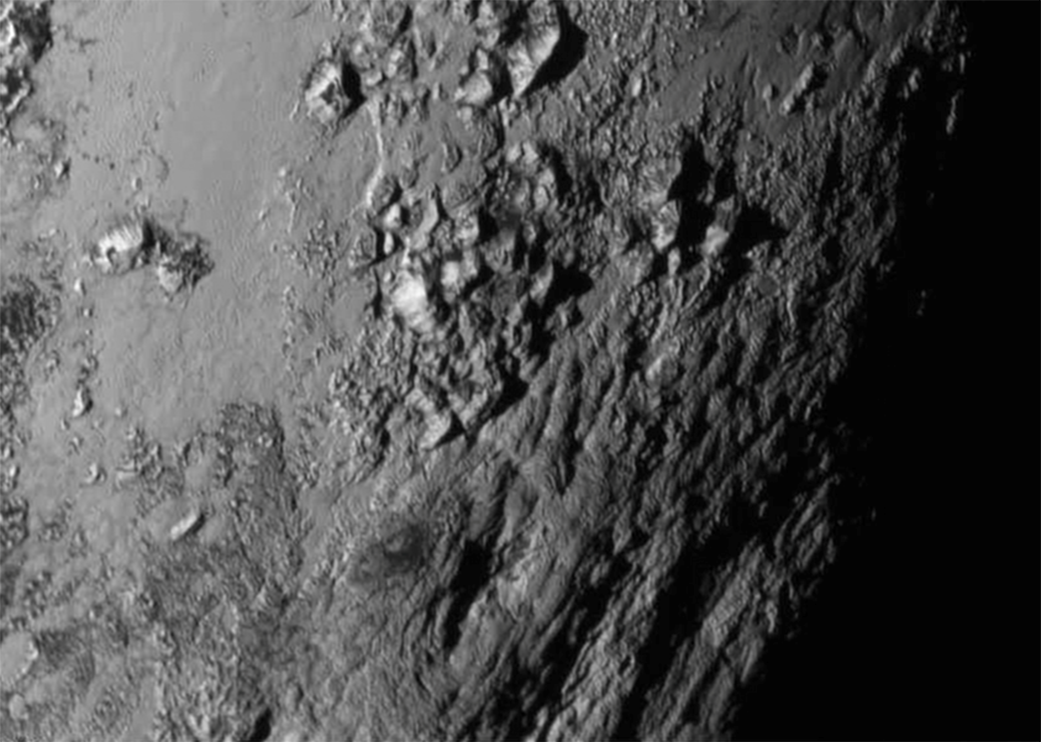
It's not often that science gives us a glimpse of a world no human has ever seen before. Look at the grey landscape and the black seas, and the icy mountains of Pluto, and tell me with a straight face that it's not a game setting. What lurks in those craggy mountains? Do windowless cyclopean towers lie beneath the forbidding black seas? What could live on this cold dark world that Lovecraft dubbed Yuggoth?

NASA photographs are not subject to copyright. All images from the New Horizons mission are available here. Photographs are used for entertainment purposes only and should not be construed as an endorsement of this site or its contents by NASA.

Friday, August 30, 2013

Clerics as Demon Hunters

There's a thread of thought among the OSR that looks at clerics primarily as undead hunters. For instance, this picture of the original cleric from Grognardia was of Peter Cushing as Abraham Van Helsing, the intrepid vampire hunter of Bram Stoker's Dracula. Generally I like this, because it makes much more sense as an adventuring class to have a "monster hunter" type. It's also cool to have a class with the ability to directly avoid combat, if like me you think of D&D as more of an exploration game and less of a series of carefully planned out fights.

Another thread of clerics that I really like is the Knights Templar. I wrote a bit about this in the OD&D setting series ("Clerical Strongholds") and it's a vibe I have always really wanted to play off of more. But clerics usually get bogged down in whatever fantasy excuse you have for a religion, and at level 2 (level 1 in AD&D) become the healer more than the knight.

What I'm thinking of is shifting the focus of the cleric a bit. Undead are okay, but I really like the idea of clerics as hunting demons and other "invading" extraplanar horrors. This is explored lightly in some editions, but I am thinking that it would be a more interesting main focus in a game where monsters are more fundamentally weird: from first level, clerics are able to repel or command (Lawful or Chaotic) entities from other worlds, whether they be certain types of oozes and slimes or at the top levels things like balrogs or some of the Lovecraftian horrors. (For more on this check out my series on higher planes.)

One thing I feel should flow pretty naturally from this type of cleric is that such types should be on the fringes of religion. Once you start looking at the history of religious orders in the real world, they're not always perfectly in line with the religious hierarchy. The Templars themselves were accused of being heretics at points in their history. When you have characters who look into monsters and how to fight them, there is always the chance that they will become monstrous themselves.

An archetypal cleric, then, is on the fringe of his organized religion, always a step or two away from excommunication. Not all among the clergy feel that his powers are miraculous; some suspect arcane trickery, and others even worse - that they are derived from the monsters the cleric spends too much time investigating. Commoners alternately love them as protectors and fear them as virtual heretics - sometimes both at once.

I think riding the "Templar" angle even a bit further lets us see clerics as intensely mysterious. They have a cultivated mystique and are occasionally involved in doings which they would rather not speak about. This could produce some interesting tension if the cleric's order occasionally has them go off and deliver mysterious parcels or deliver messages to powerful individuals. The idea of this "order" is backed up in the OD&D rules, which specify that clerics receive help from "above" - unless it is raining gold pieces from heaven, this could mean that the cleric is explicitly helped by their order.

To bring this back around and tie it together - this is intimately tied up with the law versus chaos conflict. Demons are intensely Chaotic, and templar-style clerics are Lawful to a fault. The presence of clerics in the world is a symbol of the dangers that threaten it, and they are the hunters of that dark night that now haunts the land. I think making some types of "lesser" demons with variable powers is an interesting way to integrate this into the cleric's life from the word go. One way to start is with the spectre, which is explicitly the nazgûl from Chainmail, and extrapolate the lesser demons downward as variant undead. It'd certainly be more interesting than the umpteenth time you've seen skeletons.

Monday, June 24, 2013

Ancient Astronauts and Science Fantasy

One of the phenomena of the pseudoscience industry (and I use that term purposefully) over the last few decades is the theory of "ancient astronauts." First spread by Erich von Däniken and used for commercial purposes by people like Giorgio Tsoukalos (the subject of the famous meme picture to the left), these use incredulity about the abilities of ancient civilizations and the building power of thousands of slaves to hypothesize that ancient wonders were not built by man but by extraterrestrial visitors.

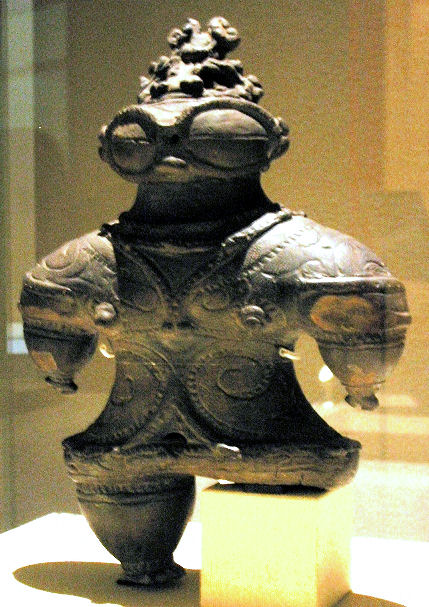
But just because something is simply bunkum doesn't mean it isn't useful gaming material. Some critics have pointed out after all that "ancient astronauts" seem to have a basis in H.P. Lovecraft more than in any scientific observation. But if we take them at face value, they do give us some potential fodder. For instance, this Dogū statue from ancient (prehistoric) Japan has features that would be really interesting either on a space suit or on a monster straight-up:


After all, with the goggle eyes, the weird armor, the cone helmet - that's gotta be something interesting to wear or to fight. Much of the ancient alien fodder is visually interesting. Can you really not think of adventure seeds with this guy?


So there are several ways you could use the ancient astronauts.
  1. They are actual aliens, with straight-up science fantasy gadgets: ray guns, various detectors, deflector shields, anti-gravity devices, you name it. This take can be done either with the aliens as current visitors (and therefore "monsters" / encounters), or they can be long-gone, with their technology - up to and including spaceships - lost in ancient and forbidding tombs. Either way is fodder for adventure. This also works if outer planes are outer planets, as I've discussed at some length.
  2. Instead of standard science fantasy aliens, they are akin to the creatures of H.P. Lovecraft. This works particularly well if you want to play up the horror aspect of the game; heck, you could practically use a lot of At the Mountains of Madness as a campaign guide. I also think "ancient aliens" as a surface cover-up would be a great way to do a dramatic reveal of some Lovecraftian horror in a lot of RPGs.
  3. The entities are actually gods or demons, if you want to go a pure-fantasy route. There's no reason that Dogū figurine can't be an extraplanar entity.
Ancient tombs and pyramids are the obvious places to put these creatures; any dungeon that sits under or relates to a megalithic structure would really do. One thing I like is that it allows you to inject antiquity into the game (the ruins themselves are 2 or 3 civilizations old) - and it can be done side-by-side with death rays and force shields, without any incongruity.

Fantasy literature and RPGs both have involved histories with bunk ideas. Theosophy in particular I think had a big influence on fantasy, including on Lovecraft and again on the outer planes - we wouldn't have our astral and ethereal if people hadn't actually believed in them. In an age where there is bunk abound, it seems a shame not to turn some of it to good use.

Monday, February 18, 2013

Going to Hell


I realize I've hinted for a while at a post about Hell and I apologize for not having it up sooner, but life has gotten in the way as it so oft does; I needed the creative juice to be going into my game for last Friday and not the Hell post, so that took priority. On the plus side, it's time now, so here goes.

The grand works of western literature tell us relatively little about heaven, a prosaic realm filled with fluffy white clouds and angels with harps and beasts with six wings and eyes front and back ... Okay, the biblical heaven's a bit more interesting than the stereotypical presentation gives it. But it is fairly one-note since the weird beasts are constantly singing the Sanctus. Forever. But it's not heaven that gets the love, even in Chick tracts it's the opposite that really stokes the imagination.

My look so far has been at the higher planes – the ones above the earth – and reinterpreting them as planets. One of the critical mis-steps in the transition from OD&D to AD&D was the loss of the very concept that there were higher planes, and by consequence also lower ones. The Nine Hells in AD&D are just one of the set of planes on the Great Wheel, hardly fitting of one of literature's greatest underworlds. Going along with this, AD&D in its reliance on the nine-point alignment system created a division between demons and devils, and even tried to turn an etymological difference into a separate category of daemons. Since this entire series of posts has been centered on a total rejection of AD&D cosmology, it is only fitting that I remove this delineation as well.

So what do we know about Hell in OD&D? When it was first published, the Balrog was just a big monster in the first book of Lord of the Rings. It wasn't until 1977 and The Silmarillion that the actual description of Balrogs as corrupted Maiar (god-like angelic beings) in the service of the fallen Vala, Morgoth, was published. Eldritch Wizardry preceded it with turning the Balrog into the Balor, an "upgraded" version that was accompanied by five other "types" of demon. These later turned into the demons of the 666-layer Abyss. We also know that a character who lost his body while in astral form would be sent gibbering down into the lowest Hell. And that's about it.

The most popular version of Hell is obviously the first portion of La Commedia Divina by Dante Alighieri, "l'Inferno" (the Italian word for Hell). This has been adapted for AD&D not once but multiple times – once by Judges Guild, written by Geoffrey O. Dale, and the other time in Dragon Magazine, in a series of articles written by Ed Greenwood that became the basis for the AD&D Nine Hells, working within Gygax's strict cosmology and replicated in Manual of the Planes and Planescape, using the bowdlerized name "Baator" in the latter. The problem with Dante is that he was more concerned with the sinners and their eternal fate, a concept that is sidestepped in D&D when characters are not generally in an either/or situation between Heaven and Hell. It's a rather crap deal for the evil, whereas the good are just given a pass into a better realm. Where's the fun in that?

Dante's "Inferno" is much more about sinners and sin than about demons. And for our purposes (this series is still an attempt to come up with new and interesting monsters) that's not quite as much fun. Sin monsters are an interesting subcategory but that really only gets you seven good ideas, and ones that have probably been trod before. What I find much more interesting are the 72 demons of the Ars Goetia in the Lesser Key of Solomon, a classical work of demonology. Simply reading the list of demon lords and their "legions of demons" and their special abilities makes it seem less like a Wikipedia page and more like a list out of a supplement somewhere between an RPG and a wargame.

The goetic demons are interesting because they do not only slay; they command legions of demons which are presumably creatures somewhat Balrog-ish in mein. But they also are very seductive, having the ability to bestow specific boons. Returning to our concept from Contact Higher Plane, the demons of the Ars Goetia are often able to answer questions accurately. They also don't take quite the kind of elaborately grotesque forms that have proliferated in fantasy, some weird mix of Giger and Lovecraft that has come to dominate the scene as far as evil goes. To me, the more subtle seduction is a far more refined form of evil - "wrong" but more in a way that makes you feel wrong deep down inside.

For lower demons, one of the more promising is the list of demons described by Alphonse de Spina: Fates, Poltergeists or Goblins, Incubi and Succubi, Marching Hordes, Familiars, Nightmares, Demons formed from Human Semen, Disguised Demons, Demons who Assail the Saintly, and Demons who Instigate Witchcraft. The "marching hordes" are obvious candidates for a whole hierarchy of demonic enemies, while Succubi, Nightmares and Familiars are fairly well covered. Demons from human semen are cambions, who've been treated numerous times in D&D. The most intriguing to me is the goblin or poltergeist; after all, have not perhaps millions of goblins been sword fodder in D&D over the years with little to show for it? A demonic connection rather than the typical humanoid hierarchy would be one angle to change up the stock enemy; instead of just some smelly critters, they are weird semi-demonic things. And poltergeists in a dungeon are just too much fun to pass up; the mere potential for mischief is so great.

For now, that's Hell. The next monster post will be on Monsters of Myth.

Sunday, February 10, 2013

Planes as Planets: The Higher You Go, the Weirder it Gets

As the planets get further removed from earth, they are less and less familiar. The moon, Mars and Venus (which I've yet to detail) are wholly alien worlds but seem to run (more or less) according to rules we understand. The further planets are more inherently alien, possessed of greater magics and undreamed-of wonders. The science fantasy of the near planets instead goes into the extreme high fantasy of the far planets; after all, these are worlds full of beings that have great knowledge but are prone to drive you mad by contact.

Jupiter is a gas giant in our reality, and I think it works as an analogue in the farthest planes. The Titans of Jupiter are massive beings relative to humans, and have advanced magic to the point where they live in floating cities among the clouds. Their faces are long, with perfectly oval eyes without pupils, and they have only slight noses; their preferred garments look superficially like robes but contain intricate patterns that go down to the very fabrics that they are made of. Despite the fact that this planet's shifting winds would seem to be a manifestation of Chaos, it is actually the opposite; the super-storms have settled into a single massive system of hierarchical bands, with the Great Red Spot as the ultimate ordered storm, effectively permanent. The floating cities are massive and permanent, and run in fixed schedules that interact with the bands of storm that they are fixed above. The Titans travel to and fro on sky-ships using massive, six-winged creatures that are to dragons as the Titans themselves are to humans.

By the time we reach the Titans, human alignment - good and evil - has been transcended. The inhabitants are not yet gods, but relative to humans in terms of power they are very nearly demigods. Scant few human affairs are important on the massive cosmic scale of the Titans, yet their intricate plans occasionally cross the earthly planet. When they do, it is often in unusual ways, through powerful artifacts or uncanny magic - the kind of things where the meaning is in long and arcane plots that the human mind can't even fathom. The Titans, like God-Emperor Leto II in Dune, think in the truly long-term, the infinite, and as such their perspective and goals are often subtle in ways that we can't really fathom.

Even beyond Jupiter, there is Yuggoth. The Mi-Go are the planet's most infamous denizens, but they are not meant to be its first. As such, it seems to me that the things found on Yuggoth in a medieval fantasy world might be the ones alluded to here:

Yuggoth... is a strange dark orb at the very rim of our solar system... There are mighty cities on Yuggoth—great tiers of terraced towers built of black stone... The sun shines there no brighter than a star, but the beings need no light. They have other subtler senses, and put no windows in their great houses and temples... The black rivers of pitch that flow under those mysterious cyclopean bridges—things built by some elder race extinct and forgotten before the beings came to Yuggoth from the ultimate voids—ought to be enough to make any man a Dante or Poe if he can keep sane long enough to tell what he has seen... - "The Whisperer in Darkness" by H.P. Lovecraft
The "elder race" is, perhaps, the one that in our time period for D&D was inhabiting the distant planet, before the later arrival of the better known fungi. It seems odd, after all, to assume that the Cthulhu Mythos are trapped in time forever as they were in the stories of the 1920s and 30s. As excellent as Realms of Crawling Chaos is, I think we need to be able to imagine some new Cthulhuoid entities that control the world.

What I'm thinking in this all-but-lightless world is of two main species. One is an entirely immobile but highly intelligent and powerful psionic crystalline entities, which enslaved a species of 2-story tall cyclopean beings with 6 tentacular arms, each ending in razor-sharp hooks or pincers of various types that are meant to be utilitarian in their construction works. There are also centipedal worker drones that haul massive blocks and dig the tunnels under the planet's surface. These are accompanied by various lesser-known members of the Great Old Ones, again not quite deities but nearly equivalent for human purposes.

Obviously, Yuggoth is a Chaotic planet - it is so far beyond human morality that our plans are irrelevant, but the ends of the Mythos deities are to reduce the universe to its ultimate chaotic state. The crystalline entities know that their slaves will eventually revolt and shatter them, and then their consciousnesses will lie dormant in thousands of pieces for millennia until the stars are right and they are re-formed to complete the rituals that they have been laying the ground for.

This is my vision for Law and Chaos; it is the truly LONG game, and the higher planets are fully engaged in that fight. They are not yet the god-realms, nor their opposite; we will be getting there next. When we go to Hell.

(As an aside, if anyone wants to draw a picture of 6-winged dragons or floating cities above the clouds of Jupiter, or of crystalline monoliths and 8-limbed servitors in Yuggoth, this entry certainly could use the artwork.)

Friday, February 8, 2013

On the Planes as Planets

In my last post I started a thread that I think interests me most in the higher planes: exploring their use as literal planets, and bringing out the idea of using the Great Moon Hoax of 1835 as a basis for lunar adventure - which, the more I think about it, the more I want to write as a module. But the lunar bat-men (referred to in the hoax as vespertiliones-homines, to use the Latin plural) are explicitly peaceful surface dwellers, which leads me to H.G. Wells's classic The First Men on the Moon, which helpfully has a race of more hostile insectoid men called "Selenites," who live in a complex underground civilization and tend giant mooncalves. So there is your conflict: there are peaceful bat-men and terrifying insect-men, and it even lets us have a dungeon under the lunar surface.

I imagine a module for this will be done before the bestiary, since I have less than a dozen monsters actually complete and need several hundred, while the module's requirements are much slighter. This also fits perfectly into my concept of the module as an adventure that can be fitted easily into an existing tentpole dungeon or sandbox, as Matthew Finch did in Demonspore.

The rest of the planes in my vision are similarly planetary, becoming more rarefied and "pure" in their approach to law and chaos as they go, eventually reaching the godly realms outside of the celestial spheres themselves. I see Yuggoth as being one of those planets, leaning heavily towards chaos, and Jupiter and its moons being the much more Lawful versions.

All this brings me to a subject that is near and dear to many gamers, and by happy coincidence several of the key works are in the public domain: Edgar Rice Burroughs's Barsoom. The original D&D booklets made direct reference to creatures of ERB's Mars, and TSR briefly published a game (now noted for its rarity) called Warriors of Mars. To say it is ripe for gaming is practically a truism; Barsoom was reached from within Castle Greyhawk itself, giving it the key D&D imprimatur.

White apes, green martians, banths, calots, thoats - these seem like they should be as basic to D&D as the goblins, orcs and so on of Tolkien's world, and red Martians as familiar as elves. They give it a much more "alien" feel that I think many DMs are looking for, and are at the same time instantly recognizable for most gamers. I know there is a need to be careful around the IP waters, but I can't help think that the bestiary would be much richer if it included creatures from the public domain Mars novels.

Barsoom is also a great setting for the Law/Chaos dynamic; when John Carter encounters it, it has clearly gone toward Chaos, with great civilizations having decayed into war and barbarism without end. The efforts of Dejah Thoris and John Carter to restore that civilization is an effort to bring back the cosmic balance that has been upset in the world.

Next entry (either tomorrow or Sunday): Jupiter and Yuggoth. After that - Hell.

Wednesday, February 6, 2013

Higher and Lower Planes of Existence

The original D&D game had a spell called Contact Other Plane, which enabled a high-level Magic-User to contact a "higher plane" and ask a number of questions of a creature there. The planes were numbered 3 through 12, and as the plane number goes higher there are four variables: the higher number of questions, the greater chance of the contacted being knowing the answer, the lower the chance of its lying, and the higher chance of the Magic-User going insane for a number of weeks equal to the level of the plane that was contacted.

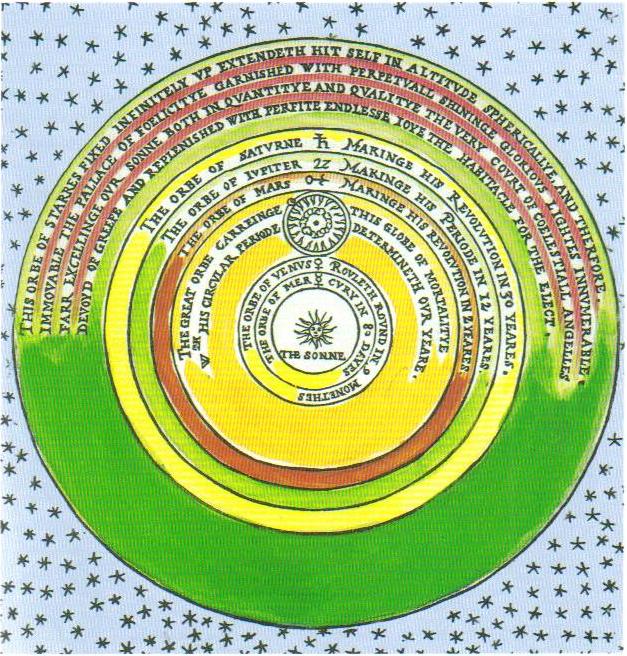
While this may seem like an utterly vanilla cosmology, in fact it suggests a view less like the "Great Wheel" and more like the medieval view of the system of celestial spheres. In religion before the modern epoch, other planes were supposed to be physically located on other planets. The astral plane, which first comes into D&D through the Astral Spell in Greyhawk, is literally the star-filled void between these spheres. If we begin numbering planes at 1 for earth, the pictured diagram of celestial spheres indeed brings us out to a 12th sphere - so that the ones Magic-Users do not contact are the Earth and the Moon. This view of the world ultimately stems from Aristotle in De Cælo, or On the Heavens.

The astral plane, then, is a place where the heavens and earth meet - open to be home to beings of pure energy, which manifest themselves in various forms when they visit the earthly realm. Weird and fluid creatures, some good, some ill; some being the remnants of humans unable to leave for another realm, others being inhabitants of the astral plane, incomprehensible and possibly Lovecraftian beings. I'm thinking for this, rather than a catalog, a system may be needed: something like Jim Raggi's Random Esoteric Creature Generator, but more focused. This is one of the things I'll also get into with alignment, since I think Chaos needs much better avatars than the Slaadi.

I'll have more to say about the numbered planes in the future, but what is memorable about them is their directionality. Since the highest plane contains the most truthful entities, but also the greatest chance of temporary insanity, it makes sense that each plane should be further removed from the mundane reality, stranger and more surreal. But as the astronomical chart above shows, there is a plane "2" that is missing from both our world and Contact Higher Plane: the Moon.

Which brings me to a gem that I found while researching this post, specifically the Great Moon Hoax of 1835. It's a story of a mythical telescope which revealed the kind of civilization that Victorian people expected to find on the Moon, and it didn't disappoint. The centerpiece were the "vespertillo-homo," lunar people, who were short, about 4' tall, furry, and possessed of bat-like wings. They had taller, whiter cousins and lived in relative harmony with the other species. This is a moon covered with crystals, flowers and volcanoes, where there is a great temple of sapphire made to look as if it is on fire; there are buffalo-like creatures, blue goats with one horn, and even tail-less beavers that walk on two legs and live in huts. Tell me that isn't a place that is just aching for weird encounters! A portal, a "moon pool"? Who cares, it's practically made for adventure.  So yes, you can anticipate a full complement of authentic lunar creatures in the bestiary. Maybe even an adventure.

Astral Spell has one further tantalizing possibility, which also ties in with our directionality. A character whose body dies while in astral form will find themselves in "the lowest hell." And yes, we will be going there.

Monday, February 4, 2013

The Otherworldly and High Levels

When discussing the "Otherworldly" category of Sham's list from Monsters & Treasure, I noted that one of the monsters was missing from the list because of the printing he was using. Specifically, the balrog. Unlike the nazgul (spectres), ents (treants) and hobbits (halflings) the balrog was removed entirely from the game until it was brought back as the Type VI Demon in Supplement III: Eldritch Wizardry. On the OD&D '74 boards I brought up a discussion of the balrog as having been the obvious "big bad" in the original D&D set.

This reflected a simple truth about the early years of D&D: the players in those pioneering campaigns tended to top out around levels 10-12, levels at which a balrog was a perfectly fine adversary. Dragons are tough but not unbeatable, and characters are as likely to meet those huge numbers of humanoids listed in M&T (like 30-300 orcs) as they were to fight a big bad, and they probably were running domains instead of just adventuring into further and bigger dungeons. In part this is a question of the endgame that is talked about, but in part it's the style of play expected in the early D&D game.

It's clear that creating levels going up to 20 or so in Greyhawk influenced players to actually go up to those levels, and TSR responded by creating more and tougher enemies, particularly in Eldritch Wizardry. The balrog comes back with a transparently similar name, and a lot of buddies - the familiar Type I through V, plus the unique demon lords Orcus and Demogorgon.

The balrog was unique in several ways. It introduced magic resistance to the game, with the irony that their removal actually creates the false impression that OD&D wasn't supposed to have this mechanic. This is one of the mechanics, particularly through its implementation in Eldritch Wizardry and AD&D, that was supposed to work around the idea of what is today called "caster supremacy." Demons and otherworldly horrors should be fundamentally different, and not allow characters to simply use spells to do away with them. EW also made them have different hit die sizes, which works well for the extreme enemies.

Demons are a solid focus for the high levels, and they introduce a particular element to the game that had been neglected, namely beings from other planes. Contact Higher Plane existed in Men & Magic, and Greyhawk had Commune, Gate, and Astral Spell, but neither hide nor hair of anything that existed on any of the planes it referenced, except for a parenthetical statement that Gate could summon "Odin, Crom, Set, Cthulhu, the Shining One, a demi-god, or whatever."

I think the "higher planes" in OD&D are ripe with adventuring potential; the simple fact that you had to roll against insanity simply for contacting them made them special. The implementations of the planes in a literal-minded extension of alignment in the AD&D Player's Handbook was a waste of this tremendous potential. My next couple of posts are going to delve into planar potential a bit and discuss the possibilities for creating new monsters.