I don't do many reviews of RPG products here, and I'm not about to start. But I do want to talk a bit about James Spahn's White Star: White Box Science Fiction Roleplaying, because there are some things worth talking about.
I think White Star was marketed poorly. It's slick and well laid out, and a lot of people in the OSR are talking about it in terms that glow more than the lens flare on the cover. There's already fan material and even a zine that I've already ordered. And that's all to the good, but clearly some people got the wrong impression, and some of the reaction to White Star has been pretty negative.
My impression is that the marketing, and the book itself, is almost too slick. Given what it is, White Star would be better off looking less polished and more "white box."
The game, as written, is not so much an adaptation of Swords & Wizardry: Whitebox as it is a reskin. It re-themes D&D magic-users as Jedi - "Star Knights" - who wield lightsabers ("Star Swords" that do all of 1d6+2 damage) and cast "Meditations" instead of spells. Fighters are Mercenaries, Thieves are Pilots, and Elves are Alien Mystics.
What really cements this is the experience system: it uses "credits" as the measure instead of gold pieces, but you get XP for killing monsters and gaining credits. Despite the back-cover claim that the game takes you "out of the dungeon and into the stars," when you read the sample adventure it's a space dungeon. And I mean, I have nothing against that; it's kind of a cool idea to have a D&D dungeon in space, and to replace your two-handed sword with a lightsaber ("Star Sword") and your crossbow with a laser pistol. But that is really what it's doing. The Star Sword does 2 points of damage more than a stick. The laser pistol does the same. Meditations are spells, period. Things work like they do in D&D, not like they do in Star Wars (or any other space opera). Because of the game's logic – really D&D's logic – you're basically going to be playing D&D in space.
Now, I don't think that's bad per se. The book has some cool science fantasy monsters and artifacts in it. And any game with Space Monkeys can't actually be bad. But I do think it's marketed wrong, possibly because it's so easy to bury the lede. This isn't Traveller, it isn't Firefly, and despite some trappings it's not Star Wars. This is Swords & Wizardry set in space dungeons.
This isn't a review, so I'm not going to answer the question of whether it's worth getting. A lot of the book is a reskinned restatement of Swords & Wizardry. The parts that are good, like the robot PCs and the 22 pages of aliens and creatures, are quite good. The parts that are lame, like the Meditations, are irretrievably lame. But hey, it does have Space Monkeys.
Showing posts with label science fantasy. Show all posts
Tuesday, May 19, 2015
Sunday, April 19, 2015
Convention Play: Metamorphosis Alpha
I spent a good part of the past week updating my adventure, now titled "Rites of Passage," for Philly GamesCon. Unlike my G+ Hangout game, the con game stayed entirely on my 10th deck of the Starship Warden, a pleasant pastoral area with two villages and a handful of strange areas.
The first area visited was a Round House Modular Dwelling Unit, populated per Jim Ward's tables in The House on the Hill. Until the power suddenly kicked out, this was a fun game of MA's typical "identify this weird technological thing," with PCs figuring out soft drink dispensers and discovering a jar of peanut butter and jelly (one of those mixed types). The insane engineering robot activated, but the PCs had just found a robot maintenance device and used it to reboot it (it discovered a firmware corruption) and open the access panel. They left after the power outage with several good technological artifacts, and some magazines and cups.
After this they decided to go to the "Forbidden Zone," a massive high-radiation area. One of the PCs went in but his Radiation Resistance was good enough that it just did damage to him. After this, the mutant with several heightened senses figured out that they were being followed by a mutant bobcat, which did some fancy tunneling and chased them back to the river that runs through the level. It was an interesting encounter, because the bobcat had tunneling claws that let it burst out of the ground. One of the PCs had an Apathy Field that helped them get away.
The PCs took a rest and then went north to a small grove, where they had spotted a dug-up area that hides a laser pistol, a brown color band, and a cougaroid skin. Unfortunately there were squirrels. The PC with Apathy Field tried using it but one o the squirrels had terrific Mental Resistance and resisted. The squirrel then used its trump card – Molecular Disruption. That PC was gone, poof. Quite dramatic. The others used Heat Breath to kill both squirrels and the vines on the trees.
After that, the remaining three PCs tried heading fore (north), and found the field of weird flowers. They were going to skirt it (not a terrible idea), but one of the PCs went to pick a flower to bring home. This happened to be a rose with poison thorns, and I had him roll a Dexterity check to avoid getting pricked. He failed and that was another PC. The last two PCs called it an adventure and went home with substantial gear.
It was an enjoyable game, although I do want to tweak the level a bit more - there needs to be an encounter near the RHMDU aside from the robot to keep it from being a cakewalk. A PC with holographic skin was able to trick the house's access panel into letting him in by imitating a color band, a neat trick but one I probably wouldn't let work with a robot or more sophisticated tech. The fact of "here's a house, try to get in" is a fun challenge. I am thinking it could use some mutant birds nesting nearby to make it more of a challenge.
The grove with the molecular-disruptor squirrels is, I think, a very Metamorphosis Alpha encounter. The squirrels don't have a lot of hit points, but they can straight-out kill PCs if they try fighting. And the trees will try to grab PCs who dig up the goods, but the PCs observed the vines moving and used Heat Breath to fry everything in sight.
In practice, the Mutation Manual is awesome, the best of the Goodman supplements. It has some great new powers that add a whole lot to making mutants, both PC and not, more interesting. I think humans need a bit more edge to make them competitive, which I'll probably work on by tweaking the pregens. I would also recommend reprinting all the powers that PC mutants have for reference if you're running the game. Also, the Referee's Screen is terrific; it essentially has the whole system aside from the mutations on it. Easily worth ten bucks.
MA is a terrific game. It's probably, for my money, the best pure exploration game out there in RPGs. Combat is extremely variable because of the mutations, and the artifacts just make discovering things a pure joy. The level I've designed would probably take three or four sessions to explore thoroughly; I think that's a good length for a very full MA mini-campaign. At some point, I may see about putting it out in the wild, because I think more good MA sandbox adventures are really needed out there.
Wednesday, April 15, 2015
It's (Almost) Metamorphosis Alpha Time!
I have a bunch of pregenerated PCs available for Metamorphosis Alpha, plus the What You Know sheet for the Metamorphosis Alpha game I will be running this Saturday at Philly GamesCon. Starred powers in the mutant pregens come from The Mutation Manual, a sourcebook full of wonderful new mutations. The non-starred powers, plus all other information, comes from the core rulebook.
I've found that the "What You Know" sheet is pretty essential for running a pick-up version of game like Metamorphosis Alpha. It summarizes briefly some basic concepts that players need to know in order to play the game. The ideas come from reading source novels like Heinlein's Orphans of the Sky and Aldiss's Non-Stop / Starship, both of which establish their main characters' general ignorance of their world.
I'm still prepping the rest of the level I'm running, which will include a few charts for random encounters and detailing out some odds and ends. I may share some or all of it after I've run it, although at least something has to be held in reserve for when I run it again via Hangout. Which, TBH, is pretty likely. Metamorphosis Alpha is a really neat game, and one of the reasons I like it so much is that it doesn't require "campaign" style play to be rewarding.
Outside of this upcoming MA session, I'm running 5e D&D again, so the blog front is probably going to be a bit quiet. Unless readers here are interested in 5e, which I certainly could write about, but the feel isn't right for me. I'm considering taking that to a separate blog, which would be devoted to that game. But I will definitely have a writeup of lessons learned from the Philly GamesCon game.
I've found that the "What You Know" sheet is pretty essential for running a pick-up version of game like Metamorphosis Alpha. It summarizes briefly some basic concepts that players need to know in order to play the game. The ideas come from reading source novels like Heinlein's Orphans of the Sky and Aldiss's Non-Stop / Starship, both of which establish their main characters' general ignorance of their world.
I'm still prepping the rest of the level I'm running, which will include a few charts for random encounters and detailing out some odds and ends. I may share some or all of it after I've run it, although at least something has to be held in reserve for when I run it again via Hangout. Which, TBH, is pretty likely. Metamorphosis Alpha is a really neat game, and one of the reasons I like it so much is that it doesn't require "campaign" style play to be rewarding.
Outside of this upcoming MA session, I'm running 5e D&D again, so the blog front is probably going to be a bit quiet. Unless readers here are interested in 5e, which I certainly could write about, but the feel isn't right for me. I'm considering taking that to a separate blog, which would be devoted to that game. But I will definitely have a writeup of lessons learned from the Philly GamesCon game.
Saturday, December 27, 2014
Actual Play: Running Metamorphosis Alpha
Since I have time off over the holidays, I wanted to make sure I got at least one really prime game in, and for months I've been wanting that to be Metamorphosis Alpha. So I finally got that done today, and a game has gone right from my to-play list to the list of games I really enjoy.
I had no idea what MA would actually be like in play, but Tim Kask's introduction to the new Goodman Games edition really defined some of the delightful moments: it gets a bit into cultural anthropologists as you explain high-tech things to players like they're the tribal barbarians their player characters are meant to be.
I loved mixing this with known science, which I think is why so many Gamma World games went into "modern plus apocalypse" rather than the "future plus apocalypse" that it was supposed to. I mean, an iPhone is basically a strange rectangle where one side is glass and the other is metal, and it has one button. (And when a PC pressed the button, an icon displaying no battery power came up. Familiar to anyone?)
The random Round House Modular Dwelling Unit generator in Craig J. Brain's module The House on the Hill helped generate some priceless moments. I think the players really enjoyed the discovery process with a packet of salt & vinegar potato chips that came out of the food machine and were a theme for the rest of the adventure. The RHMDU is a brilliant place to explore; the PCs actually got into the administrative center for a bit because of a laser pistol they had found.
Brian Blume's bionics (reproduced in the Goodman edition) made a really threatening NPC who got offed with the laser pistol - it did him a ton of damage, even more than he did with his bionic arm and vibro-sword. And I wound up using Jim Ward's forest level from Dungeoneer (also in the Goodman tome) when the PCs left the confines of the level I had designed. Both the Goodman book and House on the Hill pulled their weight.
One detail I really enjoyed playing out was that the PCs, in the RHMDU, found "casual clothing" - which I decided had them going around in "Starship Warden" t-shirts. I might need to petition WardCo to actually make some because I'm just so tickled by the idea. I also enjoyed the PCs finding out that the radiation-riddled "Forbidden Zone" was really, well, forbidden and not just somewhere the PCs' parents had warned them against.
The session ended in disaster because the PCs found explosives, which I described pretty clearly as C4. I know, I could've gone with something else, but it's so much more fun to run with something you can really get into describing. Plus, there's electrical effects abound in the game, and given that C4 is activated by electricity it only seemed fitting. This was what did the PCs in, as the electrified shed in the Dungeoneer level and a PC's ability to generate electricity both combined with the C4 and blew the PCs and the shed to kingdom come. (Two PCs technically survived because, as a G+ Hangout game, their players dropped out before the grand finale.)
The ending was appropriate given that it was a one-shot; I see MA as perfect for one-shots, or maybe a "mini-series" planned campaign. It was based on novels which are fairly brief, and relies heavily on the theme of discovery. I could also very much see it blending into D&D as I discussed in my last post. Because it isn't class-and-level based, players can get to the really good stuff right in their first or second adventure, and don't need to go through a grind of level building.
It deserves some mention that the system is more rough hewn than even OD&D. The organization of the rulebook is awful, especially given that the WardCo and Goodman reprints both contain errata-ed versions of most of the essential tables that you use to run the game. (And don't get me started on the fact that the mutations are in basically arbitrary order.) The lacunae don't really matter much, though, because the system is simply so light that an experienced referee can just make a ruling and not change the game at all. The material that is present works quite well, but it's not a game to be run by a neophyte.
One hint for the prospective referee: you should have stats for any NPCs or monsters you're using. The game runs a lot more smoothly when, at a minimum, they have Mental Resistance and Dexterity scores, and at that point you might as well give them Constitution, Strength and Radiation Resistance.
Metamorphosis Alpha is going through the best period of support in its lifetime, thanks to Goodman Games and WardCo. It's very different from the D&D experience, but it is really worth giving a try in play. MA is really good for gamers who've played a lot of D&D and want the excitement of fresh discovery, really specializing in that aspect of play, and because of how it's structured it doesn't require a commitment of months or years to a campaign.
I had no idea what MA would actually be like in play, but Tim Kask's introduction to the new Goodman Games edition really defined some of the delightful moments: it gets a bit into cultural anthropologists as you explain high-tech things to players like they're the tribal barbarians their player characters are meant to be.
I loved mixing this with known science, which I think is why so many Gamma World games went into "modern plus apocalypse" rather than the "future plus apocalypse" that it was supposed to. I mean, an iPhone is basically a strange rectangle where one side is glass and the other is metal, and it has one button. (And when a PC pressed the button, an icon displaying no battery power came up. Familiar to anyone?)
The random Round House Modular Dwelling Unit generator in Craig J. Brain's module The House on the Hill helped generate some priceless moments. I think the players really enjoyed the discovery process with a packet of salt & vinegar potato chips that came out of the food machine and were a theme for the rest of the adventure. The RHMDU is a brilliant place to explore; the PCs actually got into the administrative center for a bit because of a laser pistol they had found.
Brian Blume's bionics (reproduced in the Goodman edition) made a really threatening NPC who got offed with the laser pistol - it did him a ton of damage, even more than he did with his bionic arm and vibro-sword. And I wound up using Jim Ward's forest level from Dungeoneer (also in the Goodman tome) when the PCs left the confines of the level I had designed. Both the Goodman book and House on the Hill pulled their weight.
One detail I really enjoyed playing out was that the PCs, in the RHMDU, found "casual clothing" - which I decided had them going around in "Starship Warden" t-shirts. I might need to petition WardCo to actually make some because I'm just so tickled by the idea. I also enjoyed the PCs finding out that the radiation-riddled "Forbidden Zone" was really, well, forbidden and not just somewhere the PCs' parents had warned them against.
The session ended in disaster because the PCs found explosives, which I described pretty clearly as C4. I know, I could've gone with something else, but it's so much more fun to run with something you can really get into describing. Plus, there's electrical effects abound in the game, and given that C4 is activated by electricity it only seemed fitting. This was what did the PCs in, as the electrified shed in the Dungeoneer level and a PC's ability to generate electricity both combined with the C4 and blew the PCs and the shed to kingdom come. (Two PCs technically survived because, as a G+ Hangout game, their players dropped out before the grand finale.)
The ending was appropriate given that it was a one-shot; I see MA as perfect for one-shots, or maybe a "mini-series" planned campaign. It was based on novels which are fairly brief, and relies heavily on the theme of discovery. I could also very much see it blending into D&D as I discussed in my last post. Because it isn't class-and-level based, players can get to the really good stuff right in their first or second adventure, and don't need to go through a grind of level building.
It deserves some mention that the system is more rough hewn than even OD&D. The organization of the rulebook is awful, especially given that the WardCo and Goodman reprints both contain errata-ed versions of most of the essential tables that you use to run the game. (And don't get me started on the fact that the mutations are in basically arbitrary order.) The lacunae don't really matter much, though, because the system is simply so light that an experienced referee can just make a ruling and not change the game at all. The material that is present works quite well, but it's not a game to be run by a neophyte.
One hint for the prospective referee: you should have stats for any NPCs or monsters you're using. The game runs a lot more smoothly when, at a minimum, they have Mental Resistance and Dexterity scores, and at that point you might as well give them Constitution, Strength and Radiation Resistance.
Metamorphosis Alpha is going through the best period of support in its lifetime, thanks to Goodman Games and WardCo. It's very different from the D&D experience, but it is really worth giving a try in play. MA is really good for gamers who've played a lot of D&D and want the excitement of fresh discovery, really specializing in that aspect of play, and because of how it's structured it doesn't require a commitment of months or years to a campaign.
Thursday, December 18, 2014
Mashup: Holmes D&D and Metamorphosis Alpha
I love the Holmes rulebook, and I often wonder why I have so much affection for it. Part of it is simply that Dave Sutherland cover; the art is not polished but it is completely evocative, both in color and in the monochrome blue. (I particularly love the blue book look.)
But it's the potential in the incomplete work that draws me in. The Holmes booklet allows the DM to run a few games of D&D, but not a full campaign. Meepo's Companion is an easy fix, and fills out levels 4 through 9 in just four pages. From that basis, unorthodox "supplements" to the Holmes rulebook are one of my favorite thought experiments. It allows you to have a basis that is 100% classic Dungeons & Dragons, but change everything outside that core and create something totally different.
Of course, it helps that TSR published something totally different from D&D just a year before Holmes Basic. Just re-released as a super-deluxe book by Goodman Games, Metamorphosis Alpha is a wild game of exploration in a generation starship that has gone horribly wrong. Radiation killed most of the people on board, and the survivors have reverted to barbarism. There are weird animal mutants, deadly plants and high-tech weapons and gadgets abounding in the setting. It's a decided alternative to the stereotypical post-nuclear apocalypse world that, for instance, appears in Jim Ward's later Gamma World. MA gives nigh-magical powers through mutations, and cares not for hard science.
The games are both focused on exploration, and as such make a natural pairing. The mutants and high technology of MA are excellent variants on the overly-familiar fantasy tropes supported in Dungeons & Dragons, while D&D's framework is fundamentally similar to MA's, to the point where MA has been called a "megadungeon in space." And while MA has some wild and awesome ideas, D&D is more of a sustainable campaign game.
MA's system is very nearly in scale with classic D&D, and uses similar systems of armor, weapon, and hit dice. Its characters don't advance, and get hit points as a direct function of Constitution (1d6 per point). This is similar to an eighth level D&D fighting-man using the Holmes Companion, so it stands to reason that the tougher MA creatures will be at the lower dungeon levels, with only a scattering of mutants in the first levels. Jim Ward's game is notoriously tough, and even with D&D levels and spells it's still not a walk in the park.
Look at the Tom Wham "Skull Mountain" dungeon layout:
This is a perfect fit for a D&D/MA mashup. I picture the early levels being fairly straightforward D&D type affairs, with hints of more – a stray mutant or two, a piece of inexplicable technology here and there. Then level 4A is the first level with serious numbers of Metamorphosis Alpha style mutations as well as D&D monsters, while 4B focuses on some of the tougher "fantasy" baddies. Then the 5th and 6th levels have some serious high-tech artifacts as well as some of the humanoid mutations of MA, and progressively meaner creatures. Finally the 7th level - the "Domed City" - is a high tech city straight out of Metamorphosis Alpha. A twist suggested by Zach H of Zenopus Archives is to have the whole of Skull Mountain be aboard MA's Starship Warden.
I like this setup because it takes TSR's two "lightest" rulesets, and links them together in what I feel is a largely organic way. For instance, it would be perfectly fun to have PCs roll up a Radiation Resistance score the very first time they actually encounter radiation. Mental Resistance can be converted from Wisdom, and Leadership from Charisma. And it merges the "big reveal" style of MA with the "secret at the heart of the dungeon" aspect that D&D always promises but it turns out to be a chute to China.
(If you read that link, or if you know your classic Dragon magazines, you know that Gygax did send PCs to the Warden; here we are talking about the opposite, using MA as the "reveal" at the deeper levels of D&D.)
The mashup has some great potential for chocolate/peanut butter type mixtures. First, factions in a large-scale dungeon transition naturally into some of the classic MA bad guys: wolfoids and androids, particularly, are classic MA villains. Technology, particularly Brian Blume's Bionics table from The Dragon (Jeff Rients reproduced it here) could be a lot of fun when applied to D&D monsters. Imagine a hobgoblin with a bionic arm, or a hyper-intelligent ogre with bionic eyes and brain. Mutations, too – I mean, come on, you can have kobolds that fire frickin' lasers from their eyes. Meanwhile the D&D magic items gain particular effect in MA; after all, think of the power of a single Ring of Animal Control over the mutated beasts of MA. Not to mention the visual of, say, a bearoid wielding a flaming sword.
Part of why I think I'm enjoying this particular blend of sci-fi and fantasy over the more sword and planet ideas I've explored in the past is that it's a very human-centric game, and rooted firmly in RPG history. It also lives up to the sci-fi elements that were present in the original edition of D&D but disappeared shortly thereafter. I like it enough that I think it's worth pursuing further and looking at some of the places where the two games intersect in the most interesting ways.
But it's the potential in the incomplete work that draws me in. The Holmes booklet allows the DM to run a few games of D&D, but not a full campaign. Meepo's Companion is an easy fix, and fills out levels 4 through 9 in just four pages. From that basis, unorthodox "supplements" to the Holmes rulebook are one of my favorite thought experiments. It allows you to have a basis that is 100% classic Dungeons & Dragons, but change everything outside that core and create something totally different.
Of course, it helps that TSR published something totally different from D&D just a year before Holmes Basic. Just re-released as a super-deluxe book by Goodman Games, Metamorphosis Alpha is a wild game of exploration in a generation starship that has gone horribly wrong. Radiation killed most of the people on board, and the survivors have reverted to barbarism. There are weird animal mutants, deadly plants and high-tech weapons and gadgets abounding in the setting. It's a decided alternative to the stereotypical post-nuclear apocalypse world that, for instance, appears in Jim Ward's later Gamma World. MA gives nigh-magical powers through mutations, and cares not for hard science.
The games are both focused on exploration, and as such make a natural pairing. The mutants and high technology of MA are excellent variants on the overly-familiar fantasy tropes supported in Dungeons & Dragons, while D&D's framework is fundamentally similar to MA's, to the point where MA has been called a "megadungeon in space." And while MA has some wild and awesome ideas, D&D is more of a sustainable campaign game.
MA's system is very nearly in scale with classic D&D, and uses similar systems of armor, weapon, and hit dice. Its characters don't advance, and get hit points as a direct function of Constitution (1d6 per point). This is similar to an eighth level D&D fighting-man using the Holmes Companion, so it stands to reason that the tougher MA creatures will be at the lower dungeon levels, with only a scattering of mutants in the first levels. Jim Ward's game is notoriously tough, and even with D&D levels and spells it's still not a walk in the park.
Look at the Tom Wham "Skull Mountain" dungeon layout:
This is a perfect fit for a D&D/MA mashup. I picture the early levels being fairly straightforward D&D type affairs, with hints of more – a stray mutant or two, a piece of inexplicable technology here and there. Then level 4A is the first level with serious numbers of Metamorphosis Alpha style mutations as well as D&D monsters, while 4B focuses on some of the tougher "fantasy" baddies. Then the 5th and 6th levels have some serious high-tech artifacts as well as some of the humanoid mutations of MA, and progressively meaner creatures. Finally the 7th level - the "Domed City" - is a high tech city straight out of Metamorphosis Alpha. A twist suggested by Zach H of Zenopus Archives is to have the whole of Skull Mountain be aboard MA's Starship Warden.
I like this setup because it takes TSR's two "lightest" rulesets, and links them together in what I feel is a largely organic way. For instance, it would be perfectly fun to have PCs roll up a Radiation Resistance score the very first time they actually encounter radiation. Mental Resistance can be converted from Wisdom, and Leadership from Charisma. And it merges the "big reveal" style of MA with the "secret at the heart of the dungeon" aspect that D&D always promises but it turns out to be a chute to China.
(If you read that link, or if you know your classic Dragon magazines, you know that Gygax did send PCs to the Warden; here we are talking about the opposite, using MA as the "reveal" at the deeper levels of D&D.)
The mashup has some great potential for chocolate/peanut butter type mixtures. First, factions in a large-scale dungeon transition naturally into some of the classic MA bad guys: wolfoids and androids, particularly, are classic MA villains. Technology, particularly Brian Blume's Bionics table from The Dragon (Jeff Rients reproduced it here) could be a lot of fun when applied to D&D monsters. Imagine a hobgoblin with a bionic arm, or a hyper-intelligent ogre with bionic eyes and brain. Mutations, too – I mean, come on, you can have kobolds that fire frickin' lasers from their eyes. Meanwhile the D&D magic items gain particular effect in MA; after all, think of the power of a single Ring of Animal Control over the mutated beasts of MA. Not to mention the visual of, say, a bearoid wielding a flaming sword.
Part of why I think I'm enjoying this particular blend of sci-fi and fantasy over the more sword and planet ideas I've explored in the past is that it's a very human-centric game, and rooted firmly in RPG history. It also lives up to the sci-fi elements that were present in the original edition of D&D but disappeared shortly thereafter. I like it enough that I think it's worth pursuing further and looking at some of the places where the two games intersect in the most interesting ways.
Labels:
holmes,
mashup,
metamorphosis alpha,
science fantasy
Saturday, July 12, 2014
The Pulp Magazines Project
The kind of fantasy fiction best loved by many of us in the old school originated in the magazines popular in the early 20th century known as "pulps" because of the low-grade paper that they were printed on. Aside from the most assiduous collectors, most of us only read the pulp stories out of context, reprinted in anthologies or web pages that frequently lose the original artwork and never have the context - the editorials, the letter columns, the advertisements, and the other stories that surrounded them.
Fortunately, the Pulp Magazines Project fixes this for us. It's a terrific resource, collecting pulp magazines that have gone into public domain for one reason or another. It's fun to read and flip through these in PDF form (the "flipbook" reader is a bit annoying for me), and soak in the classic magazines.
Hugo Gernsback's Amazing Stories is a major touchstone in science fiction history; it basically created the genre, even giving it its name in the early form of "scientifiction." The site only has a handful of issues from Amazing's run, but still manages to capture its very early days and crucial material. It started with reprints, but pretty soon had seminal authors.
For fantasy fans, unquestionably the most important magazine here is Weird Tales. This was the magazine that was home to Robert E. Howard and H.P. Lovecraft, and the literary circle around them – Robert Bloch, August Derleth, Henry Kuttner, Fritz Leiber, Frank Belknap Long and Clark Ashton Smith. Howard committed suicide in June 1936, and Lovecraft passed of an illness in March of 1937; this happens to coincide with the period of Weird Tales that are on the Pulp Magazines Project archive. The loss of its two leading lights put Weird in hard times, and Farnsworth Wright left the magazine, which went under the stewardship of Dorothy McIlwraith. It had other worthy authors under McIlwraith, including Leiber, Kuttner's wife C.L. Moore, and Manly Wade Wellman.
It's worth reading Weird Tales closely, because it helps to put Howard and Lovecraft in context. Read in their context it's clear that they were the farthest-sighted of a like-minded group of authors. For instance, Seabury Quinn's occult detective stories featuring Jules de Grandin are quite clever and told in a gripping pulp fashion, but don't have the same level of transcendence as Lovecraft's work. Yet, side by side, we can see that Lovecraft was very much a part of this milieu.
Of course, you didn't think I'd let you get away without mentioning Planet Stories, did you? Of course not. This was very much not a pioneering magazine in the same sense as Amazing Stories or Weird Tales; the original sword & planet adventures had been published in The All-Story by Burroughs. But Planet Stories is where both Leigh Brackett and Ray Bradbury developed their tales of Mars, inspired of course by the Barsoom stories. Late in its run, Planet Stories also discovered a writer named Philip K. Dick, who published his first story there. Its pedigree did also include writers such as Asimov, Simak and another Appendix N writer, Frederic Brown. The emphasis on adventure didn't stop harder science fiction ideas.
I like these magazines for three reasons. First, they're full of great adventure stories. Modern genre fiction is too wrapped up in epics and has trouble just getting down to a good adventure where the protagonist is in trouble pretty much the whole time. You get it in the old, short novels that were often just several stories strung together by a thread of a plot, but it really is lacking in bigger and more complex novels.
Second, you wind up reading authors you wouldn't have otherwise. This is a great side effect of the anthology form, and it's more pronounced here. There are people in these magazines I've never heard of, but with a short story it's always worth giving them a try. Even anthologies are only preserving selected authors who appealed to the anthologist; reading the raw form of the pulps gets you some good obscure authors, and also some clunkers
Third, I am always fascinated by seeing these things in their original context. Advertisements of all sorts litter the pages; a sophisticated reader might filter them out, but it's worth pausing once in a while to drink in the environment where the stories we love originally appeared. Similarly all the letter columns, where curious readers inquire about stories and offer their opinions; it's a bit of a lost art nowadays. And of course those wonderfully pulp illustrations.
So there you have your weekend's reading, and perhaps for many weekends to come after that. Enjoy, and feel free to point out any great finds in the comments.
Fortunately, the Pulp Magazines Project fixes this for us. It's a terrific resource, collecting pulp magazines that have gone into public domain for one reason or another. It's fun to read and flip through these in PDF form (the "flipbook" reader is a bit annoying for me), and soak in the classic magazines.
Hugo Gernsback's Amazing Stories is a major touchstone in science fiction history; it basically created the genre, even giving it its name in the early form of "scientifiction." The site only has a handful of issues from Amazing's run, but still manages to capture its very early days and crucial material. It started with reprints, but pretty soon had seminal authors.
For fantasy fans, unquestionably the most important magazine here is Weird Tales. This was the magazine that was home to Robert E. Howard and H.P. Lovecraft, and the literary circle around them – Robert Bloch, August Derleth, Henry Kuttner, Fritz Leiber, Frank Belknap Long and Clark Ashton Smith. Howard committed suicide in June 1936, and Lovecraft passed of an illness in March of 1937; this happens to coincide with the period of Weird Tales that are on the Pulp Magazines Project archive. The loss of its two leading lights put Weird in hard times, and Farnsworth Wright left the magazine, which went under the stewardship of Dorothy McIlwraith. It had other worthy authors under McIlwraith, including Leiber, Kuttner's wife C.L. Moore, and Manly Wade Wellman.
It's worth reading Weird Tales closely, because it helps to put Howard and Lovecraft in context. Read in their context it's clear that they were the farthest-sighted of a like-minded group of authors. For instance, Seabury Quinn's occult detective stories featuring Jules de Grandin are quite clever and told in a gripping pulp fashion, but don't have the same level of transcendence as Lovecraft's work. Yet, side by side, we can see that Lovecraft was very much a part of this milieu.
Of course, you didn't think I'd let you get away without mentioning Planet Stories, did you? Of course not. This was very much not a pioneering magazine in the same sense as Amazing Stories or Weird Tales; the original sword & planet adventures had been published in The All-Story by Burroughs. But Planet Stories is where both Leigh Brackett and Ray Bradbury developed their tales of Mars, inspired of course by the Barsoom stories. Late in its run, Planet Stories also discovered a writer named Philip K. Dick, who published his first story there. Its pedigree did also include writers such as Asimov, Simak and another Appendix N writer, Frederic Brown. The emphasis on adventure didn't stop harder science fiction ideas.
I like these magazines for three reasons. First, they're full of great adventure stories. Modern genre fiction is too wrapped up in epics and has trouble just getting down to a good adventure where the protagonist is in trouble pretty much the whole time. You get it in the old, short novels that were often just several stories strung together by a thread of a plot, but it really is lacking in bigger and more complex novels.
Second, you wind up reading authors you wouldn't have otherwise. This is a great side effect of the anthology form, and it's more pronounced here. There are people in these magazines I've never heard of, but with a short story it's always worth giving them a try. Even anthologies are only preserving selected authors who appealed to the anthologist; reading the raw form of the pulps gets you some good obscure authors, and also some clunkers
Third, I am always fascinated by seeing these things in their original context. Advertisements of all sorts litter the pages; a sophisticated reader might filter them out, but it's worth pausing once in a while to drink in the environment where the stories we love originally appeared. Similarly all the letter columns, where curious readers inquire about stories and offer their opinions; it's a bit of a lost art nowadays. And of course those wonderfully pulp illustrations.
So there you have your weekend's reading, and perhaps for many weekends to come after that. Enjoy, and feel free to point out any great finds in the comments.
Labels:
appendix n,
magazines,
pulp fantasy,
science fantasy,
Weird Tales
Saturday, June 14, 2014
Sighting Robots in 1976
Jon Petersen, in his Playing at the World, spends a bit of time with Alarums & Excursions. The zine's early years focused heavily on actual play reports. Because Lee Gold sent me the copies that I have with the understanding that they were still copyright their original authors, I am generally loath to do too much in terms of extensive quoting from them. But I want to give a paragraph from issue #9 (March 1976), which fit in nicely with some points I've made recently about robots. Note that this isn't the 6th issue pictured, but I needed a pic of a contemporary issue of A&E.
The below is from the section "Fornholt's Mockturtle Quest" by Hilda C. Hannifen.
It's important to know that the characters at this point were circumventing a "hot" room which had some "Godholm" material (and radiation), and one of the PCs, Tedron, had turned into Efreet form temporarily to withstand the heat. They have just walked into a room with a cabinet that has 6 doors, and a door that should see them clear of the radiation area.
A few fun things come out of this. First, an idea that robots are somehow immune to the bonuses for magical weapons and the effects of high Strength. It's a neat twist in the rules, and the kind of thing that can freak out players who are quite confident in their high-level PCs. Second, the way Tedron beats his dueling robot. Maneuver like this is something that's natural in old school D&D, or at least should be; the combat system is simple but it's really meant to be run with positioning as a "natural" part of it.
Of course the robots had positronic brains; that simply seems natural for a '70s robot. (One suspects that, being in a dungeon, these "dueling dummies" may not have obeyed the Three Laws of Robotics.) But those 5000 GP pieces of jewelry - I wonder where they came from? Maybe out of a compartment in the robot, or out of the cabinet. It puts me in mind of a dungeon version of a boardwalk arcade game.
This is all very "funhouse," but to me it's a wonderful example of the kind of weirdness that permeated the early years of D&D.
The below is from the section "Fornholt's Mockturtle Quest" by Hilda C. Hannifen.
It's important to know that the characters at this point were circumventing a "hot" room which had some "Godholm" material (and radiation), and one of the PCs, Tedron, had turned into Efreet form temporarily to withstand the heat. They have just walked into a room with a cabinet that has 6 doors, and a door that should see them clear of the radiation area.
As we advanced into the room which had the cabinet, the last in line noticed a sign on the outside of the door light up: "Game in Progress." The door swung to of itself and refused to open. 3 Doors n the cabinet opened and out of the cubbyholes came 3 robots with weapons and a target-painted shield. Each had 24 lights: none glowing. We found no matter what the weapon +s or strength, the "damage" was only the weapon's basic damage as if non-magical; damage was reflected by the number of lights lit on the robot. Certain hits lit double the ordinary number of lights. Owen rolling hot (a 17 was needed to hit) was able to get Turan's robot out of the way quickly (Turan had only 18 HP so he had to be quick) and Bruciver finished his shortly thereafter. Tedron didn't do so well with his since it did not want to get too close to his "hot" armor. Instead he maneuvered it towards the corner which was slagged where its positronic brain malfunctioned. Each of the 3 fighters had to fight a robot and got a 5000 GP piece of jewelry as a result. These were dueling dummies they had fought.This immediately precedes a troll encounter. I get the feeling that it wouldn't have been out of place in the parts of Greyhawk that inspired the Machine Level and so on: an encounter that is quite serious, but at the same time is whimsical enough to have a "Game in Progress" sign light up. The California dungeons were different but the spirit is less far off than people think.
A few fun things come out of this. First, an idea that robots are somehow immune to the bonuses for magical weapons and the effects of high Strength. It's a neat twist in the rules, and the kind of thing that can freak out players who are quite confident in their high-level PCs. Second, the way Tedron beats his dueling robot. Maneuver like this is something that's natural in old school D&D, or at least should be; the combat system is simple but it's really meant to be run with positioning as a "natural" part of it.
Of course the robots had positronic brains; that simply seems natural for a '70s robot. (One suspects that, being in a dungeon, these "dueling dummies" may not have obeyed the Three Laws of Robotics.) But those 5000 GP pieces of jewelry - I wonder where they came from? Maybe out of a compartment in the robot, or out of the cabinet. It puts me in mind of a dungeon version of a boardwalk arcade game.
This is all very "funhouse," but to me it's a wonderful example of the kind of weirdness that permeated the early years of D&D.
Labels:
Alarums and Excursions,
robots,
science fantasy,
weirdness
Tuesday, May 13, 2014
Robots, Golems, Androids
1974 was an interesting year for OD&D to come out. It sat at a critical point in the development of fantasy as a genre that we easily take for granted. The sword & sorcery genre that had sustained Gary Gygax through his youth was in its resurgence, while Tolkien was moving into dominance via the unlikely route of the counterculture and the Ballantine Adult Fantasy line was cycling older material back into the genre. Fantasy literature as we now know it was not yet a coherent genre with standard assumptions.
The idea that D&D is a game primarily about "fantasy" in the post-Tolkien sense has always had a touch of historical revisionism to it. It has Tolkien elements, but these are strewn about with ideas straight from myth, others from the sword & sorcery lineage, and fresh inventions alike. Much of what has gone on in the OSR is about cutting out the more Tolkienesque elements (or distancing them from Tolkien) and playing up either the sword & sorcery or the weird elements, or both. This is sometimes done under the cover of "Appendix N," but it really has little to do with Gygax's list of favorite novels, which contain heaps of science fiction anyway.
In Monsters & Treasure, plenty of science fiction and science fantasy creatures appear: Martian creatures are suggested, as are giant insects, dinosaurs and others. But the really interesting find is under "Other Monsters," which contains a listing for "Robots, Golems, Androids" that reads: "Self-explanatory monsters which are totally subjective as far as characteristics are concerned."
Golems later became codified as enchanted beings, growing greatly removed from the creature of Jewish folklore into any wizard-made construct. But robots and androids were swept under the rug along with the Martian creatures after the original boxed set. Indeed, unlike several other categories of additional monsters, they never even make it to The Underworld & Wilderness Adventures. But they have fascinating implications for referees who want to add science fantasy elements to their settings.
Again, keep in mind that it was 1974 when OD&D was released. The robots that most people were thinking of probably looked like Robby the Robot from Forbidden Planet:
So if robots were self-explanatory, they probably looked in the imagination more like Robby or the robot from Lost in Space than our more contemporary references for robots. Androids were, ironically, probably cheaper to film but only catching on around the time of OD&D. Of course, our imaginations hardly have to be limited by what someone in 1974 would've seen as a robot; I simply think that it would be awesome to put something that looks like Robby the Robot in a D&D dungeon.
In an otherwise pseudo-medieval world, why exactly are there robots and androids in the depths of dungeons or lurking in the wilderness?
There's always room for ancient astronauts, or even more recent ones. It's also possible that the D&D world is actually long after an apocalypse in a highly technical civilization; after all, Planet of the Apes was current and had pulled off just such a trick. (This is also suggested by Appendix N, where post-apocalypse books like Hiero's Journey and Sign of the Labrys were recommended, but that was 5 years after OD&D.) There's planar travel, and if all else fails, there's the old excuse that "a wizard did it."
Robots can take any shape we like. Clockwork beings might be a closer aesthetic fit to much of what people like in their D&D; I think the visual design of the Golden Army from the second Hellboy film has a lot to recommend in this genre. But really there's no limit; robots don't even have to be anthropoid. It could be like the Terminator, or like an industrial robot arm from a modern factory, or small robots like the mouse droid in Star Wars.
One consideration a referee should give to robots is whether they are adapting their environs to their high-tech nature, or vice versa. Maybe a robot has made an area of a dungeon into a high-tech laboratory, replete with inventions and attempts to replicate its own technology level. Or it could have adapted to the low-tech but magical world it finds itself in, for instance with plate mail bolted onto its chassis or embedded a magical gem into its circuitry.
The possibilities really are endless, all from two lines in OD&D. That's some kind of magic.
The idea that D&D is a game primarily about "fantasy" in the post-Tolkien sense has always had a touch of historical revisionism to it. It has Tolkien elements, but these are strewn about with ideas straight from myth, others from the sword & sorcery lineage, and fresh inventions alike. Much of what has gone on in the OSR is about cutting out the more Tolkienesque elements (or distancing them from Tolkien) and playing up either the sword & sorcery or the weird elements, or both. This is sometimes done under the cover of "Appendix N," but it really has little to do with Gygax's list of favorite novels, which contain heaps of science fiction anyway.
In Monsters & Treasure, plenty of science fiction and science fantasy creatures appear: Martian creatures are suggested, as are giant insects, dinosaurs and others. But the really interesting find is under "Other Monsters," which contains a listing for "Robots, Golems, Androids" that reads: "Self-explanatory monsters which are totally subjective as far as characteristics are concerned."
Golems later became codified as enchanted beings, growing greatly removed from the creature of Jewish folklore into any wizard-made construct. But robots and androids were swept under the rug along with the Martian creatures after the original boxed set. Indeed, unlike several other categories of additional monsters, they never even make it to The Underworld & Wilderness Adventures. But they have fascinating implications for referees who want to add science fantasy elements to their settings.
Again, keep in mind that it was 1974 when OD&D was released. The robots that most people were thinking of probably looked like Robby the Robot from Forbidden Planet:
So if robots were self-explanatory, they probably looked in the imagination more like Robby or the robot from Lost in Space than our more contemporary references for robots. Androids were, ironically, probably cheaper to film but only catching on around the time of OD&D. Of course, our imaginations hardly have to be limited by what someone in 1974 would've seen as a robot; I simply think that it would be awesome to put something that looks like Robby the Robot in a D&D dungeon.
In an otherwise pseudo-medieval world, why exactly are there robots and androids in the depths of dungeons or lurking in the wilderness?
There's always room for ancient astronauts, or even more recent ones. It's also possible that the D&D world is actually long after an apocalypse in a highly technical civilization; after all, Planet of the Apes was current and had pulled off just such a trick. (This is also suggested by Appendix N, where post-apocalypse books like Hiero's Journey and Sign of the Labrys were recommended, but that was 5 years after OD&D.) There's planar travel, and if all else fails, there's the old excuse that "a wizard did it."
Robots can take any shape we like. Clockwork beings might be a closer aesthetic fit to much of what people like in their D&D; I think the visual design of the Golden Army from the second Hellboy film has a lot to recommend in this genre. But really there's no limit; robots don't even have to be anthropoid. It could be like the Terminator, or like an industrial robot arm from a modern factory, or small robots like the mouse droid in Star Wars.
One consideration a referee should give to robots is whether they are adapting their environs to their high-tech nature, or vice versa. Maybe a robot has made an area of a dungeon into a high-tech laboratory, replete with inventions and attempts to replicate its own technology level. Or it could have adapted to the low-tech but magical world it finds itself in, for instance with plate mail bolted onto its chassis or embedded a magical gem into its circuitry.
The possibilities really are endless, all from two lines in OD&D. That's some kind of magic.
Friday, April 4, 2014
Replacing the OD&D Monsters: Selenites
So in my science fantasy world and associated megadungeon, I want to swap out the monster listing for OD&D. A few things will be classically Dungeons & Dragons, but even those will be somewhat modified. I think the general size of the monster list in Monsters & Treasure is good, and want to talk through it.
After Men, who deserve their own entry, we get the cursus honorum of humanoids: goblins, kobolds, orcs, hobgoblins, gnolls, ogres. I've always seen these as the bread and butter enemies at lower levels, making up megadungeon factions and holding various roles in the dungeons.
I mentioned in a previous post that Selenites would be replacing goblins, so it's worth taking a bit of a look at them. In The First Men on the Moon, Selenites are pretty easy to kill, being moon creatures; starting them off at 1-1 HD and assuming they're a little more solid will approximate that. One note is that I also want larger, more dominant Selenites to replace gobgoblins on down the line; this is in line with the hierarchical Selenite culture that Wells laid out in the novel. I particularly like this because it lets me vary hit dice and armor class within the same monster.
The main occupation of Selenites is herding mooncalves, which are absolutely massive creatures. I like that; having big mooncalf caverns gives a very definite ecology to the question of the dungeon. Mooncalves graze on underground fungi, Selenites eat fungi and mooncalves.
One of the big advantages is that Selenites are fundamentally underground creatures. Their civilization is in the underworld, and the ones in my dungeon will have taken control of some part of a complex in the early levels. I'd sort of like to play it where only people who've been down in the underworld have any idea that they even exist; it's not like they're the lizardmen, who the PCs would know about, but rather a totally alien creature as soon as they go down.
As subterranean entities, I think Selenites should still get the goblin's -1 to hit in bright light. OD&D also carries a note that goblins "attack dwarves on sight." This one suggests a possibility, that dwarves who came to this planet with the setting's humans have possibly had some run-ins with Selenites in the past and there is now a standing order to attack any dwarves they may run into. This would also be an interesting twist if dwarves spoke the Selenite language where they currently speak Goblin.
(This is one of the fun things about bouncing ideas off of OD&D - the dwarf idea was not in my plans but actually works out.)
So that's how I'll be replacing goblins. Next, kobolds.
After Men, who deserve their own entry, we get the cursus honorum of humanoids: goblins, kobolds, orcs, hobgoblins, gnolls, ogres. I've always seen these as the bread and butter enemies at lower levels, making up megadungeon factions and holding various roles in the dungeons.
I mentioned in a previous post that Selenites would be replacing goblins, so it's worth taking a bit of a look at them. In The First Men on the Moon, Selenites are pretty easy to kill, being moon creatures; starting them off at 1-1 HD and assuming they're a little more solid will approximate that. One note is that I also want larger, more dominant Selenites to replace gobgoblins on down the line; this is in line with the hierarchical Selenite culture that Wells laid out in the novel. I particularly like this because it lets me vary hit dice and armor class within the same monster.
The main occupation of Selenites is herding mooncalves, which are absolutely massive creatures. I like that; having big mooncalf caverns gives a very definite ecology to the question of the dungeon. Mooncalves graze on underground fungi, Selenites eat fungi and mooncalves.
One of the big advantages is that Selenites are fundamentally underground creatures. Their civilization is in the underworld, and the ones in my dungeon will have taken control of some part of a complex in the early levels. I'd sort of like to play it where only people who've been down in the underworld have any idea that they even exist; it's not like they're the lizardmen, who the PCs would know about, but rather a totally alien creature as soon as they go down.
As subterranean entities, I think Selenites should still get the goblin's -1 to hit in bright light. OD&D also carries a note that goblins "attack dwarves on sight." This one suggests a possibility, that dwarves who came to this planet with the setting's humans have possibly had some run-ins with Selenites in the past and there is now a standing order to attack any dwarves they may run into. This would also be an interesting twist if dwarves spoke the Selenite language where they currently speak Goblin.
(This is one of the fun things about bouncing ideas off of OD&D - the dwarf idea was not in my plans but actually works out.)
So that's how I'll be replacing goblins. Next, kobolds.
Tuesday, April 1, 2014
World Building: The Look and Feel
So as I am starting to flesh out a new world, the logical question came up: what, exactly, are the influences and works that have inspired this take?
There are literary influences, but most of them are safely "Appendix N" - Burroughs, Vance, Lovecraft, Dunsany, Merritt, Brackett, Norton - and if I listed some others a lot would be token. There's a bit of H.G. Wells (The Time Traveler, The First Men in the Moon) and some ostensible nonfiction like Chariots of the Gods? - but its not that interesting.
But that's all words. What really inspires me in terms of setting are look and feel. Perhaps because I've never been very good at art, I've always loved visual sources. When something strikes my eye, it makes a much deeper impression than a story.
As to why there's a city underground, well, it's because of this drawing.
It's a Holmes thing I guess - sticking that city under the dungeon is something I've wanted to do for a long time, an explorable high-level ruined metropolis.
Recently I saw Mike Mignola's concept art for Disney's Atlantis. This is what I want my ruined city to look like. I know the Disney city is supposed to be underwater, but think of it in a massive cavern instead. Those long staircases are simply epic. The towers have this ancient astronaut vibe to me, which I've covered before and want to use for some of the "looks" of ancient weapons and such. Mignola's characters also fit my vision of the blue-skinned underground humans, who I see having various tribal-esque tattoos. It's just such a different thing to see in a D&D game that I love it.
Another favorite of mine is Jean Giraud/Moebius's concept art for Alejandro Jodorowsky's Dune. Dune is maybe my favorite novel, and the mad vision of Jodorowsky may not be very close to the original, but people made absolutely stunning visual art for it. Moebius's characters have a visual flair that makes me want to create a world where they fit. There will definitely be suits of armor that resemble the Sardaukar here, and I really want to have people in my world who look like this.
Another big visual influence is feathered dinosaurs. Like a lot of kids, I was obsessed with dinosaurs when I was a kid. The modern vision is radically different. I love dromeosaurids, partly because "Velociraptors" were popularized by Jurassic Park, partly because the real things are also interesting. Besides, how much fun would it be to have turkey-sized raptors where most dungeons have kobolds? Scaled dinosaurs, of course, have a part to play as well; but the variety of colors and shapes is endless, and prevents things from getting repetitious.
Selenites (right) from an early French film of The First Men in the Moon are one of my favorite weird races, and conveniently they live underground, tending monstrous "mooncalves." Moreover, they are "specialized" based on their particular function in society. What a perfect alien race for science fantasy D&D! The French art makes them look perfectly bizarre while retaining a "humanoid" feel. I think with some variety, they could take up a good chunk of the role played by the goblin / hobgoblin / bugbear part of the cursus honorum of humanoids.
One of the things I really want to accomplish is a world that looks different from standard D&D. I really like the vision of how radically out of place the PCs will look in medieval gear, and the possibility that as the game goes on, they'll have more of a mixed aesthetic.
So that's the look, which is a lot of the inspiration.
There are literary influences, but most of them are safely "Appendix N" - Burroughs, Vance, Lovecraft, Dunsany, Merritt, Brackett, Norton - and if I listed some others a lot would be token. There's a bit of H.G. Wells (The Time Traveler, The First Men in the Moon) and some ostensible nonfiction like Chariots of the Gods? - but its not that interesting.
But that's all words. What really inspires me in terms of setting are look and feel. Perhaps because I've never been very good at art, I've always loved visual sources. When something strikes my eye, it makes a much deeper impression than a story.
As to why there's a city underground, well, it's because of this drawing.
It's a Holmes thing I guess - sticking that city under the dungeon is something I've wanted to do for a long time, an explorable high-level ruined metropolis.
Recently I saw Mike Mignola's concept art for Disney's Atlantis. This is what I want my ruined city to look like. I know the Disney city is supposed to be underwater, but think of it in a massive cavern instead. Those long staircases are simply epic. The towers have this ancient astronaut vibe to me, which I've covered before and want to use for some of the "looks" of ancient weapons and such. Mignola's characters also fit my vision of the blue-skinned underground humans, who I see having various tribal-esque tattoos. It's just such a different thing to see in a D&D game that I love it.
Another favorite of mine is Jean Giraud/Moebius's concept art for Alejandro Jodorowsky's Dune. Dune is maybe my favorite novel, and the mad vision of Jodorowsky may not be very close to the original, but people made absolutely stunning visual art for it. Moebius's characters have a visual flair that makes me want to create a world where they fit. There will definitely be suits of armor that resemble the Sardaukar here, and I really want to have people in my world who look like this.
Another big visual influence is feathered dinosaurs. Like a lot of kids, I was obsessed with dinosaurs when I was a kid. The modern vision is radically different. I love dromeosaurids, partly because "Velociraptors" were popularized by Jurassic Park, partly because the real things are also interesting. Besides, how much fun would it be to have turkey-sized raptors where most dungeons have kobolds? Scaled dinosaurs, of course, have a part to play as well; but the variety of colors and shapes is endless, and prevents things from getting repetitious.Selenites (right) from an early French film of The First Men in the Moon are one of my favorite weird races, and conveniently they live underground, tending monstrous "mooncalves." Moreover, they are "specialized" based on their particular function in society. What a perfect alien race for science fantasy D&D! The French art makes them look perfectly bizarre while retaining a "humanoid" feel. I think with some variety, they could take up a good chunk of the role played by the goblin / hobgoblin / bugbear part of the cursus honorum of humanoids.
One of the things I really want to accomplish is a world that looks different from standard D&D. I really like the vision of how radically out of place the PCs will look in medieval gear, and the possibility that as the game goes on, they'll have more of a mixed aesthetic.
So that's the look, which is a lot of the inspiration.
Friday, March 28, 2014
Some World-Building
In addition to my B/X campaign, I've been working on some concepts for a combination of a world setting and a megadungeon. But it's a bit different from what I've been doing previously. I want to talk a bit about where I'm thinking of going in terms of world creation, theme and influences.
A big thing thematically that I want to achieve with this setting is to do a world that is, at the same time, both recognizable as Dungeons & Dragons, and isn't at all a generic fantasy setting. Hence the deinonychus above.
What I'd really like to get down is a science fantasy world that doesn't have a gonzo, crazy-go-nuts feel. I know that's an odd balance to hit when your goal is wizards and laser rifles, but I feel that it's a time-honored part of Dungeons & Dragons that should still be able to take itself with a modicum of seriousness. Part of that is doing things like dinosaurs but having them be scary rather than wacky. Again, hence deinonychus.
The basic assumption of the Dungeons & Dragons setting is that it's a pseudo-medieval world. I'm not going with that, although the PCs still look and act basically the same. The underlying idea is that the main human civilization are themselves literally aliens. The world that the PCs (well, their ancestors) come from is a high-magic world with all of the standard fantasy trimmings. They no longer live there. During the magical equivalent of a global thermonuclear war, the Second Empire opened a gate to another world. The first brave and hardy settlers had wizards helping them; much of their resources and knowledge were lost, but fragments remain. Now it is two centuries later, and the human realm (name TBD) has gone into a semblance of normal life.
So there are several sources of monsters. One is the other civilizations of the world that the humans came into; at this point the one they have the most contact with are lizardmen, who live in a vast swampy kingdom to the south of the human settlement. They have some weird technology, mostly a mix of found tech from previous civilizations – nothing orderly and modern, but enough that humans pose no fundamental threat to them.
As to the megadungeon itself, it's a multi-level dungeon that happens to be built near the ruined and long-since buried capital of an Atlantis style civilization, a mix of high technology and high magic. There are tribes of primitive blue-skinned humans living underground, the descendants of the last survivors of this world; they are savage and have no memory of their lost homeland, only a sort of religious worship of some of its artifacts.
I want to play a lot with megafauna in this setting, both dinosaurs and giant creatures. I'm particularly inspired by this description from Holmes's manuscript (reproduced on the Zenopus Archives):
Giant rats, spiders, scorpions and other horrors are naturals for dungeons. The Dungeon Master should adjust the monster's hit dice to the depth below the surface and assign a suitable armor class. These creatures fight ferociously, have special abilities, and there are many interesting possibilities.I really love that bit about "have special abilities." Yes, you know what a fire beetle is in a standard D&D world, but the beetles in this world might be based on the bombardier beetle.
Future posts will talk more about this as I flesh out the world and solidify more of its aspects. But I'd be interested in reading what thoughts and ideas folks have for developing this kind of setting while keeping it feeling like a more or less logical world, not a zany mish-mash.
Labels:
Blackmoor,
holmes,
megadungeons,
science fantasy,
setting,
weirdness,
worldbuilding
Tuesday, January 28, 2014
Lovecraft, Science Fantasy and Medieval Monstrosities
I recently read H.P. Lovecraft's "The Colour Out of Space" (which HPL regarded as his best story, and was certainly the best pure alien story I've ever read) for the first time since high school, and what's been percolating about in my head ever since was the way the eponymous Colour in the story physically taints the things around it. And it happened yesterday that Rafael Chandler posted on his G+ stream yesterday a selection of rainbow-coloured beasts from a medieval monk's book of hours.
Naturally, things began to coalesce. These rainbow monstrosities are the result of contact with an otherworldly ooze, which is normally semi-invisible (its actual coloration is not visible to the naked eye) but when a light source such as a lantern or object with light cast on it is shined directly at it, generates a sickly, unnatural rainbow of colors. Any living creature coming into contact with this ooze must save versus poison or become one step tainted.
Each level of taint brings with it some deformation, whether it be horns, growth of abnormal hair, mismatched limbs, or taking on the eerie rainbow colors of the ooze. The changes also grant some ability, roll 1d8 to determine:
- Unarmored AC improves by 1
- Hit dice improves by 1
- Gain an additional attack or +2 to existing attack
- Regenerate 1 HP / turn
- Immunity to fire / cold / acid based attacks (choose one)
- Touch causes paralysis (save to avoid)
- Can become invisible for 1 turn/day
- Successful attack causes taint (save vs. poison to avoid)
Monday, June 24, 2013
Ancient Astronauts and Science Fantasy
One of the phenomena of the pseudoscience industry (and I use that term purposefully) over the last few decades is the theory of "ancient astronauts." First spread by Erich von Däniken and used for commercial purposes by people like Giorgio Tsoukalos (the subject of the famous meme picture to the left), these use incredulity about the abilities of ancient civilizations and the building power of thousands of slaves to hypothesize that ancient wonders were not built by man but by extraterrestrial visitors.
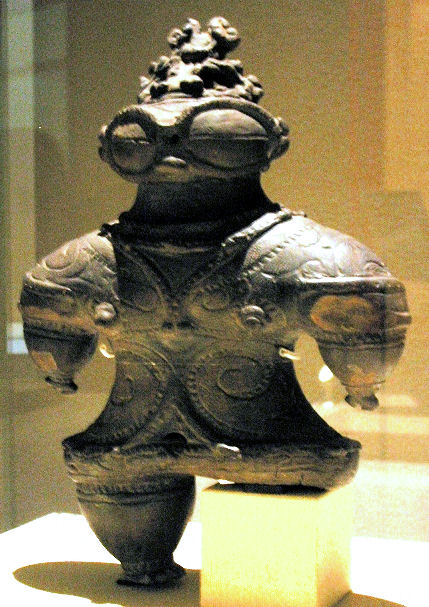
But just because something is simply bunkum doesn't mean it isn't useful gaming material. Some critics have pointed out after all that "ancient astronauts" seem to have a basis in H.P. Lovecraft more than in any scientific observation. But if we take them at face value, they do give us some potential fodder. For instance, this Dogū statue from ancient (prehistoric) Japan has features that would be really interesting either on a space suit or on a monster straight-up:
After all, with the goggle eyes, the weird armor, the cone helmet - that's gotta be something interesting to wear or to fight. Much of the ancient alien fodder is visually interesting. Can you really not think of adventure seeds with this guy?
So there are several ways you could use the ancient astronauts.
Fantasy literature and RPGs both have involved histories with bunk ideas. Theosophy in particular I think had a big influence on fantasy, including on Lovecraft and again on the outer planes - we wouldn't have our astral and ethereal if people hadn't actually believed in them. In an age where there is bunk abound, it seems a shame not to turn some of it to good use.
But just because something is simply bunkum doesn't mean it isn't useful gaming material. Some critics have pointed out after all that "ancient astronauts" seem to have a basis in H.P. Lovecraft more than in any scientific observation. But if we take them at face value, they do give us some potential fodder. For instance, this Dogū statue from ancient (prehistoric) Japan has features that would be really interesting either on a space suit or on a monster straight-up:
After all, with the goggle eyes, the weird armor, the cone helmet - that's gotta be something interesting to wear or to fight. Much of the ancient alien fodder is visually interesting. Can you really not think of adventure seeds with this guy?
So there are several ways you could use the ancient astronauts.
- They are actual aliens, with straight-up science fantasy gadgets: ray guns, various detectors, deflector shields, anti-gravity devices, you name it. This take can be done either with the aliens as current visitors (and therefore "monsters" / encounters), or they can be long-gone, with their technology - up to and including spaceships - lost in ancient and forbidding tombs. Either way is fodder for adventure. This also works if outer planes are outer planets, as I've discussed at some length.
- Instead of standard science fantasy aliens, they are akin to the creatures of H.P. Lovecraft. This works particularly well if you want to play up the horror aspect of the game; heck, you could practically use a lot of At the Mountains of Madness as a campaign guide. I also think "ancient aliens" as a surface cover-up would be a great way to do a dramatic reveal of some Lovecraftian horror in a lot of RPGs.
- The entities are actually gods or demons, if you want to go a pure-fantasy route. There's no reason that Dogū figurine can't be an extraplanar entity.
Fantasy literature and RPGs both have involved histories with bunk ideas. Theosophy in particular I think had a big influence on fantasy, including on Lovecraft and again on the outer planes - we wouldn't have our astral and ethereal if people hadn't actually believed in them. In an age where there is bunk abound, it seems a shame not to turn some of it to good use.
Friday, May 24, 2013
Jury-rigging it
In adding science fantasy elements to a setting, we are leaving open the possibility that PCs will find high-tech items. I've mentioned previously that these in general should not be reproducible, so that the society doesn't wind up migrating from fantasy to science fiction entirely. But there are other possibilities, particularly because technological artifacts will by nature be prone to breaking, and weapons will run out of ammunition, and all of them will run out of power eventually.
So how do PCs find out if they can jury-rig a solution? I'm thinking that this is a good place for some Judges Guild style tables, akin to some of the things from City State / Ready Ref Sheets, giving a series of cascading chances to scrounge spare parts from other artifacts, rig up a solution, and of course what happens when it works or doesn't.
When the PCs run out of juice on the ray gun and the personal shield is malfunctioning - I'm thinking that the rules should allow them to sacrifice one artifact to salvage another with some reasonable chance. Or perhaps they go looking and find an inoperative beam rifle from a different period and manage to mix and match a few parts and get it to work - if nothing else, it's cool if it works at least once for a big boom before it is totally useless.
The chances of malfunction should always be present, barring a major success; if you have two identical pistols and replace one's firing mechanism with the other's, that will work reliably. But for the most part there needs to be some chance of backfiring, fizzling, or exploding, perferably in the most entertaining way possible.
Extending this idea, I'm thinking that a chart of different high tech weapons and defenses, combined with a set of rules for jury-rigging fixes, perhaps that can also double for what happens if they use malfunctioning equipment. Any special requests or ideas for this? It'll be for Dungeon Crawl #3.
So how do PCs find out if they can jury-rig a solution? I'm thinking that this is a good place for some Judges Guild style tables, akin to some of the things from City State / Ready Ref Sheets, giving a series of cascading chances to scrounge spare parts from other artifacts, rig up a solution, and of course what happens when it works or doesn't.
When the PCs run out of juice on the ray gun and the personal shield is malfunctioning - I'm thinking that the rules should allow them to sacrifice one artifact to salvage another with some reasonable chance. Or perhaps they go looking and find an inoperative beam rifle from a different period and manage to mix and match a few parts and get it to work - if nothing else, it's cool if it works at least once for a big boom before it is totally useless.
The chances of malfunction should always be present, barring a major success; if you have two identical pistols and replace one's firing mechanism with the other's, that will work reliably. But for the most part there needs to be some chance of backfiring, fizzling, or exploding, perferably in the most entertaining way possible.
Extending this idea, I'm thinking that a chart of different high tech weapons and defenses, combined with a set of rules for jury-rigging fixes, perhaps that can also double for what happens if they use malfunctioning equipment. Any special requests or ideas for this? It'll be for Dungeon Crawl #3.
Thursday, May 23, 2013
Some further Dune concepts
I've been thinking more about the technology and ideas in Dune, and how they might apply to old school D&D and other games. I've already gone a bit on the Spice, but there are other concepts that I think could really play an interesting part in the game. Some of these draw on the later novels, which I think are much less widely known.
In the last three volumes of the original books (and that's all that counts), Herbert spends a lot of time dealing with the ramifications of the prescience that he has given Paul and Leto II. This is useful in fantasy games because similar problems occur with spells like ESP, Clairaudience/Clairvoyance and ultimately Teleport making secret hiding places less useful and ultimately impossible.
One of Herbert's key technologies here is the no-chamber, a room that is impervious to precognition. This is the only way that things can be hidden from people with limitless precognition, and their development is what ends the reign of God-Emperor Leto II. A no-chamber in a dungeon or in an enemy's lair would provide protection from the concept of just being able to magically find your enemies, teleport in, and kill them, particularly if it was immune to all magic acting at a distance. Of course not every villain can have a no-chamber but it makes for a good and interesting reason why PCs can't use that kind of tactics.
Then there are the Bene Tleilax - a very useful type of people. The axolotl tanks are revealed to be monstrous female Tleilaxu in the later books, and they produce gholas, perfect clones of a dead person who can recover their original memories at a certain point in their life. The Tleilaxu Face Dancers are also a great adversary to swap out for the AD&D Doppelgangers. A dungeon or megadungeon level where the Bene Tleilax have set up shop might be a fascinating and weird adversary's location.
And of course there are the Bene Gesserit, women with tremendous mental capabilities and female-line ancestral memories as well as hand-to-hand combat (the weirding way). Just the ability of a character to use the Voice would be a tremendous ability, perhaps allowing a save versus spells. I think a Bene Gesserit PC would have to start out pre-Spice Agony if someone went that way, perhaps at higher levels getting access to the really amazing powers.
Just some ideas for mashing up some classic science fiction into your fantasy games; Dune has a lot of great things for people who want a wheels-within-wheels plot.
Wednesday, May 22, 2013
Magic, Drugs and Breaking Commandments
In my last post I touched briefly upon the Spice, Melange, from Frank Herbert's Dune. Anyone who knows the Dune universe should know that the Spice is addictive, to the point where not using it means death. It has me thinking about the myopic late-era TSR Commandments, specifically this one:
Both Dune and Dungeons & Dragons came about in an era when people still thought of drugs as mind-expanding. Of course this crashed and burned in real life - but since when does fantasy have to follow reality? If drugs are really gateways into alternate worlds or ways of seeing reality, why not depict them in both positive and negative aspects?
One thought is that the fantasy world may have powerful hallucinogens that, rather than simply showing delusions to the viewer, actually reveal elements of the truth. Magic mushrooms or psychoactive substances like peyote may, in addition to rollicking hallucinations, impart upon the user the ability to detect magic or detect invisibility as per those spells. Deep in a trance, a character may be able to use spells such as ESP, clairvoyance, or clairaudience. Of course, side effects and addiction should both be likely.
Another drug might empower magic use further, allowing the user to cast spells as if they were a certain number of levels higher - for instance, a 5th level Magic-User casting an 8-dice fireball. Such impact might follow the typical "de-escalation" pattern of a mundane "high," where achieving the same result requires more of the drug. There could also be the danger of burnout, with the user needing it just to cast spells that have been over-optimized.
I might do some of these as magic items in the next Dungeon Crawl. Any thoughts?
16: NARCOTICS AND ALCOHOLThis forecloses on the ability to make really awesome, but addictive, magical substances. And so, like many of these rules, I think it should be defenestrated.
Narcotic and alcohol abuse shall not be presented, except as dangerous habits. Such abuse should be dealt with by focusing on the harmful aspects.
Both Dune and Dungeons & Dragons came about in an era when people still thought of drugs as mind-expanding. Of course this crashed and burned in real life - but since when does fantasy have to follow reality? If drugs are really gateways into alternate worlds or ways of seeing reality, why not depict them in both positive and negative aspects?
One thought is that the fantasy world may have powerful hallucinogens that, rather than simply showing delusions to the viewer, actually reveal elements of the truth. Magic mushrooms or psychoactive substances like peyote may, in addition to rollicking hallucinations, impart upon the user the ability to detect magic or detect invisibility as per those spells. Deep in a trance, a character may be able to use spells such as ESP, clairvoyance, or clairaudience. Of course, side effects and addiction should both be likely.
Another drug might empower magic use further, allowing the user to cast spells as if they were a certain number of levels higher - for instance, a 5th level Magic-User casting an 8-dice fireball. Such impact might follow the typical "de-escalation" pattern of a mundane "high," where achieving the same result requires more of the drug. There could also be the danger of burnout, with the user needing it just to cast spells that have been over-optimized.
I might do some of these as magic items in the next Dungeon Crawl. Any thoughts?
Tuesday, May 21, 2013
OD&D Setting Mashup
Blog of Holding, home of the excellent D&D with Michael Mornard posts, just released a mashup of the OD&D setting I detailed in this blog with an idea from Jeff Grubb about a world overrun with evil where most humans have taken to flying ships. This has shades of Burroughs to it, so I most heartily approve. Check it out.
One setting I've been thinking a bit about is Dune. There's a documentary coming out this year about the attempt by surrealist cult director Alejandro Jodorowsky to make a Dune movie basically as a sci-fi acid trip with lots of symbolism, but he assembled massive amounts of talent to get it made. Of course that blew the entire budget and some of the people he'd brought together went on to make Alien, while David Lynch more or less failed at making a Dune movie. The world and its aesthetic always appealed to me, though only really Dark Sun among D&D settings ever scratched a vaguely similar itch. It would be an interesting exercise to stat out melange (the Spice), sandworms, and Fremen for D&D; from later volumes, no-rooms would be tremendously valuable, as would people immune to prescience.Not too hard if we assume a bigger desert in a D&D planet.
Science fantasy seems to be a natural fit for old school Dungeons & Dragons. We've had touches of it for a long time: Barsoom in OD&D, Temple of the Frog in Blackmoor, Tékumel, Jim Ward's Metamorphosis Alpha and Gamma World, Wilderlands of High Fantasy, Arduin, S3 The Expedition to Barrier Peaks - the list is not short. Holmes mentioned his Dreenoi PC and this is just a taste of the possibilities. I think that this was a phase as much in fantasy as anything else; as worldbuilding rather than imagination became the word of the day, flagrant discontinuities such as lasers or force shields in a fantasy game had to go away. (Though there's magic in some popular sci-fi, Star Wars being fantasy in most regards.)
This is something I've touched on before and will again. But really check out the mashup idea from Blog of Holding, I think it's onto something there.
One setting I've been thinking a bit about is Dune. There's a documentary coming out this year about the attempt by surrealist cult director Alejandro Jodorowsky to make a Dune movie basically as a sci-fi acid trip with lots of symbolism, but he assembled massive amounts of talent to get it made. Of course that blew the entire budget and some of the people he'd brought together went on to make Alien, while David Lynch more or less failed at making a Dune movie. The world and its aesthetic always appealed to me, though only really Dark Sun among D&D settings ever scratched a vaguely similar itch. It would be an interesting exercise to stat out melange (the Spice), sandworms, and Fremen for D&D; from later volumes, no-rooms would be tremendously valuable, as would people immune to prescience.Not too hard if we assume a bigger desert in a D&D planet.
Science fantasy seems to be a natural fit for old school Dungeons & Dragons. We've had touches of it for a long time: Barsoom in OD&D, Temple of the Frog in Blackmoor, Tékumel, Jim Ward's Metamorphosis Alpha and Gamma World, Wilderlands of High Fantasy, Arduin, S3 The Expedition to Barrier Peaks - the list is not short. Holmes mentioned his Dreenoi PC and this is just a taste of the possibilities. I think that this was a phase as much in fantasy as anything else; as worldbuilding rather than imagination became the word of the day, flagrant discontinuities such as lasers or force shields in a fantasy game had to go away. (Though there's magic in some popular sci-fi, Star Wars being fantasy in most regards.)
This is something I've touched on before and will again. But really check out the mashup idea from Blog of Holding, I think it's onto something there.
Subscribe to:
Posts (Atom)