Wednesday, March 15, 2017

Appendix N Madness Day 15: Weinbaum vs Brown

J.R.R. Tolkien was the victor of Day 14 and goes on to face Fritz Leiber in Round 2.

Day 15 of Appendix N Madness closes out the first round for Sci-Fi with Stanley G. Weinbaum versus Frederic Brown.

Stanley G. Weinbaum
Lived: 1902-1935
Notable Works: "A Martian Odyssey", "Valley of Dreams", The Black Flame

In 1933, a new voice burst on the science fiction scene to tremendous acclaim. By 1935 he would be dead, but having made a great contribution in his short time. His first published story, "A Martian Odyssey," is an exceptional study in the creation of a genuine alien intelligence. Few subsequent science-fiction extraterrestrials are as intelligent without thinking humanly as Weinbaum's curious Tweel. One of his posthumous novels, The Black Flame, was a post-apocalyptic story firmly in the science fantasy genre. Weinbaum's death at a very young age meant that he never had time to polish the novel, or develop many of his earlier ideas, but his mark was profound and he remains one of the best golden age SF voices.


Fredric Brown
Lived: 1906-1972
Notable Works: What Mad Universe, Martians Go Home, "Arena", "Knock"

Fredric Brown was a golden age science fiction author who wrote many short stories with a distinctly wry and humorous note; this is probably why he was listed in Appendix N, since Gary Gygax had a strong love for this sort of humor. His What Mad Universe had a pulp science fiction editor who hated space opera thrust into, well, a space opera; his Martians Go Home satirically features the iconic "little green man" type of Martian. His short story "Knock" is legendary for the opening line: "The last man on Earth sat alone in a room. There was a knock at the door..." Another of his short pieces, "Arena," was adapted for the Star Trek episode of the same name.

You can vote in the poll here.

Tuesday, March 14, 2017

Appendix N Madness Day 14: Tolkien vs Tierney

Lord Dunsany took the last day of the Weird region with a powerful victory over Ramsey Campbell.

Day 14 brings us the last match-up of the Fantasy region: J.R.R. Tolkien vs Richard L. Tierney.

J.R.R. Tolkien
Lived: 1892-1973
Notable Works: The Hobbit, The Lord of the Rings, The Silmarillion, The Children of Húrin

John Ronald Reuel Tolkien was a World War I veteran and a contributor to the Oxford English Dictionary. He taught philology at Oxford and wrote a prose translation of Beowulf. During his convalescence after being wounded in war, Tolkien wrote a fantastic mythology initially called The Book of Lost Tales parallel to the development of several invented Elvish languages that would later form the Silmarillion. He never completed or published this work in his life, although his son has published numerous versions based on the in-progress work. In the 1930s Tolkien wrote a children's fantasy book, The Hobbit, loosely influenced by this mythology. In the 1940s and into the 1950s he wrote a much longer novel, The Lord of the Rings, that was broken into three volumes for publication.*

Tolkien's work was not accessible to most readers until Ace released an unauthorized paperback version (following the three-volume division) in the 1960s. These books drove an absolute mania for Tolkien and fantasy more generally, with Ballantine putting out the official authorized paperback versions. Tolkien was therefore an unexpected phenom at the end of his long life, and sadly had little time to take advantage of this. His son Christopher has published almost all of Tolkien's writing, including extensive information on his invented languages, of which Quenya is the most complete and Sindarin the most popular. Tolkien's works have been adapted into massively popular films and every genre of media imaginable, although few of these have the approval of Christopher or the estate. From the late 1970s into the 1990s, the fantasy genre became almost slavishly imitative of Tolkien, and his impact on Dungeons & Dragons and fantasy in general is profound.

*Even though copies of The Fellowship of the Ring, The Two Towers, and The Return of the King say that they were a "trilogy," Tolkien objected to this term and considered LotR a single novel, broken into six books, and not three separate works.

Richard L. Tierney
Lived: 1936-present (currently living)
Notable Works: Red Sonja series (with David C. Smith), Simon of Gitta series

Richard L. Tierney is a minor Lovecraftian writer. He is best known for co-writing the Red Sonja novels with David C. Smith, but has written his own Lovecraftian work featuring Simon of Gitta, who is introduced in "The Sword of Spartacus" in Swords Against Darkness III.The character's further adventures were collected in a 1990s volume from Chaosium, The Scroll of Thoth. Tierney was included in an anthology placing him in The New Lovecraft Circle placing him alongside writers like Ramsey Campbell, Brian Lumley, Karl Edward Wagner, Thomas LIgotti, and Robert M. Price. He has also written extensive science fiction poetry, much of it dealing with similar Lovecraftian themes.

You can vote in the poll here.

Monday, March 13, 2017

Appendix N Madness Day 13: Dunsany vs Campbell

Jack Vance won Day 12 of Appendix N Madness and goes on to face Roger Zelazny in Round 2.

Day 13 is the last match-up from the Weird region: Lord Dunsany vs Ramsey Campbell.

Edward Plunkett (Lord Dunsany)
Lived: 1878-1957
Notable Works: The Gods of Pegāna, The Sword of Welleran, The King of Elfland's Daughter

Edward John Moreton Drax Plunkett, the 18th Baron of Dunsany, was an Anglo-Irish lord, writer, and dramatist. He was a noteworthy writer, and published several cycles of invented mythology beginning with The Gods of Pegāna. Dunsany's writing had a deliberate fairy-tale quality and a strange richness to it, and he was a hugely influential fantasy writer. The major Weird Tales authors were directly influenced by him, and his King of Elfland's Daughter was the first official volume of the Ballantine Adult Fantasy series. The latter is a particular masterwork and is breathed through with the sense of wonder that Dunsany was able to create without peer.

Ramsey Campbell
Lived: 1946 - present (Currently Living)
Notable Works: "Cold Print", Demons by Daylight, The Face That Must Die

Ramsey Campbell is one of the premier authors of horror fiction of the late 20th century. He is in this tournament because he was the backbone of the Swords Against Darkness series, which featured the adventures of a mercenary swordsman Ryre in a grim and hostile world. It was Campbell's main foray into sword & sorcery, and his performance was admirable. Campbell began as a devout Lovecraftian, publishing his own anthology of Lovecraft pastiche, before making a 180 degree turn toward his own style of horror with Demons by Daylight, crisp and modern in tone. Campbell is a highly decorated author, including a Grand Master award from the World Horror Convention.

You can vote in the poll here.

Sunday, March 12, 2017

Appendix N Madness Day 12: Vance vs Carter

Day 11 of Appendix N Madness was a rout for Leigh Brackett, who will advance to take on another of Appendix N's great women, Andre Norton, in round 2.

Day 12 brings us to SAGA / Amra and a match-up between Jack Vance and Lin Carter.

Jack Vance
Lived: 1916-2013
Notable Works: Dying Earth series, Planet of Adventure series, Lyonesse series

Jack Vance was a Bay Area writer best known for his Dying Earth series which collects picaresque tales of wizards and rogues (particularly Cugel the Clever) in a far-future world where technology was so advanced as to be magical. His Planet of Adventure series had elements that Gary Gygax admitted to stealing for his own Castle Greyhawk. D&D's magic system calls itself Vancian, although this is open for debate. The author himself was a master stylist, his work heavy with decadent atmosphere and rapier-quick wit. Vance was an SFWA Grand Master in his long lifetime. He wrote further works such as the SF Demon Princes and the fantastic Lyonesse series, but the Dying Earth is probably his most lasting legacy.


Lin Carter
Lived: 1930-1988
Notable Works: World's End series, Thongor series, Jandar series

L. Sprague de Camp's protégé was a collaborator in "completing" Robert E. Howard's unfinished works, and an author of voluminous pastiche as well as original works. Lin Carter's greatest achievement was the Adult Fantasy paperback series that he edited for Ballantine, which wanted more fantasy novels after the success of The Lord of the Rings. Carter brought dozens of obscure novels to light, promoting the likes of William Morris, E.R. Eddison, James Branch Cabell, Clark Ashton Smith, Lord Dunsany, and H.P. Lovecraft. He also helped to bring up then-new fantasists such as Katherine Kurtz and Evangeline Walton. Unfortunately, none of his dying-earth work (World's End) or planetary romance (Jandar of Callisto) or lost-continent fantasy (Thongor) holds a candle to the originals he was imitating, and the reader is better off sticking to Adult Fantasy.

You can vote in the poll here.

Saturday, March 11, 2017

Appendix N Madness Day 11: Brackett vs Williamson

David C. Smith received a single vote against 72 for Robert E. Howard, who advances to take on John Bellairs in round two.

Day 11 is for the Sci-Fi region and pits Leigh Bracket against Jack Williamson.

Leigh Brackett
Lived: 1915-1978
Notable Works: Mars series, Skaith series

Leigh Brackett died the year before the AD&D Dungeon Masters Guide was published, and two years before her last major screenplay, The Empire Strikes Back, was released to massive success. After Edgar Rice Burroughs, Brackett was one of the most notable authors of planetary romance, writing various Mars stories (the fix-up The Secret of Sinharat comes from this series) and later wrote more with Sinharat's protagonist, Eric John Stark, in her Skaith books. But she is probably better known for the screenplays she wrote; aside from Empire, she wrote The Big Sleep, The Long Goodbye, and Rio Bravo - putting a major mark on the cultural landscape for decades.

Jack Williamson
Lived: 1908-2006
Notable Works: The Legion of Space series, Humanoids series

Jack Williamson was a consummate Golden Age science fiction writer, and was the second writer named as an SFWA Grand Master (after Robert Heinlein). His Legion of Space was loosely inspired by Dumas's Three Musketeers and Shakespeare's Falstaff, and is a classic space opera on par with E.E. "Doc" Smith. His Humanoids series is a classic exploration of the robot-out-of-control trope. He also wrote the Seetee series about antimatter and his short story "Collison Orbit" was the first use of the term "terraform." Williamson was unapologetic about writing popular science fiction and disliked the idea of authors needing to change or obscure their work to be "serious" or "literary."

You can vote in the poll here.

Friday, March 10, 2017

Appendix N Madness Day 10: Howard vs Smith

In the closest vote yet, and the first proper upset, Manly Wade Wellman edged out A. Merritt by 25 votes to 23 votes. He will advance to take on H.P. Lovecraft in the second round.

Day 10 of Appendix N Madness takes us to the Fantasy region and brings Robert E. Howard versus David C. Smith.

Robert E. Howard
Lived: 1906-1936
Notable Works: Conan, Kull, Solomon Kane

In 1936, Weird Tales faced a major tragedy when Robert E. Howard, a rising star at only 30 years old, took his own life. Only four years earlier Howard had published the first tale featuring Conan, a Cimmerian, in the hypothetical Hyborian Age. Howard was a Texan writer who created adventure fiction at a blazing clip, writing hundreds of stories in his short career. Kull of Atlantis, the Puritan Solomon Kane, the adventurer El Borak, the boxer Steve Costigan, the Pictish king Bran Mak Morn, the detective Steve Harrison - Howard created reams of characters, but Conan with his sword and low cunning towered above all of them. The Howard revival of the 1960s, driven by L. Sprague de Camp publishing the Conan stories in paperback form, created a positive mania for "barbarian" characters that lingered to the 1980s and a film Conan the Barbarian.

David C. Smith
Lived: 1952-present (currently alive)
Notable Works: Oron series, Red Sonja series (with Richard L. Tierney)

David C. Smith was a young author who wrote in the late years of that barbarian craze, publishing Oron and multiple stories in the Swords Against Darkness series (which is why he's in this competition). In the early 1980s, he co-wrote a series of Red Sonja novels with Richard L. Tierney based on the character as developed by Roy Thomas. There was a loose Howardian origin but Red Sonja was defined primarily in Marvel Comics. The Red Sonja film was not based on the Smith/Tierney novels. Smith has kept writing since the 1980s but at a slow pace, and remains a minor working writer, with a trilogy (Fall of the First World) and several other novels.

As an editorial comment, this is the most unfair matchup in the entire Appendix N Madness tournament. Not only did Howard write far more in about eight active years than Smith has in forty, but Smith's entire career has been in Howard's shadow.

You can vote in the poll here.
Thursday, March 9, 2017

Appendix N Madness Day 9: Merritt vs Wellman

Day 8 saw L. Sprague de Camp advance over Tanith Lee, 60% to 40%.

Day 9 is the return of the Weird bracket for A. Merritt vs Manly Wade Wellman.

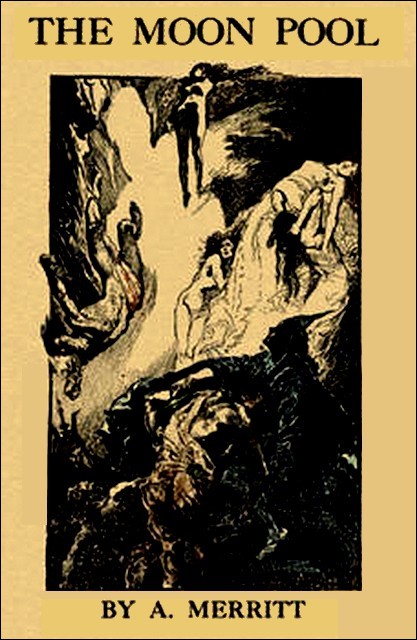
A. Merritt
Lived: 1884-1943
Notable Works: The Moon Pool, The Metal Monster, Dwellers in the Mirage.

Abraham Merritt was a working journalist and editor who wrote adventure literature with science-fiction twists as a sideline to his main work. His Moon Pool, Creep, Shadow, and Dwellers in the Mirage are listed in Appendix N, and Moon Pool is now public domain. Merritt's writing is basically a combination of adventure fiction in the tradition of H. Rider Haggard's King Solomon's Mines with twists drawn from Theosophy and other current beliefs about lost civilizations and esoteric secrets. Merritt was quite popular in his heyday but has generally faded from popular memory. He remains, with Edgar Rice Burroughs, a pioneer in combining adventure and fantastic writing.

Manly Wade Wellman
Lived: 1903-1986
Notable Works: Silver John series, John Thunstone series, Hok series

My best guess is that it was John the Balladeer who got Manly Wade Wellman into Appendix N. This was a series of short stories following Silver John through Appalachia, where he plays a silver-stringed guitar and fights off various and sundry demons. His barbarian character Hok was out of print by Gygax's time, and his John Thunstone stories were not in print between the 1940s and 1980s. Wellman, with his influence from the real-world occult, was fairly representative of the average contents of Weird Tales, which published some of his original work. A film, The Legend of Hillbilly John, was adapted from several of his Silver John stories.

You can vote in the poll here.