Showing posts with label planetary romance. Show all posts
Saturday, December 12, 2015
Actual Play: Funnel and Science Fantasy
I ran my first Dungeon Crawl Classics RPG funnel today, and four out of eight PCs met their ends in the process. The Kraken picture above is actually representative of the first encounter, where the ship the characters had signed onto was attacked by a giant sea monster. The PCs only had to beat back the tentacles, which still took a couple of characters. Then they rowed the two ship's boats to a nearby island as the ship started sinking, only to be taken down by the squid.
On the island the players actually took with gusto to surviving the night, which was one place that the funnel format showed off a wrinkle I hadn't thought of: a weaver was making a lean-to, an indentured servant starting a fire, a potato farmer finding edible tubers: characters doing survivalist stuff with the funnel skills. If you wanted to do a Swiss Family Robinson or Lost multi-part scenario in a fantasy RPG, a DCC funnel is actually a pretty great way to start it. Especially when there are a lot of interesting factions on the island.
But my scenario focused on a ziggurat at the center of the island, where things led. After a lizardman attack in the night, the characters went to the step pyramid and explored. Eventually they found a giant lizard, which took a PC out. But they found a back way down and a series of chutes that, carefully explored (though still losing a PC to a spear trap), led to an uncanny room that turned out to be a buried spaceship. I've been wanting to use one for a long time, and this one took off once the PCs sat in the command chairs. As of the end of the scenario, they were level one PCs en route to Mars.
The overall campaign setup is one I've wanted to do for a while, basically a mashup of Poul Anderson's The High Crusade with the classics of planetary romance. Crusade is science fiction where a group of English peasants commandeer a starship and get on with conquering alien worlds. Anderson's book is pretty much a romp for the humans, but I just want to take the basic image of medieval pseudo-Europeans with a starship and run with it. As a classic concept I just don't think it's done enough.
(Of course, I used an ancient astronauts explanation for the spaceship rather than a failed first-contact invasion, but that's just because it's more fun IMO.)
Adventures beyond this one are going to be using the Warriors of the Red Planet RPG as a supplement for Barsoom material. It's a retro-clone type of game by Al Krombach that provides a thorough D&D-alike conversion for the Edgar Rice Burroughs Barsoom with the serial numbers filed off (or at least down to a near-rhyme; I mean, the sample character is Pars Parthas). But it will be using the DCC RPG, which I think is a good fit for sword & planet type adventure.
Beyond Mars / Barsoom, there are many worlds I'd like to explore in broad strokes. Venus, of course, with others in the solar system; and maybe even savage Almuric, the Purple Planet and its weirdling sun, Jorune, and frozen Yuggoth and dim Carcosa.
Really, the only problem is picking where to go first.
Wednesday, April 17, 2013
S&W Bonus #4: Vespertilians (Bat-Men of the Moon)
I had talked back in February about the Great Moon Hoax of 1835. Well, there was an adaptation of the bat-men of the moon that I've got written up, which will be published when I finally actually put out the adventure - I have some notes but other projects and frequent blogging have gotten in the way. In the mean time, for S&W Appreciation Day: the Vespertilians.
Armor Class: 8 [11]
Attacks: 1d2 or by weapon
Saving Throw: 18
Special: None
Move: 9/6 (flying)
Alignment: Law
Challenge Level/XP: B/10
Vespertilians are a species of humanoids that dwell on the lunar surface. They are covered in fur save for their faces, and have bat-like wings that extend under their arms and down their torsos to their legs. Vespertilians vary in height from 4’ to 6’ and in coloration from dark brown to a light blonde. They are uncivilized but fairly intelligent and live in relative harmony; a vespertilian eats primarily fruits and is rarely armed. They do not form mated pairs and will frequently intermingle between different small tribal groups. 10% of any encountered will be shamans who operate as a 3rd level cleric. Vespertilians are unable to fly, and become uncommonly weak (Strength 4) if taken to a world with Earth-like gravity.
Vespertilian
Hit Dice: 1d6 or by classArmor Class: 8 [11]
Attacks: 1d2 or by weapon
Saving Throw: 18
Special: None
Move: 9/6 (flying)
Alignment: Law
Challenge Level/XP: B/10
Vespertilians are a species of humanoids that dwell on the lunar surface. They are covered in fur save for their faces, and have bat-like wings that extend under their arms and down their torsos to their legs. Vespertilians vary in height from 4’ to 6’ and in coloration from dark brown to a light blonde. They are uncivilized but fairly intelligent and live in relative harmony; a vespertilian eats primarily fruits and is rarely armed. They do not form mated pairs and will frequently intermingle between different small tribal groups. 10% of any encountered will be shamans who operate as a 3rd level cleric. Vespertilians are unable to fly, and become uncommonly weak (Strength 4) if taken to a world with Earth-like gravity.
Sunday, February 10, 2013
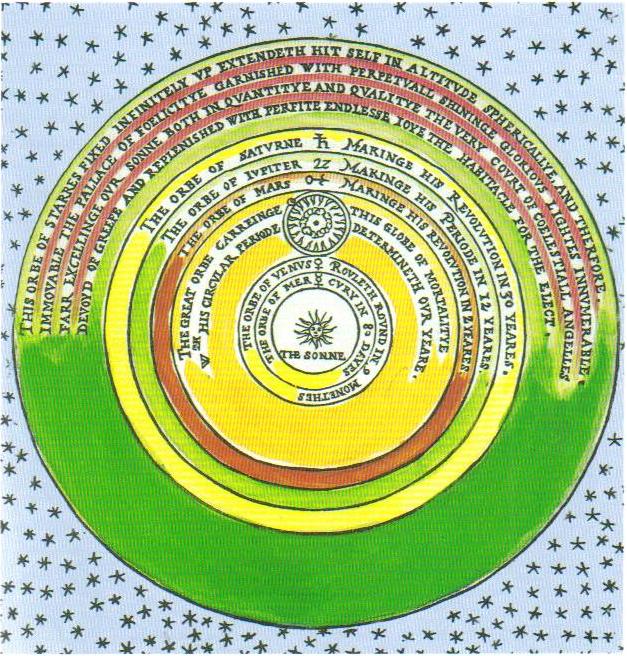
Planes as Planets: The Higher You Go, the Weirder it Gets
As the planets get further removed from earth, they are less and less familiar. The moon, Mars and Venus (which I've yet to detail) are wholly alien worlds but seem to run (more or less) according to rules we understand. The further planets are more inherently alien, possessed of greater magics and undreamed-of wonders. The science fantasy of the near planets instead goes into the extreme high fantasy of the far planets; after all, these are worlds full of beings that have great knowledge but are prone to drive you mad by contact.
Jupiter is a gas giant in our reality, and I think it works as an analogue in the farthest planes. The Titans of Jupiter are massive beings relative to humans, and have advanced magic to the point where they live in floating cities among the clouds. Their faces are long, with perfectly oval eyes without pupils, and they have only slight noses; their preferred garments look superficially like robes but contain intricate patterns that go down to the very fabrics that they are made of. Despite the fact that this planet's shifting winds would seem to be a manifestation of Chaos, it is actually the opposite; the super-storms have settled into a single massive system of hierarchical bands, with the Great Red Spot as the ultimate ordered storm, effectively permanent. The floating cities are massive and permanent, and run in fixed schedules that interact with the bands of storm that they are fixed above. The Titans travel to and fro on sky-ships using massive, six-winged creatures that are to dragons as the Titans themselves are to humans.
By the time we reach the Titans, human alignment - good and evil - has been transcended. The inhabitants are not yet gods, but relative to humans in terms of power they are very nearly demigods. Scant few human affairs are important on the massive cosmic scale of the Titans, yet their intricate plans occasionally cross the earthly planet. When they do, it is often in unusual ways, through powerful artifacts or uncanny magic - the kind of things where the meaning is in long and arcane plots that the human mind can't even fathom. The Titans, like God-Emperor Leto II in Dune, think in the truly long-term, the infinite, and as such their perspective and goals are often subtle in ways that we can't really fathom.
Even beyond Jupiter, there is Yuggoth. The Mi-Go are the planet's most infamous denizens, but they are not meant to be its first. As such, it seems to me that the things found on Yuggoth in a medieval fantasy world might be the ones alluded to here:
What I'm thinking in this all-but-lightless world is of two main species. One is an entirely immobile but highly intelligent and powerful psionic crystalline entities, which enslaved a species of 2-story tall cyclopean beings with 6 tentacular arms, each ending in razor-sharp hooks or pincers of various types that are meant to be utilitarian in their construction works. There are also centipedal worker drones that haul massive blocks and dig the tunnels under the planet's surface. These are accompanied by various lesser-known members of the Great Old Ones, again not quite deities but nearly equivalent for human purposes.
Obviously, Yuggoth is a Chaotic planet - it is so far beyond human morality that our plans are irrelevant, but the ends of the Mythos deities are to reduce the universe to its ultimate chaotic state. The crystalline entities know that their slaves will eventually revolt and shatter them, and then their consciousnesses will lie dormant in thousands of pieces for millennia until the stars are right and they are re-formed to complete the rituals that they have been laying the ground for.
This is my vision for Law and Chaos; it is the truly LONG game, and the higher planets are fully engaged in that fight. They are not yet the god-realms, nor their opposite; we will be getting there next. When we go to Hell.
(As an aside, if anyone wants to draw a picture of 6-winged dragons or floating cities above the clouds of Jupiter, or of crystalline monoliths and 8-limbed servitors in Yuggoth, this entry certainly could use the artwork.)
Jupiter is a gas giant in our reality, and I think it works as an analogue in the farthest planes. The Titans of Jupiter are massive beings relative to humans, and have advanced magic to the point where they live in floating cities among the clouds. Their faces are long, with perfectly oval eyes without pupils, and they have only slight noses; their preferred garments look superficially like robes but contain intricate patterns that go down to the very fabrics that they are made of. Despite the fact that this planet's shifting winds would seem to be a manifestation of Chaos, it is actually the opposite; the super-storms have settled into a single massive system of hierarchical bands, with the Great Red Spot as the ultimate ordered storm, effectively permanent. The floating cities are massive and permanent, and run in fixed schedules that interact with the bands of storm that they are fixed above. The Titans travel to and fro on sky-ships using massive, six-winged creatures that are to dragons as the Titans themselves are to humans.
By the time we reach the Titans, human alignment - good and evil - has been transcended. The inhabitants are not yet gods, but relative to humans in terms of power they are very nearly demigods. Scant few human affairs are important on the massive cosmic scale of the Titans, yet their intricate plans occasionally cross the earthly planet. When they do, it is often in unusual ways, through powerful artifacts or uncanny magic - the kind of things where the meaning is in long and arcane plots that the human mind can't even fathom. The Titans, like God-Emperor Leto II in Dune, think in the truly long-term, the infinite, and as such their perspective and goals are often subtle in ways that we can't really fathom.
Even beyond Jupiter, there is Yuggoth. The Mi-Go are the planet's most infamous denizens, but they are not meant to be its first. As such, it seems to me that the things found on Yuggoth in a medieval fantasy world might be the ones alluded to here:
Yuggoth... is a strange dark orb at the very rim of our solar system... There are mighty cities on Yuggoth—great tiers of terraced towers built of black stone... The sun shines there no brighter than a star, but the beings need no light. They have other subtler senses, and put no windows in their great houses and temples... The black rivers of pitch that flow under those mysterious cyclopean bridges—things built by some elder race extinct and forgotten before the beings came to Yuggoth from the ultimate voids—ought to be enough to make any man a Dante or Poe if he can keep sane long enough to tell what he has seen... - "The Whisperer in Darkness" by H.P. LovecraftThe "elder race" is, perhaps, the one that in our time period for D&D was inhabiting the distant planet, before the later arrival of the better known fungi. It seems odd, after all, to assume that the Cthulhu Mythos are trapped in time forever as they were in the stories of the 1920s and 30s. As excellent as Realms of Crawling Chaos is, I think we need to be able to imagine some new Cthulhuoid entities that control the world.
What I'm thinking in this all-but-lightless world is of two main species. One is an entirely immobile but highly intelligent and powerful psionic crystalline entities, which enslaved a species of 2-story tall cyclopean beings with 6 tentacular arms, each ending in razor-sharp hooks or pincers of various types that are meant to be utilitarian in their construction works. There are also centipedal worker drones that haul massive blocks and dig the tunnels under the planet's surface. These are accompanied by various lesser-known members of the Great Old Ones, again not quite deities but nearly equivalent for human purposes.
Obviously, Yuggoth is a Chaotic planet - it is so far beyond human morality that our plans are irrelevant, but the ends of the Mythos deities are to reduce the universe to its ultimate chaotic state. The crystalline entities know that their slaves will eventually revolt and shatter them, and then their consciousnesses will lie dormant in thousands of pieces for millennia until the stars are right and they are re-formed to complete the rituals that they have been laying the ground for.
This is my vision for Law and Chaos; it is the truly LONG game, and the higher planets are fully engaged in that fight. They are not yet the god-realms, nor their opposite; we will be getting there next. When we go to Hell.
(As an aside, if anyone wants to draw a picture of 6-winged dragons or floating cities above the clouds of Jupiter, or of crystalline monoliths and 8-limbed servitors in Yuggoth, this entry certainly could use the artwork.)
Friday, February 8, 2013
On the Planes as Planets
In my last post I started a thread that I think interests me most in the higher planes: exploring their use as literal planets, and bringing out the idea of using the Great Moon Hoax of 1835 as a basis for lunar adventure - which, the more I think about it, the more I want to write as a module. But the lunar bat-men (referred to in the hoax as vespertiliones-homines, to use the Latin plural) are explicitly peaceful surface dwellers, which leads me to H.G. Wells's classic The First Men on the Moon, which helpfully has a race of more hostile insectoid men called "Selenites," who live in a complex underground civilization and tend giant mooncalves. So there is your conflict: there are peaceful bat-men and terrifying insect-men, and it even lets us have a dungeon under the lunar surface.
I imagine a module for this will be done before the bestiary, since I have less than a dozen monsters actually complete and need several hundred, while the module's requirements are much slighter. This also fits perfectly into my concept of the module as an adventure that can be fitted easily into an existing tentpole dungeon or sandbox, as Matthew Finch did in Demonspore.
The rest of the planes in my vision are similarly planetary, becoming more rarefied and "pure" in their approach to law and chaos as they go, eventually reaching the godly realms outside of the celestial spheres themselves. I see Yuggoth as being one of those planets, leaning heavily towards chaos, and Jupiter and its moons being the much more Lawful versions.
All this brings me to a subject that is near and dear to many gamers, and by happy coincidence several of the key works are in the public domain: Edgar Rice Burroughs's Barsoom. The original D&D booklets made direct reference to creatures of ERB's Mars, and TSR briefly published a game (now noted for its rarity) called Warriors of Mars. To say it is ripe for gaming is practically a truism; Barsoom was reached from within Castle Greyhawk itself, giving it the key D&D imprimatur.
White apes, green martians, banths, calots, thoats - these seem like they should be as basic to D&D as the goblins, orcs and so on of Tolkien's world, and red Martians as familiar as elves. They give it a much more "alien" feel that I think many DMs are looking for, and are at the same time instantly recognizable for most gamers. I know there is a need to be careful around the IP waters, but I can't help think that the bestiary would be much richer if it included creatures from the public domain Mars novels.
Barsoom is also a great setting for the Law/Chaos dynamic; when John Carter encounters it, it has clearly gone toward Chaos, with great civilizations having decayed into war and barbarism without end. The efforts of Dejah Thoris and John Carter to restore that civilization is an effort to bring back the cosmic balance that has been upset in the world.
Next entry (either tomorrow or Sunday): Jupiter and Yuggoth. After that - Hell.
I imagine a module for this will be done before the bestiary, since I have less than a dozen monsters actually complete and need several hundred, while the module's requirements are much slighter. This also fits perfectly into my concept of the module as an adventure that can be fitted easily into an existing tentpole dungeon or sandbox, as Matthew Finch did in Demonspore.
The rest of the planes in my vision are similarly planetary, becoming more rarefied and "pure" in their approach to law and chaos as they go, eventually reaching the godly realms outside of the celestial spheres themselves. I see Yuggoth as being one of those planets, leaning heavily towards chaos, and Jupiter and its moons being the much more Lawful versions.
All this brings me to a subject that is near and dear to many gamers, and by happy coincidence several of the key works are in the public domain: Edgar Rice Burroughs's Barsoom. The original D&D booklets made direct reference to creatures of ERB's Mars, and TSR briefly published a game (now noted for its rarity) called Warriors of Mars. To say it is ripe for gaming is practically a truism; Barsoom was reached from within Castle Greyhawk itself, giving it the key D&D imprimatur.
White apes, green martians, banths, calots, thoats - these seem like they should be as basic to D&D as the goblins, orcs and so on of Tolkien's world, and red Martians as familiar as elves. They give it a much more "alien" feel that I think many DMs are looking for, and are at the same time instantly recognizable for most gamers. I know there is a need to be careful around the IP waters, but I can't help think that the bestiary would be much richer if it included creatures from the public domain Mars novels.
Barsoom is also a great setting for the Law/Chaos dynamic; when John Carter encounters it, it has clearly gone toward Chaos, with great civilizations having decayed into war and barbarism without end. The efforts of Dejah Thoris and John Carter to restore that civilization is an effort to bring back the cosmic balance that has been upset in the world.
Next entry (either tomorrow or Sunday): Jupiter and Yuggoth. After that - Hell.
Subscribe to:
Comments (Atom)