Wednesday, March 29, 2017

Appendix N Madness Day 29: Lovecraft vs Howard

Jack Vance defeated Michael Moorcock and will advance to the semi-final.

In the Weird vs Fantasy semi-final, the man from Providence faces off against the two-fisted Texan in a battle of the immortals.

Appendix N Madness Semifinal A: H.P. Lovecraft vs. Robert E. Howard


This could have been the final round, if they didn't meet in the semifinals. Lovecraft has overcome Margaret St. Clair, Manly Wade Wellman, and Edgar Rice Burroughs to justify his spot atop the Weird bracket. Robert E. Howard was barely troubled by David C. Smith and John Bellairs, and defeated J.R.R. Tolkien decisively.

Both are titans in Appendix N and their influence and reputation barely have to be justified. They appear of course on the "short list" of Gary Gygax's particular influences, and both of their works have been adapted to D&D as well as inspiring multiple independent RPGs.


Biography links these two authors tightly, even though they never met in person. Lovecraft kept an extensive circle of correspondents, and Howard was a member of this group. They both had major successes in Weird Tales, which Howard was increasingly part of toward the end of his life. And Lovecraft would pass on less than a year after young Howard took his own life, cutting the golden period of the magazine woefully short.

With each of them I'd be hard pressed to pick only one favorite story. I dearly love "The Colour Out of Space" by Lovecraft, and probably would pick "Tower of the Elephant" as a favorite Howard yarn. But any of their works is dripping with inspiration both as fantastic literature and for roleplaying gamers.

Howard's written output, at least in terms of short stories, is several times longer than Lovecraft's. And it is actually worth climbing into; Del Rey did a series of trade paperbacks in recent years that includes not just Conan, but also volumes of Solomon Kane, Kull, Bran Mak Morn, El-Borak, and general collections of Howard's historical and horror stories. (Long-time readers of the Marvel Comics Conan the Barbarian and Savage Sword of Conan will recognize some of these stories, although the comics added Conan to them.)

Lovecraft's fiction fits in three modest volumes from Penguin, which I prefer because of the footnotes by S.T. Joshi. They show how closely Lovecraft grounded some of his work in the real world, particularly with The Case of Charles Dexter Ward. This is a stark contrast between Lovecraft and Howard: where Lovecraft's work was deeply set in the contemporary world, Howard used his settings as a backdrop to add color to the adventure.

The difference in philosophy strikes me as similar to this comic:
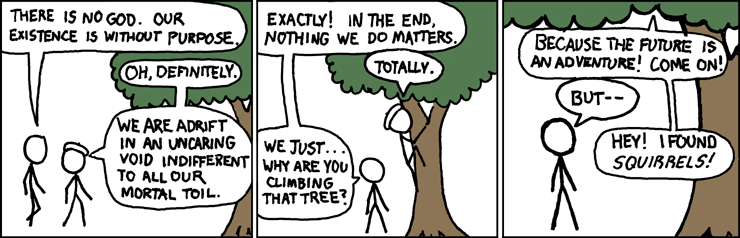

Lovecraft prefers to dwell on the nihilistic elements of scientific materialism. He uses alien horrors to show the irrelevance of human life and endeavor when viewed against a bleak and unknown cosmos. Howard looks at similar horrors, shrugs, and creates Conan, who is going to carve his own meaning into this empty shell of life.

By far the best examples are two famous quotes. Lovecraft's from "The Call of Cthulhu":
The most merciful thing in the world, I think, is the inability of the human mind to correlate all its contents. We live on a placid island of ignorance in the midst of black seas of infinity, and it was not meant that we should voyage far. The sciences, each straining in its own direction, have hitherto harmed us little; but some day the piecing together of dissociated knowledge will open up such terrifying vistas of reality, and of our frightful position therein, that we shall either go mad from the revelation or flee from the light into the peace and safety of a new dark age.
And Howard's from "Queen of the Black Coast:
He shrugged his shoulders. "I have known many gods. He who denies them is as blind as he who trusts them too deeply. I seek not beyond death. It may be the blackness averred by the Nemedian skeptics, or Crom's realm of ice and cloud, or the snowy plains and vaulted halls of the Nordheimer's Valhalla. I know not, nor do I care. Let me live deep while I live; let me know the rich juices of red meat and stinging wine on my palate, the hot embrace of white arms, the mad exultation of battle when the blue blades flame and crimson, and I am content. Let teachers and priests and philosophers brood over questions of reality and illusion. I know this: if life is illusion, then I am no less an illusion, and being thus, the illusion is real to me. I live, I burn with life, I love, I slay, and am content."
(It is a great shame that the real Conan's philosophy, which is quite sophisticated, is forgotten in favor of the quote from the John Milius Conan the Barbarian.)

A piece of the greatness of both Howard and Lovecraft is how accessible they are. You can sit down in an hour or two and read "The Call of Cthulhu" or "Red Nails" and you will have an immediate connection to these authors and their work. Yet they are infinitely rewarding for re-reading; I've sat down and read every single word of "Shadows in the Moonlight" closely, just to get a feel for how Howard built that story, and every three or four sentences throbs with life and creation. And every time I re-read Lovecraft's work (at least the ones from 1926 onward) I find new connections and threads that I hadn't seen before.

This is a battle of the titans.

You can vote in the poll here.

Tuesday, March 28, 2017

Appendix N Madness Day 28: Moorcock vs Vance

Poul Anderson triumphed over Leigh Brackett in the Sci-Fi final and advances to the semifinal round, where he will take on the winner of today's match-up.

SAGA/Amra Region Final: Michael Moorcock vs Jack Vance

The second Appendix N book I ever read was Elric of Melniboné. (The first was The Hobbit.) A classmate, the same one who introduced me to Dragonlance and AD&D, loaned me the slim Ace paperback. It was weird, and dangerous, and had chaos gods and demon swords and sex and albinism and all kinds of things that set my sixth-grade imagination afire. It even had horseriding which was normally boring but worked here.

I don't remember exactly when I read The Dying Earth; it was probably about six or seven years later, and I'm certain that I had read it by my sophomore year of college. I remember the cover, a yellow Lancer edition that I had bought second-hand, a shocking yellow with a weird swordsman and a strange creature. It stuck with me, as book covers often do. That picture became entangled in my mind with the word-drunk stories of Vance, infinitely stranger than I had expected, tales of antiheroes in a strangely aged world with a bloated red sun. My father, a Tolkien fan from before I was born, wound up reading Eyes of the Overworld when I had left it lying around at home (during a summer break, as I recall) and found Cugel a rather unheroic figure.

I'm not sure anyone ever got word-drunk reading Moorcock. For that a good series is probably the Corum books, not listed in Appendix N but eminently worth reading, inspired by Moorcock's own discovery of a Cornish-English dictionary, and words like vadhagh and mabden. The multiversal adventures of this strange, haunted hero have some of Moorcock's better prose - although at times one is reminded that Moorcock writes at blinding speed and some of the results are more inspired by others.

Not every Vance book is equally witty and decadent in its prose as The Dying Earth, either; Planet of Adventure, while it's a ton of fun, is written closer to the register of science fiction. But Vance was, of our two writers, the one whose work you can read simply for the joy of the words on paper.

Moorcock builds worlds by speeding between interesting places, often invoking a huge shared multiverse. He will throw his protagonists across gulfs of land and sea, or space and time, to take them to a location that makes a memorable backdrop for adventure. They will be as varied as Melniboné with its cit of Immryr, or the eternal city of Tanelorn, and many in between, but all serve the purposes of his story.

Vance's worlds are built impressionistically; a map of the Dying Earth seems like an absurdity, but it offers up a variety of locales and as often as not itself challenges the protagonists. The planet Tschai is likewise practically a character itself, and the four books are each named after the four weird species living on the planet.

Both Moorcock and Vance are notable for using antiheroes in their fantasy work. The best examples, and the most illustrative, are Elric and Cugel. They are good symbols for the choice between the two authors: Elric is ultraviolent, tragic, gloomy, and has tremendous power but crippling weaknesses. Cugel is thrust into going on quests against his will but principally uses his wits and lack of morals as his weapons. It's not the starkest choice we've faced in this tournament, but it is a real contrast between two of the giants of fantastic literature.

You can vote in the poll here.

Monday, March 27, 2017

Appendix N Madness Day 27: Anderson vs Brackett

Robert E. Howard has tread the jeweled thrones of Middle-Earth beneath his sandaled feet and goes on to face H.P. Lovecraft in the semifinal round.

Sci-Fi Region Final: Poul Anderson vs. Leigh Brackett

Our previous region finals were contests between authors whose ideas and philosophies were stark contrasts. This one is between two solid classic sci-fi authors who also did other interesting writing.

According to the story, Leigh Brackett was called up by Howard Hawks to help contribute to the screenplay for The Big Sleep, being called "This Brackett guy." For the English majors in the audience, one of her cowriters was William Faulkner. The other was Jules Furthman; Hawks would call upon Brackett and Furthman again for the John Wayne vehicle Rio Bravo. Robert Altman had her write the screenplay for The Long Goodbye and her final screen work was an early draft of The Empire Strikes Back.

Poul Anderson doesn't have anything so popular or dramatic to his name, but he did take breaks from his sci-fi work to write several classic fantasy novels. He also wrote an essay I've found tantalizing called "Uncleftish Beholding" that describes atomic theory from a hypothetical English purged of French and Latin loanwords. It defines out many words in etymological forms and uses the German-derived terms for them.

I persist in feeling that it's Eric John Stark who gets Leigh Brackett's work in Appendix N. Her work combines post-Amazing Stories type science fiction with the high-adventure planetary fantasy that typified Mars before the 1950s and "little green men." Stark was in a way the opposite of the hyper-rational sci-fi protagonist, a mix of Mowgli and Tarzan in the John Carter role. She earned the title "The Queen of Space Opera" for her work.

Anderson, of course, had his works listed: Three Hearts and Three Lions, The Broken Sword, and The High Crusade. Reading all three is a series of incredible tonal shifts; Three Hearts and Three Lions is a solid adventure but with its nose in the science; The Broken Sword is a thundering Germanic tragedy; and The High Crusade is something of a farce. Anderson's science fiction also does an admirable job of switching tones and registers, even in the space of a single story.

This is a choice between a Grand Master and a Queen; a decision of whether the rationalistic characters of Anderson's stories and his starfaring work compares with the primal hero of Brackett's planetary romance and her incomparable screenwriting work.

You can vote in the poll here.

Sunday, March 26, 2017

Appendix N Madness Day 26: Howard vs Tolkien

The Weird Region Final was won by H.P. Lovecraft, who will go on to face the winner of today's match-up in the semifinal round.

Fantasy Region Final: Robert E. Howard vs J.R.R. Tolkien

Is there a starker choice in all of fantastic literature than Robert E. Howard and J.R.R. Tolkien?

Howard was a Texan who wrote short fiction by the ream. While he is remembered mainly for his creation of Conan across eighteen stories published in his lifetime, he published literally hundreds of others. He was prolific in the way that only a writer paid by the word can be, even though Howard never padded his stories. He left dozens of unfinished fragments, and when his work was popularized in the 1960s it created a craze for "Barbarian" fantasy that was of absolutely lower quality than Howard's original.

Tolkien was an Englishman who taught Beowulf at Oxford. He published two major works in his lifetime, as well as a few minor pieces. From his convalescence in a war hospital in 1916 until shortly before his death in 1973, he worked on the legendarium that was published in wholly inadequate form as the Silmarillion and in various drafts as The History of Middle-Earth. This work of over 50 years involved endless re-framing and revisions to the mythology. The Lord of the Rings was, in part, an attempt to use the success of The Hobbit to show a further tale in the same mythology, and also to publish the Silmarillion.

Ace Books manages to be responsible for controversial editions of both Conan and The Lord of the Rings; the former because L. Sprague de Camp and Lin Carter wrote a good chunk of the material, the latter because they were using a loophole in copyright to publish without paying any royalties to Tolkien and incorporated a great number of typographical errors. Both editions contributed greatly to the popularity of Howard and Tolkien, and of fantasy in general.

It was The Sword of Shannara in 1977 that started a craze for Tolkien imitations in fantasy publishing, and began to close the period of Conan imitations. While I generally reserve critique on these epigones, those imitating Howard did have at least the minor virtue of writing much shorter works.

Middle-Earth and the Hyborian Age bear a striking symmetry. The story of Númenor was a deliberate parallel to the sinking of Atlantis, and set up the Middle-Earth of the Third Age as an immediate pre-historic precursor to the current age of history. The Hyborian Age is explicitly between Atlantis and the coming of the Aryan people into the Indus Valley. Both story cycles, then, are set on Earth in a lost prehistory.

But they are set to opposite effect. Howard's Hyborian Age was an excuse to use various historical periods like the sound stages on a Hollywood backlot, interesting and flavorful backdrops for his stories but with a breezy disregard for historical details and gleeful use of anachronisms. Tolkien's Third Age, on the other hand, is the conclusion of his mythological cycle, chosen precisely for the exact mythic resonances that its elaborate history creates.

Their prose, too, diverges almost completely. Howard's words leap from the page in a vivid gush of color, painting a world that is rough and brutal and immediate, savage in both its joy and destruction. He uses a wide vocabulary because ordinary words fail to create the pictures he is painting. Tolkien's language is almost infinitely patient, describing details and landscapes to root the reader as fully as possible in the world he imagines as clearly as a photograph. For his action scenes he elevates it almost to a mythological pitch, reaching its absolute apex when Éowyn slays the Witch-King of Angmar.

Philosophically there is an utter contrast. Conan has a personal set of morals that is the only thing that matters to him; he has utterly no compunctions about killing or stealing, but he has a strong sense of honor that he will not violate. Tolkien, particularly in the character of Gandalf, strongly enforces Judeo-Christian morality, and even a creature such as Gollum must be spared. Conan would have dispatched him and used the Ring, we can be sure.

(As a brief aside: I find that none of the films of either Howard's stories or Tolkien's, except maybe the Rankin-Bass Hobbit, demonstrates a deep understanding of either author or his work. I understand that there is a wider appreciation of the same, though.)

Writing about the influence of either Howard or Tolkien on D&D is silly. Between the two of them they are the sine qua non of the game; Gary wouldn't have written it if not for Conan, nor would fantasy have had a mass audience without Tolkien.

In short, Howard vs Tolkien is the battle for the soul of fantasy. Is it in Conan or in Frodo?

You can vote in the poll here.

Saturday, March 25, 2017

Appendix N Madness Day 25: Lovecraft vs Burroughs


Round 2 of Appendix N Madness has ended with the top of the bracket in high style. Round 3 has shaped up as a clash of titans.

Weird Region Final: H.P. Lovecraft vs Edgar Rice Burroughs

Edgar Rice Burroughs was a phenomenal success in his lifetime, although the popularity of his stories has waned somewhat. H.P. Lovecraft wasn't; he had some success in Weird Tales magazine, but it took decades for his writing to catch a mass audience. Now it has.

Both Lovecraft and Burroughs looked at our solar system, but what they took away was infinitely different. Burroughs saw in Mars and later Venus places to set some rip-roaring adventures, full of strange civilizations. His Barsoom is a place rife with ruined cities and secretive enclaves, letting him build strange new creatures and customs into each adventure he wrote. It was a place where John Carter, his morality based on a long-past code of honor, could carve out an empire.

When Lovecraft looked up he saw the "black seas of infinity" between the stars.The discovery of Pluto in 1930 was not cause for wonder but a sign related to bizarre cosmic entities, in this case the fungi from Yuggoth. Being transported beyond the cozy confines of modern Earth in Lovecraft is not an adventure but a cause for horror and madness.

Burroughs wrote in a picaresque fashion, adventures fine tuned for pulp magazines. His writing style is adapted to this, using occasional flourishes but focusing on the relentless pace of action. This is the direct opposite of Lovecraft, who wrote with a dense, obscure vocabulary to evoke the strange and unfathomable nature of the beings he had contemplated. His style had been widely derided for some time, but scholars such as S.T. Joshi have rehabilitated it to a significant degree.

Burroughs preceded dozens of authors of sword and planet adventures; there was, after all, a magazine called Planet Stories. Many other Appendix N authors are considered to have written major sword & planet works - Robert E. Howard's Almuric, Leigh Brackett's Mars and Skaith novels, Gardner F. Fox's Llarn novels, Michael Moorcock's Kane of Old Mars, Lin Carter's Callisto novels, Jack Vance's Planet of Adventure series, even Manly Wade Wellman's Sojarr of Titan. He had a supposed rivalry with Otis Adelbert Kline, whose Venus stories are among the best known sword & planet rivals to Burroughs. (Kline was Robert E. Howard's agent and put forward Almuric; it has been widely speculated as to whether he had some hand in its writing.)

If Burroughs was imitated in print in his day, it took years for Lovecraft. In his life, he had a close "circle" of authors around him: Robert Bloch, August Derleth, Robert E. Howard, Clark Ashton Smith, and Frank Belknap Long were the "core" authors. We know, of course, that Derleth made a great deal of hay out of this, and while he did yeoman's work in popularizing Lovecraft, he also put out an anthology (The Watcher out of Time) with attribution to Lovecraft that stretches the definition of "collaboration" to the breaking point. CAS, of course, is the author whose omission from Appendix N is most egregious.

D&D purposefully evokes a great deal of Burroughs. Picaresque adventure, strange locales, and bizarre creatures are naturals, even though D&D isn't set on Barsoom. Philosophically it is much further from Lovecraft; it puts forward an optimistic metaphysics that seems incompatible with the nihilistic Cthulhu Mythos, even though they were in the early printings of AD&D. Certainly Lovecraft's monsters can be used as enemies in the game, although this bears with it none of the spirit of his mature stories. Some of his "dream cycle" is ripe for inspiration, although this is not his finest work as literature.

Choosing between Lovecraft and Burroughs is fundamentally a question of what you want in literature. Lovecraft was one of the most original thinkers in horror writing of the 20th century. Burroughs crafted pitch-perfect adventures in thrilling worlds.

You can vote in the poll here.

Friday, March 24, 2017

Appendix N Madness Day 24: Moorcock vs de Camp

Day 23 was 75% less exciting than Day 22, with Poul Anderson easily whipping Fredric Brown. Anderson will go up against Leigh Brackett in round 3.

Day 24 is Michael Moorcock versus L. Sprague de Camp.


Michael Moorcock

If only the Hawkmoon and Corum and Jerry Cornelius novels existed to represent Michael Moorcock's fantasy output, he would be well regarded. The Eternal Champion series provides a rich tapestry of ideas, from the thoroughly 60s/70s oddity of Cornelius to the post-apocalyptic Hawkmoon to the rich Celtic overtones of Corum. But, of course, he launched his career with the most enduring of his characters, Elric of Melniboné.

For D&D purposes, the most important thing Moorcock did was to take the Law and Chaos conflict in Poul Anderson's Three Hearts and Three Lions and run with it. D&D proceeded to do likewise, and alignment has shaped its universe in subtle and not-so-subtle ways. Elric's runesword of course is copied in the classic module White Plume Mountain, although D&D has never been good at the kind of summoning magic he performs.

The Elric novels are mostly fix-ups, and recent re-releases have included the earlier forms. Moorcock is the sort of author who always has room to tinker with his past creations, and filled out a surprisingly long backstory for his albino sorcerer. But in terms of sword & sorcery anti-heroes, he remains one of the most compelling, his glooms the deepest, his savage bouts with Stormbringer among the best action.


L. Sprague de Camp

If you judged merely by what he did before 1966, L. Sprague de Camp would clearly rate as a significant fantasy author. His collaborations with Fletcher Pratt are among his finest work: the Harold Shea works, Land of Unreason, The Carnelian Cube, and so on. And his anthologies such as Sword and Sorcery and The Spell of Seven were important in defining swords & sorcery as a genre.

But de Camp also edited the 1960s Conan paperbacks. This would seem to be a good thing - after all, they popularized the tales of the Cimmerian and brought Frank Frazetta's iconic art to the character. Had these books not also included original stories by de Camp and his protégé Lin Carter, and had they not rewritten unfinished Howard stories, de Camp's reputation might have been sterling. Instead he is heavily disliked by Howardian purists.

de Camp's work was credited by Gygax as a major inspiration, even if his rationalist streak seems a bit too skeptical for D&D. His Viagens Interplanetarias series was used for GURPS Planet Krishna, and his Harold Shea books are a solid go-to if you want to incorporate elements of myth and classic fantastic literature. He was, deservedly, a Grand Master in his lifetime. But one must decide where they stand on his editing work.

You can vote in the poll here.

Thursday, March 23, 2017

Appendix N Madness Day 23: Anderson vs Brown

In a tightly fought battle, J.R.R. Tolkien triumphed over Fritz Leiber with 72 votes to 70 votes and will go on to face Robert E. Howard in round 3.

Day 23 takes us back to Sci-Fi for Poul Anderson vs Fredric Brown.


Poul Anderson

The relative handful of fantasy books that Poul Anderson put out all have some science fiction touches to them. The paladin protagonist of Three Hearts and Three Lions is an engineer from Earth who finds himself in a fantastic realm; the scene where Holger tosses a bucket of water down the gullet of a dragon is one of the strangest such fights I can think of. Even the more explicitly fantastical The Broken Sword justifies its elves' allergy to iron in pseudo-scientific terms. In both, you can see Anderson's love of medieval lore (the Matter of France in Three Hearts and Norse myth in Broken Sword) strain against his instincts as a SF writer. In The High Crusade he just goes whole hog and throws medieval Englishmen against aliens.

Gary Gygax stole a bunch of concepts in complete detail from Three Hearts, so its influence is transparent. Michael Moorcock also was explicitly inspired by the fight between Law and Chaos in that novel, so you can blame it for everything from alignment to Arioch. Yet D&D oddly doesn't draw any of the scientific conclusions that Anderson's novel would. Paladins are purely taken at face value, and dragons don't end badly if you use a bucket of water against them. A Sword +3 Flame Tongue isn't made of magnesium, either. The borrowing winds up being shallower than one might think. And while The Broken Sword makes a stronger impression as a novel it leaves much less direct, verifiable evidence in D&D.

Anderson, with Norton, is one of the best SF writers in Appendix N for fans of Traveller. His cycle of the Polesotechnic League and the Terran Empire with merchant-explorer Nicholas van Rijn and space spy Dominic Flandry are terrific. But for D&D purposes, it's really his fantasy output that is worth considering.


Fredric Brown

If there's an author in Appendix N who didn't make an appreciable mark on D&D, Fredric Brown (his name is misspelled in Gary's list) is that author. His finest work was in his short fiction, which tends to be stories heavy on irony and moral lessons. Brown's "Sentry" is the archetype of the story that ends with the reveal that the protagonist is an alien fighting against humans. His "Knock" is entirely structured around the lines: "The last man on earth sat alone in a room. There was a knock at the door..."

An enterprising referee could grab the "roller" from Brown's "Arena" or the more famous Gorn from its Star Trek adaptation as a go-to monster (I included a picture of the latter because I don't have any good Fredric Brown inspired art). And Gary Gygax, being the sort who loved puns and jokes, probably got mileage from Martians Go Home for monster inspiration. Brown is a fine short story author but I can't see him making an Appendix N drawn up on any principles other than "Gary Gygax's bookshelf."

You can vote in the poll here.