Thursday, February 28, 2013

Dungeon Format, B1 Style

Apologies for the lapse in updates, I've been working on some stuff for Dungeon Crawl and I've been busy both at work and at home.

In the first issue of Dungeon Crawl, I used the "One Page Dungeon Template." I think it presented a pretty neat little dungeon level, but the format leaves me wanting in one respect: complexity. I tend to enjoy big dungeon maps, and I've actually worked out a level in the past on 17"x11" graph paper so it could be really sprawling. But I've been tinkering with another idea, and I've decided that I want to pursue a different approach for the next issue's main dungeon, and want to discuss it a bit here.

This thread on the OD&D forum about Geoffrey McKinney's Dungeon of the Unknown (for the recent LotFP kickstarter) got me thinking about a set of caverns I've been working on and hadn't really been satisfied with. The problem is, the dungeon was too static. I want it to be full of things that are already in motion, not waiting for PCs to come along and kill them (esp. because most of the encounters are intended to have options).

I agree with the theme of the blog post Geoffrey linked to in the OD&D forum thread - Why Word Walls Won't Work. The idea of workbook dungeons is appealing because it lets you vary things up; why does the giant weasel always have to be hanging out in its lair? And of course this has a very Holmesian imprimatur, since B1 In Search of the Unknown is the original workbook dungeon.

The format I've decided on is following B1 in a rough fashion. There are a few rooms where the encounters are programmed, because they are fixed; the statue and the altar (separate things) aren't moving around, they are placed there. The giant weasel lair, likewise, is a single place, and the giant bee hive, and the geological formations in the caves (and various growths) of course are built-in. But the rest of the content, both monsters and treasure, are going to be set aside in a separate table and potentially could be anywhere in the dungeon.

This allows for a "rival party," which is present in this dungeon in the form of a group of gnomes. It's my opinion that gnomes are an under-utilized element, and it adds a bit of time pressure since there's a limited amount of treasure and the gnomes are also looking for it. Also the gnomes are illusionists, which should have some interesting consequences.

From there, the key will also double as a wandering encounter list. Again I think this gives a real dynamism to a dungeon that is sometimes difficult to re-create. So there will be an absolute limit to the number of giant bees, and if you encounter all the bees from the key there won't be any more (except the ones permanently guarding the hive). Treasure won't move around, unless the gnomes manage to find it before the PCs can...

I'm hoping this kind of dungeon starts to catch on. It's something I'd find much more useful than the standard map-and-key format, which  I find often has trouble tying a dungeon together. I'm hoping, through the seemingly paradoxical method of taking all the moving parts out from the map keys and putting them into a table to make their interaction a much more fluid thing.

Anyone who wants to contribute to Dungeon Crawl should email me - wrossi81 at gmail.

Friday, February 22, 2013

Monsters of Myth

When we start talking about "Monsters of Myth" (also the name of the fine OSRIC monster supplement), Dave "Sham" Bowman broke down the category as follows:
Manticoras, Hydras, Chimeras, Wyverns, Dragons, Gargoyles, Lycanthropes, Purple Worms, Sea Monsters, Minotaurs
This is a good list, hitting many of the core mythological creatures that D&D has long featured. Greek and Roman myth and various diverse ancient and medieval ideas have been so thoroughly plundered that it feels downright derivative (or at best, a duplication of work) to go back to them for yet another round of inspiration. Gygax and Arneson thoroughly cemented the various monsters of heraldry and heroism into the "default" fantasy world, unfortunately almost to the level of cliché.

What I've found interesting, as anyone who's read Dungeon Crawl #1 will know, are the monsters of more recent vintage. That's a hodag in the picture, and damn if the thing - it's supposed to have lived in rural Wisconsin - doesn't look like a D&D creature. So I made it into one. (It felt particularly right since TSR, like the hodag, was from Wisconsin.) The myths of America are less well-trod and a bit weirder, since we're getting into the realms of cryptozoology and urban legends.

Living as I do in New Jersey, and having grown up in the regions that were changing from rural to suburban near Philadelphia, I went camping a lot as a kid. And when you're ten years old and sleeping out in the Pine Barrens, the Jersey Devil is the damn scariest thing in the world. You can walk by the kind of creepy old half-abandoned cabins that just seem like they could have been the birthplace of the abomination offspring of a woman and the devil, that fled out of the house as soon as it was born. Every twig snapping, even if it's just another kid going to take a leak, pings your senses and makes you certain that there's something out there in the woods. A shadow moving, even if it's the most coincidental thing, as you're gathered around the campfire sends shivers down your spine.

This classic picture of the Jersey Devil doesn't inspire the kind of fear we had, and I am thinking for my D&D adaptation of it I'd like something a bit more ... threatening. Not like a monster on a metal album cover, but something that's just a bit less goofy. We didn't think it was a muscle-bound horror, it was frightening because we thought it was real. And lurking somewhere out there in the pine forests, flying above us, able to take any of us out at any time. Camping in the cool night air it's a hell of a thought, and of course fodder for the most gruesome tales.

Fear of these monsters is fear of the unknown. It's rooted in the fact that there's something out there and you don't know what it is, but it can strike you dead in an instant. Even someone in chain mail with a sword would not relish an encounter with the Jersey Devil, or the hodag for that matter. It's a kind of horror that I think takes a subtle touch, often times more like the creepiness that you get in the X-Files than splatter horror or Cthulhuesque entities.

Really I do think there should be some element of a horror game to Dungeons & Dragons. All this time thinking about monsters has really rammed it home for me that, hey, these are monsters, any single one of which could be the subject of a horror film itself. And really it's a game about characters becoming heroic in the face of these monsters, even if the horror is primarily in the fact that so many fights end in character death.

At the same time, I want to adapt cryptids in ways that aren't overly reliant on the "solo horror monster" model that I see as working well for creatures like the Jersey Devil. There are well-worn variants, many of which have fairly popular variants: the lake monster like the Loch Ness monster or Champ in Lake Champlain, the dog-like monsters like the Chupacabra, or the humanoids like Sasquatch. I'd like to dig a little further into more types of cryptids in future entries, including their implications in play, and after that talk about the other kind of American myths, the Native American mythologies.

Tuesday, February 19, 2013

OD&D, soon to be back in print

You may already have heard that Original Dungeons & Dragons is being reprinted.

At $150 it's a bit high priced for a hobby purchase, and the cover art looks like Wizards of the Coast figured out how to make the OD&D booklets look worse than they originally did. Of course, the $10 original set would be $45.92 in today's dollars and you'd have a bit of trouble getting late printings of the original boxed set, much less the supplements, for $150. But it's still not going to make OD&D exactly a mainstream game, which is what a lot of people want.

I'm holding out hope for a hardcover under $75 that would collect all the books in a solid, game-worthy volume. The problem isn't that the edition is so expensive but that it's exclusively a collector's edition and not something for everyday play. I have a pristine set of OD&D books in a slightly worse for wear box that sits on my shelf, and a rougher set of books that I use for reference (two copies each of volumes 1 and 2, and a single extra copy of 3). The problem is getting the books into formats where I can hand them to players and not have to ask for a deposit on my collectible. Not to mention, being able to play on G+ without requiring everyone to use their own collectibles.

I may get it for the sheer reason that I want more like it and it's best to vote with your dollars, although it hurts a bit with a hundred and fifty of them at once. I didn't need the AD&D hardbacks but I bought them because I wanted more like them, and enough other people did the same that WotC is listening.

For me, the real idea mine of the old school renaissance was not sparked by the retroclones but by the rediscovery of OD&D in the PDFs that were briefly legally available. Finding the original three books and the freedom they offer - a very real sense of playing without a net and without the rather byzantine rules of AD&D - enabled people to rediscover the megadungeon, the hex crawl and the spirit of pre-1979 D&D. I'm still holding out hope that this will be available to large numbers of gamers once again.

Monday, February 18, 2013

Going to Hell


I realize I've hinted for a while at a post about Hell and I apologize for not having it up sooner, but life has gotten in the way as it so oft does; I needed the creative juice to be going into my game for last Friday and not the Hell post, so that took priority. On the plus side, it's time now, so here goes.

The grand works of western literature tell us relatively little about heaven, a prosaic realm filled with fluffy white clouds and angels with harps and beasts with six wings and eyes front and back ... Okay, the biblical heaven's a bit more interesting than the stereotypical presentation gives it. But it is fairly one-note since the weird beasts are constantly singing the Sanctus. Forever. But it's not heaven that gets the love, even in Chick tracts it's the opposite that really stokes the imagination.

My look so far has been at the higher planes – the ones above the earth – and reinterpreting them as planets. One of the critical mis-steps in the transition from OD&D to AD&D was the loss of the very concept that there were higher planes, and by consequence also lower ones. The Nine Hells in AD&D are just one of the set of planes on the Great Wheel, hardly fitting of one of literature's greatest underworlds. Going along with this, AD&D in its reliance on the nine-point alignment system created a division between demons and devils, and even tried to turn an etymological difference into a separate category of daemons. Since this entire series of posts has been centered on a total rejection of AD&D cosmology, it is only fitting that I remove this delineation as well.

So what do we know about Hell in OD&D? When it was first published, the Balrog was just a big monster in the first book of Lord of the Rings. It wasn't until 1977 and The Silmarillion that the actual description of Balrogs as corrupted Maiar (god-like angelic beings) in the service of the fallen Vala, Morgoth, was published. Eldritch Wizardry preceded it with turning the Balrog into the Balor, an "upgraded" version that was accompanied by five other "types" of demon. These later turned into the demons of the 666-layer Abyss. We also know that a character who lost his body while in astral form would be sent gibbering down into the lowest Hell. And that's about it.

The most popular version of Hell is obviously the first portion of La Commedia Divina by Dante Alighieri, "l'Inferno" (the Italian word for Hell). This has been adapted for AD&D not once but multiple times – once by Judges Guild, written by Geoffrey O. Dale, and the other time in Dragon Magazine, in a series of articles written by Ed Greenwood that became the basis for the AD&D Nine Hells, working within Gygax's strict cosmology and replicated in Manual of the Planes and Planescape, using the bowdlerized name "Baator" in the latter. The problem with Dante is that he was more concerned with the sinners and their eternal fate, a concept that is sidestepped in D&D when characters are not generally in an either/or situation between Heaven and Hell. It's a rather crap deal for the evil, whereas the good are just given a pass into a better realm. Where's the fun in that?

Dante's "Inferno" is much more about sinners and sin than about demons. And for our purposes (this series is still an attempt to come up with new and interesting monsters) that's not quite as much fun. Sin monsters are an interesting subcategory but that really only gets you seven good ideas, and ones that have probably been trod before. What I find much more interesting are the 72 demons of the Ars Goetia in the Lesser Key of Solomon, a classical work of demonology. Simply reading the list of demon lords and their "legions of demons" and their special abilities makes it seem less like a Wikipedia page and more like a list out of a supplement somewhere between an RPG and a wargame.

The goetic demons are interesting because they do not only slay; they command legions of demons which are presumably creatures somewhat Balrog-ish in mein. But they also are very seductive, having the ability to bestow specific boons. Returning to our concept from Contact Higher Plane, the demons of the Ars Goetia are often able to answer questions accurately. They also don't take quite the kind of elaborately grotesque forms that have proliferated in fantasy, some weird mix of Giger and Lovecraft that has come to dominate the scene as far as evil goes. To me, the more subtle seduction is a far more refined form of evil - "wrong" but more in a way that makes you feel wrong deep down inside.

For lower demons, one of the more promising is the list of demons described by Alphonse de Spina: Fates, Poltergeists or Goblins, Incubi and Succubi, Marching Hordes, Familiars, Nightmares, Demons formed from Human Semen, Disguised Demons, Demons who Assail the Saintly, and Demons who Instigate Witchcraft. The "marching hordes" are obvious candidates for a whole hierarchy of demonic enemies, while Succubi, Nightmares and Familiars are fairly well covered. Demons from human semen are cambions, who've been treated numerous times in D&D. The most intriguing to me is the goblin or poltergeist; after all, have not perhaps millions of goblins been sword fodder in D&D over the years with little to show for it? A demonic connection rather than the typical humanoid hierarchy would be one angle to change up the stock enemy; instead of just some smelly critters, they are weird semi-demonic things. And poltergeists in a dungeon are just too much fun to pass up; the mere potential for mischief is so great.

For now, that's Hell. The next monster post will be on Monsters of Myth.

Saturday, February 16, 2013

Holmes D&D: a Testimonial

I've finally started a new campaign, set in a fantasy Europe after the Roman Empire's fall. And for the system I've found myself using Holmes basic D&D, augmented by the traditional "anything I like." Today being the anniversary of J. Eric Holmes's birth it seems only fitting to discuss the Holmes book and its legacy.

The Holmes booklet was written because the OD&D rules were impenetrable, poorly organized and difficult to learn outside of being taught the game. It condensed the D&D essentials into 48 pages, a feat that is pretty much unrepeated especially when you consider he more or less includes a dungeon module in that page count. (Even the recent simulacrum Blueholme is longer, although it's better organized.)

What's fascinating is the timing of Holmes's D&D. As I've noted before, it arrived in 1977 and described the transitional late OD&D - the game as it was played before AD&D became the dominant player on the scene. In this sense it is much more relevant to "golden age" play than the OD&D LBBs themselves, where the additions such as Greyhawk, Blackmoor and Eldritch Wizardry were eagerly integrated into most games.

The thing that's really made me fall for Holmes is its open-ended nature. Technically Holmes specifies a setup for races and classes similar to Moldvay's Basic rulebook, where Halflings, Dwarves and Elves are merged down into single classes; but it also implies that there are more possibilities. Aesthetically it's so much easier for me to hack and alter the Holmes game, since race/class are already separate, than to try and do the same with Moldvay and Cook/Marsh Expert.

In the Cook/Marsh Expert rulebook there is advice on integrating Holmes but unfortunately it's all backward. The Expert book should be used for adding the levels above 3 to Holmes, and additional spells, monsters, and magic items, and the wilderness rules that Holmes left out - but that's about the extent of what I think its utility is. Other material can be freely integrated; my current game has a ranger from the Strategic Review.

One of the most unique rules in Holmes basic is about initiative - it is assumed to be determined by Dexterity rather than rolling a d6 for each side. This actually provides a fairly unique order of battle, and allows it to proceed in a straightforward and smooth fashion, without either the uniformity of rolling for "sides" or the tedium of rolling initiative for every participant. It gives a tactical dimension with the potential for monsters to have a higher Dexterity than the PCs, and a bit of differentiation. I've come around to this and find it a refreshing change.

Holmes, for me, is the ideal basis for a "make your own" D&D, constructed from bits and pieces both new and old. As a monster aficionado, there is no limit to the number of sources I'll consult, but beyond that Holmes is such a simple framework that most sources fit into it without much effort. Clones of Holmes such as Blueholme beat it in terms of organization, but for me nothing has quite the same appeal as that simple 48-page booklet.

Thursday, February 14, 2013

Submissions for Dungeon Crawl #2

If you're interested in submitting content for Dungeon Crawl #2, I will be taking submissions of the following up through March 8.

  • Articles on game content or processes
  • Adventures
  • Product reviews (max. 800 words)
  • Short fiction
  • Charts and Tables for random determination
  • New "crunch": magic items, spells, monsters, races, classes, rule variants, etc.
  • Art pieces
Longer submissions may involve profit-sharing, short submissions will get free PDFs; this is all subject to negotiation.

Email wrossi81 at gmail dot com if you are interested in submitting anything.

Wednesday, February 13, 2013

Fighting On!

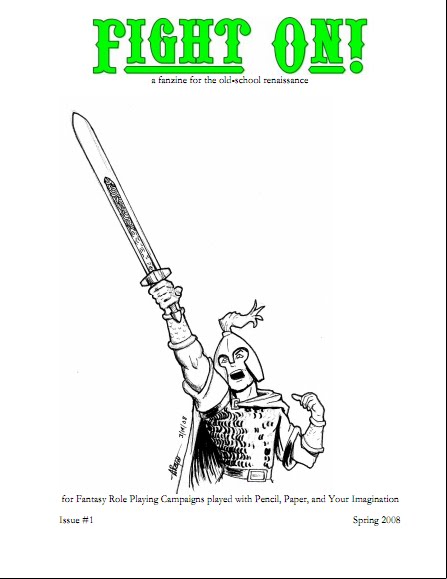
You've probably already read that Fight On! will be wrapping up with issue 14 or 15. It's disappointing because FO! was, to me, the best of the really community projects we had going in the OSR. The megadungeon designed by collaborative addition, the lists of spells and monsters that we'd throw stuff at, the always-excellent charts in the middle of the issue, it felt like something that truly belonged to the OSR as a whole.

Knockspell, which I suppose technically is still alive, has only released 6 issues since 2009; FO! released 13 from 2008-2011 and will wrap with either 1 or 2 in 2013. Loviatar went 14 issues and has finished its run. My own Dungeon Crawl zine only printed 1 issue, but that issue is free online. AFS is running and has gotten to #2. There's a DCC zine called Crawl which I haven't gotten, not being a follower of the DCC game.

I'd like to start exploring the concept of putting out an expanded Dungeon Crawl. After all, I have to put my trap charts somewhere, and FO! isn't going to be able to take it; at this point I want to do them all as one big article. With a baby and a game I'm starting (add Wayne Rossi on G+ if you want in) I don't have time for this to be anything more than a quarterly, and I'd want to do all fulfillment by Lulu (print and PDF). But I need content - I am not an artist and have no talent for it, and I don't write enough stuff to fill more than a few pages a month.

I do have some monsters ready and more concepts from my monster series here that I'll be expanding. I may also write up my lunar sandbox (hinted at here), but I'd need help with the map and the art. And of course the trap charts. I think expanded versions of the planar sketches I've been doing in general would be good article fodder.

My ideal follow-up to FO! would feature a mix of adventures, articles (instructional and expanding on game ideas), crunchy bits (classes, races, monsters, spells, magic items, random charts), comics/fiction, interviews and reviews. I think we'd need a good chunk of content to get this off the ground. I'm also considering whether the name should be different, since "Crawl" is getting out there as a zine.

So, the big question: who else is willing to be a part of this? Comment here or email me - wrossi81 at gmail.